Showing posts with label Marx. Show all posts

Sunday, December 30, 2012

Can We Talk? About Perfume? Part 2


What does disagreement 
about the value of a perfume really mean?

Perfume reception is the consummate expression of subjectivity. This is how and why two different perfume enthusiasts can disagree vehemently about the value of the very same perfume. Chandler Burr hails as masterpieces Diptyque Eau de Lierre and Dolce & Gabbana Light Blue. Turin & Sanchez deride both of those perfumes as one-star failures. If the value of a perfume were a matter of objective fact, then one of two critics who held diametrically opposed views would have to be wrong.

So is Light Blue a triumph of modern perfumery? Or is it a hopeless wreck, less a perfume than it is swill or dreck? Perhaps it all comes down to idiosyncratic tastes. Burr likes clean scents, which Turin & Sanchez appear generally to abhor. Burr appreciates streamlined scents, while Turin & Sanchez are easily bored. Burr likes amber and hails Prada Amber as a masterpiece. Turin & Sanchez dislike amber in general and, logically enough, Prada Amber more specifically. A chacun son goût. One person's masterpiece is another person's disaster. End of story.

Or perhaps the critics who disagree in their most basic evaluations really disagree because they actually smell different things, owing to the natural range of variations in scent sensitivity within a human population for all of the components of the complex mixtures known as perfumes. Perhaps those who despise some perfumes fail to detect their beauty because they do not smell everything that is there. Another possibility is that they smell more than most other people do. They may smell substances the presence of which would ruin another person's experience of the perfume, if only he were capable of detecting them. A chacun son nez.

If this way of understanding aesthetic disagreement about perfumes is true, then in seeking out the opinions of critics, we would do well to hew to those who seem to share our basic sensitivities. Otherwise, we'll be led astray by the advice of people different enough from us to make it the case that we actually smell different objects when we smell perfume even drawn from the very same bottle.

Given the considerable evidence of heterogeneity in human scent perception, the effort to point outward, attempting to taxonomize perfumes as stable things in the world alongside other stable things—whether various types of paintings or the products of less-exalted crafts such as cooking or winemaking—would seem ultimately to be an otiose endeavor. To do such a thing is to walk down a path to a dead-end, because the primary value of perfume—beyond its simple inducement in us of pleasure—is not artistic but philosophical. The aforementioned critics want to uphold the objective reality of perfumic masterpieces. But they cannot even agree amongst themselves about what the pillars of perfumery are supposed to be.

The best—and most charitable—way of understanding profound disagreements about perfume among self-proclaimed experts is simply to accept the intrinsically subjective nature of perfume perception: A chacun son goût et son nez! This vindicates the critics—they are neither incompetent nor anosmic—while however simultaneously implying that no one is really a better expert than anyone else when it comes to perfume, a conclusion which will likely make the self-styled experts bristle. If their opinions are no more worthy than anyone else's, then why should anyone listen to what they have to say? For what, precisely, are professional perfume critics being paid? 

I think that the answer is clear: they are promoting some perfumes which will be bought because many ignorant people will simply accept the self-appointed experts' advice as authoritative. They end by serving as marketing shills when they hail certain perfumes, holding them up as objective masterpieces, and effectively advise their readers to avoid those which they either omit from mention or vociferously decry. The “experts” become marketing tools—whether wittingly or not—because perfume, being essentially and inextricably enmeshed in an economic context, is consumable and commodified. People pay to wear perfumes, and they choose to buy some but not others on the basis of the so-called experts' advice. Or am I giving the critics too much credit? How many of the millions of perfume consumers out there even know their names?

Probably not that many, I'd surmise. But another bottle sold is still another bottle sold, so marketers will support those who support the products which they are trying to sell. This explains how and why mutually beneficial arrangements such as The Art of Scent Exhibit at the Museum of Arts and Design can arise under the guise of objective art appreciation when in fact the works being exalted are already best-selling perfumes.


What do perfume marketers do?


Christian Dior does not use screen captures of Charlize Theron from the film Monster (2003) to advertise their best-selling perfume J'Adore. 

Instead, they seduce consumers into believing that they, too, will be bathed in a golden light of glamour, if only they buy and wear the perfume. 

J'Adore has been reformulated, but the advertisements remain more or less the same and are apparently just as effective as—if not more than—they were at the perfume's launch.

It probably does not matter much anymore what's inside the bottle. So long as it is at least wearable, women will continue to buy the perfume, seduced by the vain hope that they, too, can be as glamorous as Charlize Theron. But the properties of the perfume are completely distinct from the images used to market the perfume. This point is graphically illustrated when the same model advertises a variety of different perfumes.


Given the highly subjective basis for perfume appreciation, slapping new and foreign but apparently approbative labels on familiar perfumes, exalting them as masterworks of this or that movement in art, would seem to be just another variation on the marketer's game. 

In advertisements for perfumes, we are told, in effect, that we will be beautiful and glamorous or sexy and alluring, if only we don the product which the advertisement is attempting to persuade us to buy. There is no logical connection between the models who pose in perfume advertisements holding bottles and the liquid inside. All of this is no more and no less than a game of sleight of hand.

Similarly, the application to perfumes of labels borrowed from the visual arts such as Neo-romanticism and Surrealism is essentially equivalent to what marketers have always done. In other words, one way of understanding the current exhibit at the Museum of Arts and Design is as an innovative and ingenious marketing scheme. Perfumistas may wish to believe otherwise, but perfumery is a business, and anyone who has even the faintest grasp of the nature of the enterprise of enterprise should be well aware that the managers who agreed to invest money in the Art of Scent exhibit were concerned above all with one thing: selling more of their perfume.

Perfumistas see this:


and hail the dawning of a new age, in which perfume is finally given the recognition it deserves as one of the beaux arts.

In contrast, the people at the corporate headquarters of the perfume conglomerate giants making financial investment decisions—whether or not to fund The Art of Scent exhibit and donate free perfume to the Museum of Arts and Design—see, instead, this:


As they deliberate over whether to fund such an initiative, they may rub the palms of their hands together while dreaming gleefully about upcoming second-quarter returns. 

I do not mean to suggest that there is anything wrong with any of this. Savvy businessmen have always succeeded through such schemes. Indeed, the very point of marketing—its raison d'être—is to persuade people to believe that they need what they do not need, and to buy what they would not otherwise have bought. We have a wide range of choices in deciding how to dispense with our wallet share available for nonessential expenses, including luxuries such as perfume. Marketers' job is to see to it they we spend our money on their products, not those of the competition.

The marketing masterminds who agreed to promote the event are well aware that the fact that the perfumes on display in “The Art of Scent” are not being sold in the museum's gift shop certainly will not prevent enthusiastic exhibit goers from stopping at the nearest Sephora or other retail perfume purveyor on their way home. As for the countless people who have no way to travel to New York City to see the exhibit, they can console themselves by purchasing bottles of the “masterpieces” online.

The reason why all of this should matter, to supporters of independent perfume houses, is because consumers only allocate a portion of their budget to perfume, and once that money has been spent, it will not be spent again. Judging by some of the gushing I've seen around the blogs, some perfumistas have come to believe that exalting bestselling perfumes as artistic masterpieces will somehow help independent perfumers, when in fact nothing could be farther from the truth.

In reality, the more money people spend at the big houses funding the exhibit and whose works are being heralded as masterpieces, the less they will spend on the unnamed houses not being celebrated. The irony in all of this is that the perfumistas who rush to lavish praise upon Chandler Burr and his initiative seem to be entirely unaware of the likely economic outcome of this scheme: to buoy and promote the ongoing corporatization of perfumery. If Chandler Burr's funding, including his own salary, derives from the megacorporations controlling the houses whose works are currently on display at the Museum of Arts and Design, then he works for them. If his initiative succeeds in improving those companies' bottom line, then he will keep his job. If not, he will not.


The Good News


Can we talk about perfume? Yes, of course. Why? Because we do. Hundreds of new perfume reviews are written online every day, and people are reading them. The reviews combine personal anecdote and feelings with references to terms recognizable to other perfume lovers because they derive from what has emerged as a full-fledged perfume culture. The discourse among members of fragrance communities is informed by an idiom used by perfumers themselves. This makes perfect sense because perfumers know more than anyone else what their own intentions are in developing a new creation with particular aesthetic properties.


Certain conventions have already been widely embraced. Because perfumistas often commence from the text created by perfumers and marketers themselves, they have become fond of talking about the objects of their devotion in triangular hierarchies, as though there really were a distinct and distinguishable top, middle, and base to perfumes. 


In reality, the various stages in the evolution of a nonlinear perfume—from spritz to disappearance—are infinitely more nuanced and unfold continuously with no sharp breaks from one stage to the next. In some ways, perfume development bears similarities to music, which, too, flows through time in ways that static paintings, sculptures, and buildings do not.

The complex evolution of a perfume over time can also be compared to the aging process of a person. Each person is born an infant, grows and transforms continuously over the decades comprising his or her life, until old age and finally death, at which point there is little—if any—resemblance to the person's appearance at birth. At any moment in time we can describe how the person looks: her size, weight, and shape; the color of her hair and eyes; the texture of her skin; the presence or absence of skin pigmentation, etc. Just as in the case of perfume, we can decide to divide the life into three parts: childhood, adulthood, and old age, but those are in some ways arbitrary divisions, although they can be useful in certain circumstances.

Despite its somewhat fictional quality and the grayness of its boundaries, the tripartite hierarchy in perfume profiles may be nonetheless helpful because in fact the opening stages in a perfume's development are detectable but also transient, ceding quickly to the later stages, the longest and most memorable part of which we refer to as the drydown.

In discussing what they perceive during their experience of a perfume, reviewers sometimes lament not “getting” this or that note, but in reality the notes are nearly never ingredients, as some of them are explicitly claimed to be by the perfumers themselves in self-consciously minimalist perfumes such as Escentric Molecules Molecule 01 and Molecule 02 and Juliette Has A Gun Not A Perfume.

Iso-E-super is usually not mentioned as a note even though it is quite frequently used as a cedar surrogate, just as ambroxan is used to mimic natural ambergris, which is often listed as a note though it is in such cases a fiction. All of this should suffice once and for all to demonstrate that the ingredients are not the notes, and the alleged notes said to be salient in a given creation by marketers are metaphors and manifest evocations: an attempt to tell consumers what they are supposed to find in the perfume.

Those who know the difference between the scent of cedar and the scent of the aromachemicals used to confer a cedar-like quality to a perfume, may say that they do not detect cedar in a perfume which lists cedar as a note. And they are right. Others may have arrived at a concept of cedar which is more open and includes the scent of the aromachemicals used to mimic the scent of cedar in nature, just as the perfumer intended them to. 

Once we know what iso-E-super and ambroxan smell like, having compared them directly to perfumes containing real cedar and ambergris extracts, then we may become difficult to fool, jaded and even annoyed by the near ubiquity of the use of such blatant aromachemical surrogates under the guise of more natural substances. But iso-E-super and ambroxan are only the beginning of the story, or the first drops in a sea of metaphor. 

No perfume literally contains a cedar tree. Even those which contain substances derived directly from cedar wood are abstractions. Why are certain substances included in perfumes while others are not? Why do perfumers choose to produce a cedar scent, or one which smells like ambergris? For their effects on our sensory apparatus.

Ionones are used to produce a violet-like scent; and eugenol smacks of clove to many. But because different people have variable sensibilities and sensitivities to all scents, the first-person experience of a perfume may bear little—if any—resemblance to what the press materials decree is the nature of the creation which they have launched and are attempting to sell. Sometimes this is because they use unfamiliar metaphors: oud and papyrus may have scents, but how many times have most of us encountered them beyond the realm of perfume?

When we identify notes, we are sharing with others our own subjective experience of a perfume. Likewise, when we laud a perfume as beautiful or great, we may be saying something about its aesthetic properties, but we are also saying something—indeed, much more—about ourselves. The reason why we perfumistas have been flocking together to discuss perfume is that we have established a language through which to share our experiences with others who also appreciate these same sorts of insights made possible by perfume.

By penning reviews and commenting on them, explaining how our own experience coheres or does not with that of another perceiver of the same perfume, we broaden our understanding of not only perfume, but also ourselves. We come to see what it means to perceive different facets of a perfume and how two equally valid experiences may arrive at divergent judgments about the value of the very same thing, as a result of each individual's distinct history, memories, personality, and tastes.

Perfume language should be exactly what develops among perfume lovers informed by perfumers and marketers because the only reason why we have any understanding of perfume at all is because it is sustained through the perception by some people of perfume as profitable. If no one believed that they could make money from selling perfume, then they would sell something else, and we would not be meeting to discuss perfumes—the good, the bad, the beautiful, and the ugly—because they would not exist at all.


At the end of the day, what matters is our personal experience of perfume. This implies, among other things, that if one loves celebrity fragrances despised by niche snobs, one should nonetheless wear them with one's head held high. How could anyone be a better judge of what one likes than one's self? 

It does not matter whether other people disagree with our taste in perfume, although it would be decent of us, whenever possible, to make an effort not to offend others or induce in them undue strife, as a courtesy to our fellow community members, by which we express our respect for and tolerance of difference. Within the privacy of our home, anything goes: we are the kings and queens of our scented castle!


What are perfume reviews?

Perfume is a cultural artifact, but it has no meaning unless it is experienced, and for many people, the perfume story ends at pleasure. It is no coincidence that perfumes lauded as “great” are also thought by many to be delightful to smell. But perfume perception can also serve as a phenomenological tool, providing insight into our place in the universe and how we in fact construct it, conceptually speaking. Because of the intimate connections in our nervous system between the processes of olfaction, cognition and emotion, perfume immediately elicits memories of our past and may trigger in our mind a cascade of emotions, images, and ideas. 


There is no question that marketers attempt to shape those images through advertising, but any positive label or image attached or implied points the consumer in the very same direction: to reach for his or her credit card. 

Looking beyond the perceiver, to the established art world in trying to make sense of perfume, is to turn away from the profound philosophical insights to which perfume may give rise. It is also to diminish or deny the value of the uniquely intimate engagement which forms the very basis of our love of perfume. We do not love a perfume because someone else has labeled it in one way or another or hailed it as a masterpiece. No, we love a perfume, when we do, for the pleasure it provides and the richness it adds to our mental life, thanks to its ability instantly to evoke ideas and images in our mind. 

The language in which we discuss perfume must connect directly with the objects of our own experience as recorded in our memory bank because that is both how and why perfume succeeds in affecting us. We compare perfumes to other, noncomposed scents, because we have memories of them, too. As perfumistas grow more and more familiar with the vast terrain of the universe of perfume, they may begin to compare perfumes to one another. However we choose to convey our experience, it must commence from ideas in our own minds, whether rudimentary or complex, and whatever their provenance. We are, in the end, products of our culture.

Some perfume reviewers take themselves to be offering advice to their readers about which perfumes are good and which are not. Others, however, regard their task as a more modest one: to record the subjective experience of their own encounter with a perfume. Such an experience can never, strictly speaking, be replicated, even within the very same perceiver who spritzes on the very same perfume. Why? Because the perceiver will have changed, and the conditions in which the perfume is being used will be different, too.

In fact, the two different kinds of reviewers may inhere in the very same person, someone who chronicles his or her subjective experience in order to inform other people that there is someone somewhere who has experienced the perfume thus. In other words, the review expresses one possible reaction to the perfume, which may or may not cohere with other people's experience. It is interesting, all the same, because it reveals how other people may perceive what we perceive in an entirely different way. Therein lies the profound philosophical importance of perfume.


Monday, December 17, 2012

STOP THE OUD MADNESS! An open letter to perfumers and perfumistas alike


My fragrant friends, I come to you today with an urgent matter requiring your immediate attention if we are to avert impending doom: 

the complete take-over of perfumery by the Oud Machine (hereafter, OM). 
You may find my warning alarmist, and I own that it is—as it must be, given the gravity of the crisis before us. Before I offer you the tools to extricate yourself from the insidious OM, let us review the facts. According to the Parfumo.net database:


  1. In 2006, no perfume was launched with the word oud in its name.

  1. In 2007, three perfumes were launched with the word oud  in their name.

  1. In 2008, thirteen perfumes were launched with the word oud  in their name, but all came from the houses of Montale, Mancera (more on the “M” connection, below...), or Ajmal.

  1. In 2009, twelve perfumes with the word oud in their name were launched, distributed over eight different houses.

  1. In 2011, all hell broke loose, with twenty-two oud-named perfumes launched by sixteen different houses

  1. In 2012, the numbers leapt to thirty-four oud-named perfumes launched by thirty different houses


I think that you can see where all of this is leading:


“Scores of sheep flock together and head in the same direction
after being told by a sales associate in a niche emporium
that cool people wear oud perfumes.”

Three oud-perfume producing houses became eight, became ten, became sixteen, producing where there were none only five years earlier: thirty new oud perfumes!

Let's look at some of the mathematical series involved, selecting a few choice data points:

3——>8——>16——>34

The change in the numbers:

5——>8——>18

The next number in the series, those readers proficient at standardized tests will aver, is:

34

From there we can continue the series:

5——>8——>18——>34——>70——>138——>278——>564!!!!!!!

As you can see, within five years, the world will be literally awash in oud perfume. By the end of a decade, there will be an oud perfume purveyor on every corner, all asking for our precious wallet share, and what choice will we really have by then????

Yes, I'm afraid that the complete and utter homogenization of niche perfumery looms before us. The turning point may have been the admission of Estée Lauder and Jo Malone into the oud club. So now middle-class suburban housewives are wearing oud as well? Adding oud perfumes to their shopping carts along with their BB creams so that they can qualify for the latest GWP (gift with purchase) worth all of $1? What is this world coming to? I ask most sincerely.

I suppose that I should share with those of you who do not know that “BB creams” or Beauty Balms, too, were a capitalist-generated need now clamored for by all image-conscious women of the world. But let us return to the far more pressing matter at hand: the question of oud and the spectre of OM.


The Story of OM


Perfume tastes cycle, just like tastes in everything else fashion related. How else to explain the oft-wielded locution by younger perfumistas, Old Lady Perfume, used to denounce perfumes which the whippersnappers deem fit to be worn only by octogenarians rotting away in retirement homes? Proud wearers of so-called Old Lady Perfumes may smugly reply: “ignorance.” But do you really know anything whatsoever about what you do not know, aptly termed by former U.S. defense secretary and epistemologist Donald Rumsfeld, the “unknown unknowns”?

Our concern here is not with the question of Chanel no 5, whether it is as cool as Brad Pitt or as outmoded as Zsa Zsa Gabor. No, we have much stinkier odors to mask. Yes, the latest craze in perfume, which has yet to run its course and is gaining strength with each passing day, is in fact the basis of some of the stinkiest perfumes ever concocted on the face of the earth, to wit: oud.

In truth, we are being shepherded quite contradictorily from two sides simultaneously. At the mainstream designer level, we are being told to scent ourselves as though we were dryer sheets, shampoo and conditioner, or even household cleaning products, as the influence of industrial giants such as Procter & Gamble continues to swell unabated.

Yes, the perfumers creating scents for Oil of Olay face products are indeed the same perfumers creating scents for Pantene shampoo, and they also design pseudo-niche series of perfumes for the once independent houses now comprising but a thin page in the P&G portfolio. Will they survive? Does it even matter anymore?

If we stray from the designer herd, attempting to identify creativity and novelty in the niche arena, we find ourselves corralled more and more narrowly into yet another, perhaps even more insidious olfactory ghetto: the land of oud perfumes.


This clever plot has obviously been designed to secure our conformity with what we are told is desirable in perfume. But have we ever spent any time asking ourselves, in our heart of hearts, whether this is really true? Why in the world should we want to smell and waft of oud, pray tell?

I recently experienced something of an epiphany in this regard, which I am anxious to share with you O Not-so-gently Scented Reader. You may have reservations, having come to the conclusion—and not unjustifiably so—that “one person's epiphany is another person's hallucination.” And I do not deny that this is true. Fortunately, however, true epiphanies wear their veridicality on their face, and I was blessed to have been the recipient of one only just recently, which happens, not coincidentally, to bear on the topic at hand.

I was testing the latest oud creation to have found its way into my queue, Rosamunda, from the house of Laboratorio Olfattivo. It smelled good, and it smelled comfortingly familiar. Sure enough, it was that tried-and-true triad of rose, saffron, and oud rolled together once again and poured into a bottle to entice those of us by now accustomed—and drawn like iron filings to a magnet—to the scent.

My first reaction was: “Hmm.... smells like Bond no 9 New York Oud.” In my admittedly obsessive-compulsive quest for truth in reviewing, I decided to do a side-by-side test of the two perfumes. What did I find? I discovered that I preferred the Bond no 9. Why? Because it wafted much less of oud and much more of rose. Suddenly the truth flashed before my eyes like a javelin hurled down from the heavens by an angry God with no stock holdings in niche oud ventures:

Do I even like oud?

I was shocked, at first, by the question. I had spent many a review taking a house to task for producing what appeared to be an oudless oud perfume, but here I was at last confronted with the fact that in a comparison of two oud-boasting perfumes, I preferred the one with less, not more of the allegedly precious substance, which I had been incessantly indoctrinated by the OM to believe that I desire!

What, then, was the basis of my complaint in earlier reviews of oud-challenged oud perfumes, my fragrant friends? That the perfume in question, allegedly issued for we oud aficionados, was too oud weak to meet our oud need.

What oud need might that be? Why it's none other than the very one which was created by the launch of so many oud perfumes over the course of the past six years! First there were no oud perfumes. Today there are dozens, and they continue to proliferate as so many of us have been tricked by the OM—the most effective promulgator of propaganda since Goebbels himself—into believing that we not only want but in fact need oud.

We will travel to the ends of the cyber-world and pay exorbitant sums (relative to the price of other perfumes) to be able to sniff yet another new oud perfume, and to be thereby granted the privilege of bitching when the perfume inside an oud-labeled bottle contains nothing of the kind. Or so we think.

But do we really know this, in the first place? Many of the honest perfumistas among us must own that we have never been to Oman and do not expect to travel there anytime soon. Our concept of “oud” derives solely from what we have been presented as “oud” in perfume. This means that if rose, oud, and saffron are often rolled together in the same composition, we may find difficulty discerning the oud as an isolable note from the complex in which it is conveyed to our nose. And if we think that we don't, we may be deluding ourselves.

The devoted-to-oud reader may snort in response to my concern, to which I can only reply: the problem is much more profound than it may on its surface seem. Perhaps the art-mongers will own that perfume is subject to the whims of fashion no more and no less than anything else proposed to consumers by design houses. Perhaps they will not worry that they have been molded into oud-ingesters, always wanting more and more oud, never satiated, just as Marx and others so incisively diagnosed.


The truth, my fragrant friends, is that the proverbial wool of your very own coat has been pulled over your eyes, blinding you to the reality of what has been transpiring in niche perfumery over these past few years.


Is it too late to stop the OM? Has my little manifesto been for naught? I think not, my comrades-in-noses, but we must take action now, and we must do so swiftly, prepared to beat off those who would draw us back into the oud-herd once again.

For those stalwarth souls who are now ready to take back the oud-saturated night. I offer the following four-step program for recovery.


Saying “No” to the OM


It is high time for us to get our wits about us and nip this oud monster in the bud. Just say “No” to OM. The challenge before us may seem daunting, but a few guidelines may help you to win back your perfuming autonomy. If you are a perfumer, at last ready to break from the pseudo-niche herd, I encourage you, too, not only to cease and desist from producing oud perfumes but also to refrain from succumbing to what will no doubt remain the temptation to wear some of the oud stockpiled in the back room of your atelier. Please be forewarned that we will stop the OM, and when we do, you will want to be on the right side of history.

  1. Don't fall for the price trap—all that glitters of oud is not gold. Oud perfumes often cost more than the non-oud perfumes of the very same house. The first step, then, must be to refuse to pay the price being asked for über niche perfumes. Let niche be good enough for you. Don't be fooled by this little game, the suggestion that you get what you pay for. In the case of oud, my fragrant friends, you pay only to be enslaved by the OM.

  2. Temptation must be thwarted. When you espy a new oud offering, beckoning you from the counter of one of your customary niche emporium haunts, take a deep breath, count to eight, and walk slowly toward the door. Do not run, because you do not want to draw the attention of an SA, who may, and likely will, run after you to spritz you with a bit of the evil elixir, hoping that this will precipitate your return to the herd, that a few drops will cause you to throw open the oud floodgates, and your wallet, once again.

  3. Repeat after me: Rien n'est gratuit... [Nothing is free.] You will no doubt for the foreseeable future continue to receive “free” samples of oud perfumes from “generous” emporia and houses with new launches. Don't be fooled. Upon receiving one of these vials, proceed with dispatch and purpose to your kitchen sink, remove the lid from the vial, and pour the contents down the drain. This will be difficult at first, I am aware, but with time, and as your own sense of your perfumic autonomy slowly begins to return, you will become stronger and more determined with each vial emptied in a haughty show of disdain for the OM.

  4. Knowledge is power. Be ever vigilant of the forces at work behind the scenes of the OM. Everyone knows deep down inside that behind every Machine hides The Man, the puppetmaster pulling the strings. Is it a coincidence that in this case his name also happens to begin with the letter 'M'? I think not. The veritable flood of oud perfumes over the last few years has been yet another ingenious scheme on the part of The Man to convince perfume enthusiasts that they desire nothing more than Middle Eastern inspired oud perfume. 


    But once the oud seed has been planted—like a tick, or a microchip—it won't be long before the sheep all flock back to Montale/Mancera. Why? Because all oud roads lead ultimately to Montale, one way or the anagrammatically other. The Man's man on the ground, Ammar Atmeh is there to authenticate the perfumes being produced by the OM (not coincidentally located in OMan) as the real thing. That's right genuine oud perfumes, and in sufficiently high concentration so as to be detectable by even the marginally hyposmic nose, can be dependably found at one and only one house, and it does indeed begin with the letter 'M'.

So there you have it, my fragrant friends, the peculiar phenomenon of oudless oud perfumes, too, has as at its source The Man. As difficult to believe as it may be (not at all to the savvy shoppers among my readers, those who have studied up close the wily ways of capitalists, and devised ways to beat them at their own game), Monsieur M. has been sending oud-siphoning elves out to dilute the stores of oud juice at his competitors' houses the night before aliquots are to be measured and mixed into the final perfumes.

The results we have all seen—or rather sniffed—and we have indeed become, as was the intention of this ploy, ever more cynical, wary of the sheer possibility of finding a decent oud perfume produced by any house other than Montale/Mancera. I rest my case.

To those perfumers whose interest may have been piqued by my posting of pictures of their oud creations, I offer commiseration. Yes, I am afraid that you have become the feckless minions of The Man. Until today, you, too, were being tricked into complicity with the OM. Yes, lurking in the shadows of every machine, even those of which we have become unwitting cogs, stands The Man, whose covert actions keep it chugging along as though in perpetual motion, when in fact nothing could be further from the truth.

My dear, honorable perfumers, it is time for you to throw your own wrench into the OM's works. Just say “No” to future oud-perfume launches! Working together, as a team, we perfumistas and you, the perfumers not profitably affiliated with the OM, can take back the oud night, allowing creativity and autonomy to reign in the glorious universe of perfume once again.


Saturday, November 3, 2012

The Scent of "The Scent of Green Papaya"


Synaesthetic Suggestion and Subjectivity 
in the 1993 film by Tran Anh Hyung


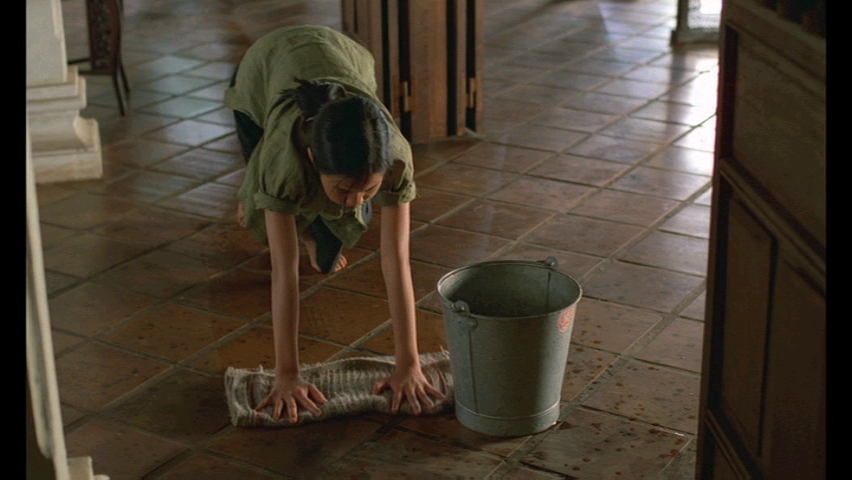
Set in Saigon, Vietnam, in the 1950s, The Scent of Green Papaya relays, on its most obvious level, the tale of a young peasant girl, Mui, who has been sent away from her home to work as a domestic servant as a result of hardships endured by her family after her father's premature death. In some respects, certainly for Western viewers, the story follows a familiar plot, that of the fairytale Cinderella.


There are important deviations from that morality play, however, including the fact that in this film virtually all of the women appear to be victims of circumstances beyond their control. 


Harridans and shrews are nowhere to be seen, and in the one scene in which a woman scolds another, a man is the ultimate cause of her lashing out. The mother-in-law upbraids her daughter-in-law for having failed to please her husband, what the mother takes to be the explanation for her son's flight from the home. 

For the most part, aside from that single scene, the women of the film are quiet, gentle creatures, hard-working, well-meaning, and resigned to their fate. Even the mother-in-law spends the duration of the film in her room lightly beating a drum as she mourns the dead.

The men in the story can be interpreted, in some sense, as the women's oppressors, but this, too, appears to be a result more of the social and economic context than of their own maliciousness. 


The superficially Cinderella-esque plot develops rather differently in the final section of the film, although it is true that upon reaching womanhood, Mui is ultimately “rescued” by a man, a composer whom she met and admired from afar while working as a domestic helper when she was still a child.


Basically, as cynical as this may sound, she trades one domestic role for another. The indentured servant becomes an indebted wife. After toiling away for more than ten years for other people, Mui, upon reaching womanhood, is “rewarded” by becoming the wife of the man for whom she was working, and also the mother of his child.

Some Western viewers have no doubt voiced complaints that the story is objectionable in one way or another, and I do believe that in order to be able truly to appreciate this work it may be necessary to “evacuate your critical mind,” as I recall a yoga instructor once exhorted those participating in her class to do (including me, who of course rolled her eyes). 

For some such a feat is easier said than done, but it does seem to me that the plot of this film is arguably beside the point, and the wide-ranging and penetrating feminist and neo-Marxist critiques to which it could easily give rise need to be set to one side if one is to discover what it was that the director here intended to convey.

The film garnered much praise from critics but much less from nonprofessional reviewers, many of whom seem to have found it affected (“artsy-fartsy”) and over-contrived. Other viewers complained about the slow pace and relative dearth of action. The Scent of Green Papaya received awards for its cinematographic excellence, and therein lies the true value of this creation, not in its banal plot.

To focus on the narrative of this film is to miss the beauty which unfolds in infinite complexity from the opening and all the way to the final scene, as the deliverances of the senses are presented so as to create a quasi-synaesthetic sensory odyssey of sorts while capturing and conveying the perspective of the central protagonist at the same time.


The Buddhist philosophy undercurrent of The Scent of Green Papaya, which is unmistakeably symbolized throughout the film, is finally made graphic (flagrant?), for those who somehow failed to grasp it earlier, with the concluding shot being none other than a statue of the Eastern sage.


But if this film is Buddhist in orientation, what does that mean? And can the manifest sensuality of so much of the film be reconciled with Buddhist philosophy? 


Scenes of ablution are interwoven throughout the film, but especially near the end, once Mui has achieved womanhood, bathing takes on a decidedly sensualist cast.


On one level, the message, if you will, of much of this film may seem to overlap with the ethical vision of the ancient Greek Stoics, according to which one must steel one's self against adversities over which one has no control. In this regard, the film might seem to share what the nineteenth-century German philosopher Friedrich Nietzsche regarded as the life-negating aspect of resignation common to most religions, which was a bit later pithily summarized by Karl Marx in the phrase “Religion is the opium of the masses.”


Buddhism is a religion, albeit a godless one, but it enjoins the same attitude toward life on earth as the theistic religions: that our attachment to earthly things, all possessions, including our very life, is vain and otiose. 


Desire is to be squelched, since only then, without the constant yearnings to succumb to temptation, can one be at peace with oneself, living harmoniously and in equanimity with nature. In keeping with this Buddhist-cum-Stoic outlook, one way of understanding the docile acceptance by Mui of her station in life is as an expression of her acceptance of this fate and refusal to struggle against it.


It does seem as though all people are constrained by chains of one variety or another, though most of them are invisible. The men and boys of the film, no less than the women, are born into a context rife with expectations of what they must be and do, and those expectations undeniably play a role in shaping the persons whom they eventually become—to a greater or lesser degree, depending upon the individual's relative propensity toward freespiritedness, on the one hand, and malleability or tendency to conform, on the other. Their ostensibly privileged status certainly does not render the males immune from suffering.


There is another way, however, of viewing Mui's way of looking at and attitude toward the world, and even for those who reject the teachings of the “preachers of death,” there are truths here to be pondered for those with eyes to see, ears to hear, and a nose to smell. This film illustrates that far more important for the quality of one's own life than external factors beyond one's control are internal factors and the perspective which one adopts toward the people and things in one's experience, a Stoic point, to be sure, but an aesthetic one as well.


Obviously there are extreme cases, where people are physically imprisoned in nightmarish scenarios created by others, and which make it impossible for those shackled to enjoy their own subjective experience of the world. In The Scent of Green Papaya, the focal protagonist retains sufficient liberty to be able think about and to perceive the world as colored by her own values. Her interactions with people and things evince a quiet nobility, despite her low social standing.

Mui lives in a bubble of sorts, entirely unaware of what life might be, were she not situated where she has found herself, as the servant of a well-to-do family. Having received no education, she is illiterate and powerless—not only economically, but also conceptually—to extricate herself from her indentured role. In reality, her station is not so different from the billions of women throughout history whose only hope for economic and social security has been marriage to a man capable of providing those things.


The institution of marriage was initially established to formalize the relation between a man and some of his property, his wife, who took his name and essentially gave her life over to him in agreeing to propagate his name through the production and nurturing of his progeny. 


Today marriage has taken on new meanings, but it will always be tainted by its purely pragmatic and sordid origins, which prevented most women for most of human history from realizing their creative potential beyond the narrow ambits of the home. Many women have flourished, no doubt, in such a role, and many do still today, but for thousands of years they had no viable alternative and so cannot be said to have freely chosen what became their primary vocation. 


In theory, of course, such a lifestyle may well be every bit as valid and worthwhile as any other choice which a woman might make—a point underscored by recent gay marriage activists—provided that it really is her own choice and not imposed upon her from outside.

What is unique about The Scent of Green Papaya is that, rather than negating the servant girl's value, this film reveals the preciousness of her subjective engagement with reality, what is typically ignored in social critiques of gender- and class-based inequities. The focus of social critics has typically been on improving the circumstances of such persons, not on revealing their unique perspective on the situation in which they find themselves. The ironic result is that the victims are often doubly negated. They already have no power over the system in which they exist and which rules their lives, but they also have no voice.


This film presents an anthropological tableau, not a social or moral critique, in displaying the economic stratification as well as the patriarchy of the society in which Mui finds herself. Early on it may appear that a critique is forthcoming, as the males of the family are painted in somber shades as capricious and despotic. The father and head of the household, a troubled musician who appears to be dissatisfied with his bourgeois family life, disappears at periodic intervals with the family's savings to indulge in debauchery with prostitutes until the money has all been exhausted, at which time he returns home.

Even the smallest boy of the family manifests ignoble behaviors toward Mui which suggest that in the future he will follow in the footsteps of his father, and will perhaps even grow up to mistreat women. No good will come of any it, suggests the plight of the father, who having apparently contracted venereal disease during the last of his fugues of fornication, succumbs shortly thereafter, leaving the family forever and permanently behind.


Truth is Subjectivity

A social critique can of course be made of this entire situation, with the women at the beck and call and mercy of the men in 1950s Vietnam—as most everywhere else—but what director Tran Anh Hung does instead is to focus upon the subjective perspective of Mui and the lush beauty which surrounds her like a halo. The girl has an artist's sensibility and finds value in every single thing she encounters. She views the world in a state of awe at the infinite richness contained within it, and she perfectly encapsulates the maxim that beauty lies in the eyes of the beholder.


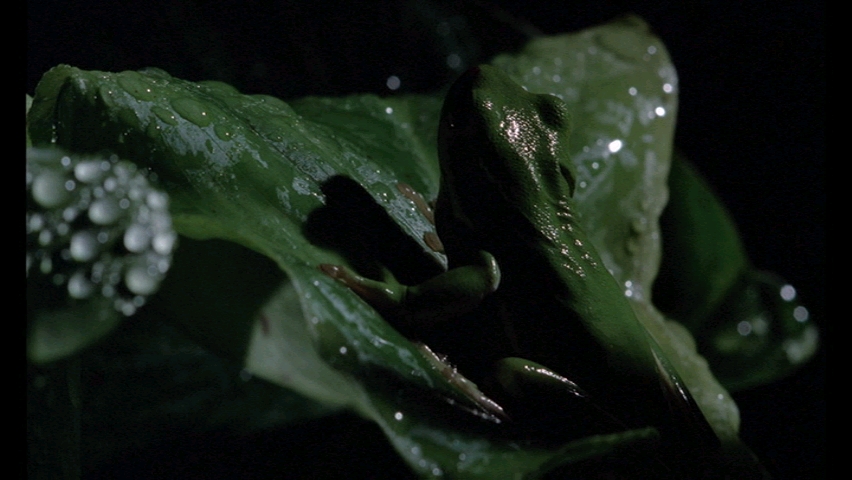
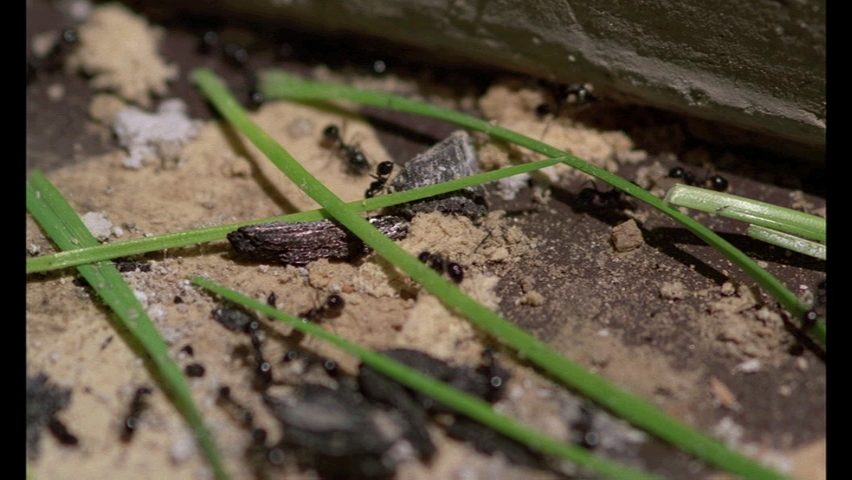
Mui takes note of the minutest of details in her experience, watching an ant attempt to hoist a piece of rice or a toad as it croaks. The house is structured openly, making it possible for various creatures, insects, lizards, frogs, to lead their separate existence while harmonizing with the people also present.


Mui's attitude toward these creatures is very different from most people's, and none of what are often regarded as pests appear to be so from her own perspective. Rather than setting out to destroy the ants, as the son of her master does—lighting a candle and dripping wax upon them as he watches them slowly die—Mui observes in a state of awe the beauty of their struggle to survive.


A ten-year lacuna of Mui's life is not covered by the film. The story is taken up again when she is twenty years old, at which point she seems physically different but still a child at heart and in her interactions with the world. In the opening shot of this final section of the film, Mui seems almost retarded, although the intention appears to be to depict her as saintlike—in something like a state of transport achieved through natural mysticism. 

There have been many varieties of mystic throughout history, with some holding a pantheistic view, finding divine elements or “gods” in all that they encounter. Others have understood their extraordinary experiences as direct communications with a canonized God in a particular religion such as Christianity.

Mui's ecstatic encounters with nature are reminiscent of those of many religious mystics throughout history, including Saint Teresa of Avila (1515-1582AD). The difference between Mui and the mystics of established religious traditions is that she does not possess any of the cognitive or conceptual apparatus to be able to articulate her interactions with God—or the divine—as manifested through nature. It is noteworthy, however, that many orthodox mystics, too, have insisted that the content of their experiences was ultimately ineffable. Incapable of being transmitted to others through human language, the phenomena giving rise to the mystic's experience could only be gestured toward.

As a young woman, Mui seems even less inclined to talk—close to mute—by now, and one suspects that this was how she managed to survive pure and innocent in a system where many analogous people throughout history have suffered corruption at the hands of those more powerful. Having been adopted as a surrogate daughter by the woman of the house (who had lost her own daughter), one senses that Mui benefited from the protection afforded her by this relationship.


Once Mui is sent to work for the composer in his house, preparing his meals and tending to his domestic needs, he ends up falling in love with her, and ultimately forsakes his fiancée, a well-to-do young woman of society who appears to have no use for or real interest in the composer's true calling, music.


The unmistakeable message is that the musician, like Mui, is nobler in spirit than his would-have been wife of high society, who comes off as shallow and superficial. 


The woman becomes outraged upon recognizing that her lover and would-have-been husband has fallen for his live-in servant. She throws a tirade before storming out of the house, leaving her engagement ring behind.


The musician's infatuation with Mui during what is a nearly speechless section of the film is revealed through the sketches he has made of her face. It appears that he finds himself drawn to Mui as to a kindred spirit of sorts. The possibility of course exists that the father of Mui's child, too, like the troubled musician at the head of the household where she worked as a child, may grow restless and forsake bourgeois family life. But one senses that Mui is unlikely to be devastated by such a development, because every single thing around her is miraculous to her. She has no identity to lose, because she blends in with the environment no less than do the toads and the lizards and the ants.


Music as a Metaphor for Scent

How can the subjective experience of such a person be captured on film? A virtual infinity of colorful images carefully composed and juxtaposed make up the visuals of The Scent of Green Papaya, but the musical score—comprising both original material and well-known classical music pieces—is just as important, and together the two help to create the synaesthetic illusion of scent throughout the film.

In some ways, the music serves a metaphor for scent, with rapid transitions and modulations signaling abrupt emotional changes, just as occurs when a scent, invisible to the eye, eventually penetrates a person's consciousness as the molecules make contact with olfactory receptors and a message is transmitted to the brain.

I have often felt that scents are colored. I do not suffer from—or is it enjoy?—the literal synaesthetic conflation of sight and scent. I do, however, strongly associate certain scents with certain colors. The Scent of Green Papaya synaesthetically suggests for me the sense of scent through the use of breathtakingly beautiful visual images and sounds, both natural and manmade. As Mui shreds fresh papaya, the music and the image together produce a scent-like experience because it seems to be right there before me.

At first the unpeeled papaya smells vegetal and green, somewhere between Pierre Balmain Vent Vert and Frédéric Malle Carnal Flower, but then it becomes fresh and fragrant and tart like a bright eau de cologne such as Parfums de Nicolaï Cédrat or perhaps one of the Hermès Jardins. The film is literally filled with clean, limpid, aqueous, and vegetal scents, and the musical sound of water—whether dripping or splashing—suffuses the entire work.


The smell of rice in the kitchen is evoked as dinner is prepared, but the rice is scented, as beautiful as Gianfranco Ferre's Ferré eau de parfum, which includes a succulent rice note.


When, as a young woman, Mui applies red lipstick for the very first time, my memory of that scent becomes activated. I think of the smell of Guerlain Météorites or Frédéric Malle Lipstick Rose.


When the composer's fiancée flirts with him at the piano, I sense the presence of Chanel no 5. When she becomes angry, throwing a temper tantrum and destroying beautiful pieces of ceramics before storming out of the house, all of her charm evaporates away, leaving something harsh and ugly, an aura of caustic chemical soup (selection of an apt example is best left to the reader...).


When the composer enters Mui's private quarters for the very first time, I smell something with musk, but a clean, light, sweet and innocent heliotrope-laced musk such as Kenzo Vintage Peace. 


The green incense burning in the home brings to my mind Comme des Garçons Kyoto.


As the couple shares playfully in the process of educating Mui, I sense the juxtaposition of L'Artisan Parfumeur Voleur de Roses and Drôle de Roses. The couple lives harmoniously together, respecting one another as fellow creatures in the Buddhist rock garden which is their home, far from the fray of urban contention and strife.


All of these image-scent associations emerge from my own subjective experience and are likely unique to me of all viewers, but therein lies precisely what I find so fascinating about the sense of scent: our associations arise out of our own memories, shared with no one else in all of space and time. Our interactions with our environment and our reactions to what we see and smell and hear have as much to do with us as they do with the things which serve as catalysts of sorts in causing a flood of memories to rush as from nowhere to the forefront of our mind. Whether we like or we dislike what we see has a great deal to do with our prior experiences and beliefs.

I must admit that I myself disliked the heavy-handed sexual imagery near the end of The Scent of Green Papaya, and feel that the effect would have been much stronger more subtly applied, but overall this film is a richly scented evocative gem and well-worth any perfumista's time.


Should Class and Gender Inequity be Aestheticized?

Social criticism is important. Without it, no progress would ever have been made toward the betterment of the circumstances of marginalized and diminished persons, including all persons who are non-White or lack a Y chromosome—or both. Strides have been made toward equalizing the opportunities of the people of all races and both genders and, more recently, sexual orientations, although there is much more to be done.

Even in ostensibly free and enlightened Western nations, the diminished status of females, in particular, is evidenced by economic statistics revealing that they continue to be paid significantly less than their equally qualified male counterparts for performing the very same work. In other words, women continue to be regarded as less than full-fledged persons equivalent in moral value to males, as has been the case throughout human history. This is a valid concern, and some viewers may find that The Scent of Green Papaya conveys a conservative perspective too ready to condone inequalities and injustice. Such criticisms have a great deal of merit in their own right, but morality and justice are not really what this film is about, when all is said and sniffed.