Showing posts with label multilaunchers. Show all posts

Thursday, June 27, 2013

FRAGRANCE IS FUNCTIONAL: How I learned to stop worrying about art and enjoy my perfume for what it is


Summertime presents a propitious opportunity to reflect upon the nature of perfume. Why? Because it's damned hot outside—at least here in Boston—and a good cologne can vastly improve one's oppressive and muggy and sweaty and otherwise unpleasant afternoon. How does cologne work its mood-elevating magic?

First off, it smells good. From bright citrus to clean musk to grassy green to violet leaf and lightly spiced tea, colognes manage to cover the gamut of scents found in the larger olfactory sphere spanning all perfumes, but the lower percentage of key ingredients makes cologne perfect for the summer months.

Yes, cologne cools and refreshes the body, particularly when applied as a splash, which is possible because of the lower concentrations of scent-making ingredients. More of the liquid which hits the skin is alcohol and water, proving yet again that hydration is good. With a few spritzes or a gentle splash, the spirit is immediately renewed as the air spinning off that ceiling fan suddenly seems twenty degrees cooler than it did. The action of the fan and the cologne are collaborating in a small piece of deceit: neither changes the temperature of the ambient air in the room, but together they fool the body into feeling much cooler than it was before.

My favorite colognes are those featuring a large percentage—preferably 100%—of natural ingredients. That's because in extreme weather conditions newfangled chemical soups sometimes morph in unexpected ways, just as I imagine perfumes do more generally when exposed to heat and light. Because the temperature is elevated even while the cologne is worn, I have found that the more natural it is, the better it tends to hold together and consistently smell nice. 

Cologne used in this way is obviously functional fragrance. Is it anything else? To be honest, my unedited response to this question is: Who cares? Is not fulfilling one important function enough to justify the existence of cologne? Why must it also be something else? Who says that it must be, and why?

I began thinking about this question recently while soaking in a scented tub and listening to one of Beethoven's string quartets. It suddenly dawned on me how much more complex and interesting even a single passage from a work of classical music is than even the most complicated of perfumes. Sure some of them (albeit fewer and fewer these days...) unfurl in interesting ways, transforming from one to another scent over the course of a wear.

In the most dynamic of cases, the perfume may undulate as its component scents wax and wane, leading one's nose to take note of different features of the composition at different moments in time and permitting a form of olfactory reflection and refraction to take place. But even in those rare cases of the most complex of perfumes, probably the closest comparison to complexity in music would be something along the lines of a four-chord pop song.

Perfume simply cannot, even in principle, scale the heights achieved by music, first, because it is so much simpler and, second, because our perception of it is so very subjective. I admit that I am pianist, trained in classical repertoire, and so my apparent disparagement or belittling of perfume may seem unfair to someone who, instead, has spent his life creating new combinations of scents. There may be some truth to that criticism, but I still believe that a finished perfume is considerably less interesting than any sonata or ballade, or prélude or mazurka or étude—or even two-part invention by J.S. Bach. I truly believe that even the profoundest of perfumes is nowhere near as interesting as even the simplest piece of music which I've ever played or heard.

Perfume is there to be enjoyed, a number of scents combined together in a small volume of space and usually not found together in exactly that way in nature. (Exceptions to the rule include realistic soliflores.) If masterfully composed, the combination of these scents will play out over time, but there is nothing even approaching tonal counterpoint to be found in a bottle of perfume. Even worse, owing to a variety of features peculiar to perfume perception in human beings, we cannot even seem to agree what we are talking about!

In approaching music, we have something to point to. There are key signatures and tempos and voices and refrains and codas. These are all written right there into the score, so no one can deny their presence. We can have a conversation about all of those aspects of music in the way in which we cannot so much when it comes to perfume because people do not even agree about what they smell, and its significance appears clearly to be determined by their idiosyncratic past history, values, and beliefs.

Judging by the reviews I've seen online, many people are affected by the note pyramids offered up by the house, even though it seems obvious that they are often a part of marketing the perfume and may or may not have any objective validity. My distinct impression is that many reviewers feel that they must perceive the official notes, and this may lead them to offer a narrative about the perfume which features those notes, even in those cases—such as highly abstract designer fragrances—where nothing even approaching the essences of the named flowers is present. What is in the bottle does matter, but it is mediated through an amalgamation of entirely subjective associations—and market-induced expectations. People are influenced to different degrees by marketing, and since no one else has lived our own life or walked in our shoes, no one else will perceive a perfume in exactly the same way that we do. Yes, you can tell a story about a perfume, but 99% of it derives from inside your head.

One might retort that the same can be said about music, which is just as subjectively processed, and it is true that people have different tastes in music and different levels of sophistication when it comes to understanding music theoretically. But two people who have been trained classically—say, two pianists—can talk about the objective features of a sonata written into the score. In stark contrast, two equally knowledgeable perfumistas may or may not agree about what they smell or whether it is any good.

While sitting in my tub listening to beautiful music and enjoying a pleasant scent wafting off the water, it occurred to me that the value of perfume has absolutely nothing to do with whether it will ever be exalted as one of the beaux arts by Western culture. It simply does not matter, at the end of the day, because the only reason why I really care about perfume is because I use it. My enjoyment of perfume is not different in kind from my enjoyment of the scent wafting off the bath water, even though the two scents may have been produced in entirely different ways.

Let me repeat the above confession: I use perfume, and I value it only insofar as it serves my purposes. It has no importance beyond its capacity to serve my purposes, to be used by me. A perfume never spritzed may as well not exist. I use perfume to scent myself, to cool off, to derive a sense of pleasure. But wait, there's more.

Not that we need any more, but I came up with a new argument against the “Perfumery is art” thesis. Here's how it goes: Home fragrance is functional. But home fragrance differs from perfume not in kind but in degree. We occupy our home, and when we wear perfume we may serve the same function as a scented candle to those around us—and also to ourselves. I have many niche candles: Diptyque, L'Artisan Parfumeur, Sage, Bond no 9, elizabethW, Etro, and all of them smell every bit as splendid as the perfumes of those houses which they feature. 

At the other end of the home fragrance spectrum are found Febreeze spray, Yankee candles, Wick plug-ins, and the like. If we allow that niche candles are art, then how to exclude all of these less noble forms of home fragrance? And if we deny that niche candles are art, must we not deny that the fragrances which scent them are as well? So here we have another conundrum, beyond the concerns so incisively articulated by Bryan Ross at From Pyrgos and Christos at Memory of Scent.

While thinking about this issue again, in the light of recent developments in perfumery, I also began to realize that even if perfumery could be considered art in some rare cases, it will never be recognized as such, in a general way, for the following reasons deriving from the current state of Western civilization:

1. Reformulation. Whether because of the IFRA restrictions (and now IFRA-inspired EU regulations) or for more crassly economic reasons, the once-classic perfumes have undergone vast changes in composition. The same names are being used in most cases (one exception being Christian Dior Miss Dior), but for the most part, the perfume bearing the name of an icon from the twentieth century has changed enough to make it impossible to say much about that perfume in a general way. Yes, once upon a time it was rich and had incredible depth. Yes, today it may seem flatter and less inspired, but people will continue to buy it because its reputation precedes it, and people's reception is informed by what they are told that they ought to believe. In order for objective masterpieces of perfume art to be exalted by posterity, they must exist in the same form as they existed when earlier writers described them. Does the Osmothèque solve this problem? I think not, but that's another story.

2. House management. The twenty-first-century phenomenon of corporate conglomeratization has affected many aspects of business in all realms of consumer goods, but the implications may be starkest of all in the case of perfume. Why? Because the answers to all of the key questions determining the fate of a perfume are made by managers who may or may not have any interest in preserving the original perfume intact. Publicly traded companies, as Coty recently became, are beholden to stockholders, and healthy profit margins become essential if a manager is to retain his position, as all of them obviously seek to do (unless of course they resign).

Such a manager will do what needs to be done to see to it that the stockholders are happy with the way the business is being run. Stockholders in Coty may or may not care about the intrinsic quality of the products. Many people in the world could not care less about perfume, and CEOs may in some cases number among them. The only thing that we can really count on is that if quality happens to translate into sales, then quality will be regarded by managers as good. If, on the other hand, quality eats into profits, then it must be sacrificed. If it becomes more profitable to sell many bottles at a lower price than fewer bottles at a higher price, then the formula will be cheapened. 

The stockholders of companies, in their capacity as stockholders—and whatever their personal feelings about perfume may be—want profit . Perhaps as individual consumers they appreciate perfume, but they'll have no problem with procuring their fine perfume elsewhere, using the funds which they reap from whatever it is that Coty does to maximize profit in the case of its various subsumed brands.

3. Niche houses—and autodidact perfumers—today abound and continue to proliferate. This niche perfumery industry has obviously proven to be profitable, requires little initial outlay or even professional training, and gives the power to create and profit from the fruits of one's labor even with no background or history in the area. It's remarkable, actually, the marked distinction between perfumery and the (other) arts in this regard.

No one decides as a result of a mid-life crisis (or reasonable facsimile) that the time has arrived to become a concert pianist, though one never took any piano lessons as a child or adolescent. To publicly profess such a plan would probably be taken as a sign of mental instability, even delusions of grandeur. Accomplished pianists have spent years upon years training to achieve even basic competency, and even more years to achieve the skill of a master pianist. In perfumery in the past, more or less the same situation appears to have obtained, which is probably why so many perfumers were born into families whose business it was to produce perfume.

In the past, during the golden age of perfumery, the skill of a trained perfumer was handed down from generation to generation, not claimed to be acquired in a short period of time by someone who liked perfume and decided to try to make some from an assortment of fragrance and essential oils which he began mixing together in his kitchen or garage. Just as a fondness for instrumental music does not alone suffice to make one a skilled musician, is it not rather pretentious and insulting to the history of perfumery (not to mention unrealistic) to suppose that one can simply “decide,” with no prior education or experience in the subject, to be a perfumer, in fact, next week?

But anyone has the right to pick up a paintbrush and take a stab at landscape or portrait painting, so why should aspiring perfumers not be able to do the same? one may well rejoinder. People can do such things, of course, but the lack of training and attention to detail of a professional perfumer will likely be missing. For this reason, among others, I believe that most of the current niche firms will cease to exist in short order. Some of these people will decide to move on, perhaps to obtain a realtor's license or to open up a fast-food franchise store. With so many choices, so many established and very fine perfumers who have dedicated their lives to perfecting their craft, why should consumers invest their modest wallet share in the work of dilettantes? The answer is clear...

4. Hype is what appears above all to sell perfume in the twenty-first century. New is good, everyone seems to assume. The next big thing is always just around the bend, and people are willing to invest large sums of money to own bottles of the latest “it” perfume. Once they have invested, they become more apt to defend the integrity of their acquisition, so as not to feel like a dupe.

Given the current state of the industry, it seems safe to say that the golden age of perfumery is behind us. Why? Because most perfumes produced today are simple, linear, and abstract. They are essentially mixtures of a few components to produce a “pleasant” scent. Perfume making in the age of the multilaunchers, who put out several or even dozens of perfumes at a time, has become a matter of mixing a set number of ingredients together in every conceivable logical combination. Lego perfumery is not the exception but the rule.

This, my fragrant friends, is what the business of perfumery has become, and it is hard to see how anything might reverse the seemingly inexorable forward-marching trajectory to greater simplicity and more cost-effective and abstract scents. Because nearly everyone in the mainstream is doing this--and many in the niche category as well--anyone concerned to survive in the competitive market must do the same, and all the more because modern people's tastes are being transformed in the process. 

Not so long ago, the house of Clean hit on a market-viable idea: give all people, including those who have previously shunned perfumes, a product which they can feel comfortable with. How could anything be more naturally and intuitively appealing than the scent of being clean? Today abstract sweet laundry and shampoo and conditioner scents are being sold as perfumes. The process by which this "clean agenda" is being inculcated in modern consumers is precisely the same as the process by which Gabrielle Chanel convinced women that they should smell like aldehydes: seduction.

Market forces and consumer behavior are mutually reinforcing. When consumers are essentially told that good perfume is clean and simple and abstract, then that becomes their concept of perfume. Now that the companies holding the key formulas of the classic perfumes of the twentieth-century have capitulated to the “modern way,” we appear to be moving more and more toward a toiletry-centric conception of perfume, which will become less not more expensive and comprise a large number of "temporary" fragrances whose market life can be expected to become shorter and shorter in the age of Twitter launches and flankers. 

Given this state of affairs, I see no hope for the vindication of the "perfumery is art" thesis. In fact, I would go so far as to say that, as things currently stand, the art thesis is no more and no less than a marketing tack used by exclusive niche houses. It adds an extra appeal to some sorts of consumers not unlike the appeal enjoyed by a perfume which is explicitly associated with a celebrity's name. It's probably not a coincidence that the celebrity phenomenon has infected niche perfumery as well, with “rock star” perfumers worshiped by throngs of fawning perfumistas, when in fact most such perfumers are simply doing their job!

So there you have it, my fragrant friends, how I learned to stop worrying about art and enjoy my perfume for what it really is: functional fragrance. If we are honest with ourselves, we must own that, in our day-to-day use of perfume, the art question does not matter in the least. So long as we are able to use our perfume to serve our own purposes, then we'll continue to be happy that it exists. Calling our favorite perfumes "works of art" adds nothing to them whatsoever. They are what they are: collections of scents which fill us with delight whenever we wear and smell them.

Now I do believe that it is time for a bath.


Friday, February 22, 2013

On the Many Uses (none of which are abuses) of Perfume


Business as usual

Many different kinds of people use and produce perfume, and they do so for all different kinds of reasons. What percentage of people regard perfume as valuable in and of itself—beyond its functional value as a source of money or pleasure or as a tool of seduction? I wonder because even those who wish to exalt perfume to the status of art can achieve wealth and fame from doing so. Whether curators or perfumers, no one stands to lose by aligning perfume among the beaux arts. Or do they? Perhaps only consumers, the people who pay for perfume, should be wary of such initiatives, given the astronomical prices which fine art works command in today's capitalized art market.

Perfume is produced in order to be worn and because it is consumed. Bottles are drained, and they must be replaced, and this generates an enormous potential for profit on the part of those who seize the opportunity to promote perfume in any and every possible way. Each new development which casts perfume in a positive light will automatically generate an increase in sales. Drawing attention to perfume in any approbative way—for example, by calling it art—will make it coveted by an ever-expanding market niche. Art is good, so if perfume is art—in addition to offering a variety of functional benefits—all the better! Whether people regard perfumes as art objects or toiletries, the challenge for anyone attempting to profit from this industry remains how to woo consumers to spend a finite perfume wallet share—whether large or small—on one's own wares rather than those of competitors.

When a single company controls several houses, this goal becomes easier to achieve since a given customer may be persuaded to buy through a variety of different marketing techniques running alongside one another simultaneously. Conglomerate corporatization strengthens all of the houses under the aegis of a single company because it can absorb the shock of revenue troughs at some of the houses, so long as others in the same group are doing well. Independent houses, in contrast, must be more rugged and resilient to survive. A particularly bad year may result in a crippling insolvency, culminating in the need to shutter the store. Perhaps the recent phenomenon of proliferating niche houses under the direction of a single person or small group is a result of perfume makers' recognition that there really is “safety in numbers”.


Boadicea the Victorious and Illuminum, both British luxury lines, are the houses of Michael Boadi, a former hair stylist and self-taught perfumer. There is nothing wrong with those credentials, per se—they are precisely the same as those of Serge Lutens—and Boadi is certainly not the only creative director behind more than one house. Pierre Guillaume's ventures—Huitième Art, Parfumerie Générale, and Phaedon—leap to mind as another example of the same. A further case: Sospiro and XerJoff, two apparently distinct Italian luxury perfume houses, too, are linked. The people running these houses all seem to share an entrepreneurial spirit quite separate from their interest in perfume.


In addition to some niche houses sporing more houses with new names and concepts—or gimmicks—virtually all of them appear to be launching large numbers of new perfumes in a continuous stream, which can be understood as a counter-reaction to the corporate houses' penchant for flanker production. Perfumes used to be launched one at a time by professional perfumers, most of whom learned their trade in Grasse and many of whom were borne and bred by perfumers. The business of perfume has changed a great deal in the past few years, and part of this may be explained by considering parallel developments in the case of the wine industry.


Not so long ago, perfumery was primarily a family business, just as was the case in centuries past for wine making, concentrated primarily around the vineyards of France. Today, perfume houses are sprouting up all over the world, and many perfumers proudly display their lack of formal education as a badge of their independence and creativity. 


Similarly, in the aftermath of the California wine revolution, successful vineyards and producers can be found in countries quite far from France. Many celebrities, such as actor Gérard Depardieu and director Francis Ford Coppola, have started or become involved in wine ventures, despite having no obvious background or training in oenology.

In terms of consumption, too, perfumery appears today to be undergoing some of the same sorts of changes which were seen in the wine sector in the United States over the course of the second half of the twentieth century. Today millions of Americans fashion themselves as wine connoisseurs as a direct result of the success of ingenious schemes to elevate the image of this particular type of alcoholic beverage, to which a sought-after prestige was attached, luring consumers in and away from beer and other spirits.


More alcohol per capita is undoubtedly consumed today in the United States as a result, but the proportions have also changed, for a person who is already drinking a glass of wine does not reach at the same time for a stein of beer. There is a culture peculiar to beer drinking, of course. It remains the beverage of choice for sporting events and college parties. But wine came to prominence as a result of its having been marketed to consumers in an epicurean light, while inviting ordinary, middle class people to lift stemware glasses up to their lips to imbibe.

The paradox of the wine revolution is that it was democratic, reaching ever further down the socioeconomic chain through the marketing of wine as a prestige beverage, the consumption of which would confer on people a sense of being somehow elite. The phenomenon of the wine club, whereby one is shipped regular “curated” selections of bottles being sold at an advantageous price—and often with free shipping—exemplifies this paradoxical democratization of wine connoisseurship.

The same curiously paradoxical dynamic seems to be working in the case of perfume, which has become democratized as well, through the very same seductive device, the sly suggestion that by entering into the world of perfume connoisseurs, one is joining the ranks of elites. People are drawn to consume what they have been persuaded to believe is sophisticated, and the same forces which brought about the wine revolution appear to be acting as well in the case of niche perfume.

The consumption logic of perfume is analogous to the one operating in the case of ingested alcohol solutions. Once one has selected one's scent of the day (affectionately referred to by perfumistas by its acronym, SOTD), the matter has been settled. The challenge for marketers is to persuade consumers to buy and apply their perfume first, before all of the many others which they might have selected instead.


The Perfumery Microcosm

Does perfume have a value independent of its identity as a commodified object? Is there any way to disentangle perfume as a “thing-in-itself” from the business nexus in which it is contained? The status of perfume seems quite confused above all because the producers of perfume themselves seem to vary so much, from those for whom perfume is the ultimate expression of creativity, to those for whom it is primarily—or solely—a very lucrative business. This is why it seems to me false to say that perfumery, in and of itself, is an art. To make such a sweeping, global claim is to indulge in falsificatory abstraction. The truth about perfume is not nearly so obvious and simple as we may wish for it to be, because people produce and use perfume for many different reasons. Are some of those reasons better than others? What is the force of that question? All of them—the good, the bad, the ugly, and the beautiful—together conspire to create the complex world of perfumery, a microcosm of the larger world in which it is lodged.


Perfumes may all be liquids containing a variety of solvents and essences, but perfumery is not a single “thing in itself”. Perfumery is a multilayered, multifaceted network of people and practices, the end products of which are perfumes. In reality, many of the practices which lead to the production of perfumes bear no resemblance to the production of art by individual creators. When one attempts to speak of “perfumery” as a whole, one is bound to emit falsehoods, because the people whose industry results in perfume differ so much from one another in their intentions and values.

Perfumers themselves appear to cover a rather heterogeneous range. Perhaps some perfumers are truly olfactory artists, but most of them appear to be contracted designers or noses for hire. Certainly some artisan and truly independent perfumers would seem to fall into the former camp, at least initially, but their creative output is undoubtedly modified according to business constraints and exigencies. In one way of looking at art, there can be no “rules” whatsoever at the outset, so if a perfumer commences his or her work under the assumption that perfumes must be wearable, then the resultant creations would seem to be intrinsically functional products. This alone should suffice to demonstrate that such creators are designers, not artists, at least not in the strictest sense of that term.

Things in the world come in various colors, shapes and sizes. The world of perfumery, like the world more generally, contains artists, visionaries and hacks; entrepreneurs, shysters and cads. (How could it not?) Some houses maintain high compositional standards and seek out and use only the finest materials; others prefer to sell more bottles of less expensive perfume. Perfumery is conducted by perfumers, but also by CEOs, chemists, and accountants. Some of these people hold beauty to be of paramount value; others are concerned primarily—or only—with profit and may use marketing data and surveys to decide what to produce. The many fragrances created by this motley cast of characters range from masterpieces to disasters, although which are which appears to depend largely upon one's idiosyncratic tastes.

Is it a category mistake to claim that an unwearable perfume is a perfume? Or is it just a bad perfume? Do we know of any intrinsically unwearable perfumes? Or is the fact that a perfume exists to the extent that we are made aware of it not proof that someone, somewhere does wear it, and so it is not entirely unwearable? Does the survival of a perfume in the marketplace not prove that a perfume is a perfume, whether we happen to like it or not? We may denounce a fragrance as swill, but so long as someone else somewhere stills wears it, then it meets the minimal criterion needed to qualify as perfume.

Perfume users, like perfume producers, vary enormously from one case to the next. Some wear perfume in order to garner the attention—and favor—of other people. They may seek out perfumes which will augment their appeal to a prospective mate. They may wish to convey an image of glamour and sophistication, or to radiate facts about their lifestyle, as they do with their manner of dress. Other consumers wear perfume solely for themselves and may not even don it in public places precisely because they prefer not to attract the unwanted attention of strangers or to send out any signals at all.

In this regard, too, perfume use can be compared to wine and spirits consumption. Some people drink solely in order to get drunk. Whatever will accomplish that aim is fine: beer, cheap wine, hard liquor, even Everclear will do. Others drink fine wine to accompany cuisine and enhance their experience of a meal. Even everyday food can be elevated to some extent by being served with a delectable wine. Still others may drink wine in order to "decompress," for its psychological effects. The connoisseurs among connoisseurs regard wine as an object of transcendent aesthetic value. Many of today's self-styled connoisseurs may enjoy both the taste and the effects of their ingestion of wine. In reality, the list of reasons why people consume alcoholic beverages, including fine wine, goes on and on...

Niche perfumers may or may not be primarily interested in producing perfume as an expression of their creativity, although many perfumistas tend to give them the benefit of the doubt. Luxury niche seems pretty clearly to be a business-oriented approach to perfume. How to seduce consumers into believing that they should pay $200, $300, even $800 for a small bottle of consumable liquid? Why in the world, for example, should a bottle of simple vanilla perfume cost two hundred times more than the same volume of organic vanilla extract? Some of the creations of niche houses are quite good, while others are at best mediocre, but the emphasis among luxury niche firms appears to be on packaging and the cultivation of a house image. Let's put it this way: more effort, time and money appear to be poured into those aspects of the business than into the liquid inside the bottle, just as we learned about mainstream perfumes from “Behind the Spritz.”

One issue which might seem on its face to muddy the waters is the celebrity and glitz which has come to surround the business of perfumery, and especially exclusive, niche perfumery. Perhaps the latter, too, is a result of the inextricable link between ad campaigns and successfully mass-marketed perfumes. Image matters for not only designer but also niche perfumes, and the aura of exclusivity surrounding the latter undoubtedly contributes to the success of those who produce them. If a consumer is being asked to pay two or three or four or five times more for a perfume, there has to be some reason for that. There must be a pretext grounded in something. Hope springs eternal.

Christos at Memory of Scent recently raised the interesting question of quality. Are we willing to pay more for niche perfumes because they are of higher quality? Or do we simply assume that they must be of higher quality because they cost more? So many counterexamples leap to mind, of hyped niche perfumes which do not seem to be of high—or high enough—quality to warrant the exaggerated price, that we may safely conclude that, as much as we'd like it to be the case, it simply is not true that you get what you pay for. Or do you? What, exactly, is it that we are paying for when we buy a perfume?


Mixing Business with Pleasure: 
You Get What You Pay For

Confusions begin to arise in the case of perfume when the liquid is abstracted from the context. For consumers, it's all a package deal. Part of what we like is the scent, to be sure, but we also like the feeling of being associated somehow, in some way, with the images linked to that scent. The images may be of “beautiful” people, but they most certainly also include the whole aura of exclusivity surrounding niche perfume houses. We want to believe that we have refined tastes, that we are privy to olfactory secrets and wonders to which others have no or limited access.


All of this is the essence of luxury, and perfume is a luxury. To strip perfume of the complex marketing apparatus erected in order to sell it would be to remove the rich context which imbues creations such as Chanel no 5 with profound significance to countless consumers. Are they wrong to be seduced by the suggestion that they are as sexy as Marilyn Monroe or as glamorous as Carole Bouquet or Nicole Kidman when they don the perfume? Of course not. They are indulging in a fantasy made possible not by the smell alone but by the context in which it has been embedded, nurtured, and disseminated around the globe.

To remove the perfume from the bottle and abstract it from its marketing context is, in theory, possible. In reality, we can attempt to ignore marketing forces, but our efforts will ultimately be for naught. Why? Because the entire enterprise of perfumery is anchored in an image-based production mechanism. People do not buy perfumes solely on the basis of scent. Even those who think that they do cannot really abstract the scent from the cultural context which made perfume appreciation possible for them in the first place.

No matter how assiduously we may attempt to abstract the scent and to pull it conceptually out of its packaging, in the back of our minds, our origins in perfume appreciation will always remain. No matter how sophisticated we may become in our knowledge and understanding of perfume as a “thing in itself”, each and every one of us began as the unsophisticated consumer at the counter. It's the only entrance possible to the world of perfume for anyone, in principle.

We may wish to kick the ladder away, to use Ludwig Wittgenstein's metaphor, but in reality we cannot. To persuade oneself to believe that we can is to succumb to self delusion. If one orders a sample set from MinNewYork or Aedes, and then sets out to test the samples blind, one will still know, in the back of one's mind, where the perfumes came from: niche emporia. The prestige is inextricably present even when the liquid in the vial is tested without reading the label.

Perfume bottle collectors who focus on the vessel in which perfume is housed, like perfume lovers who would strip perfume of its packaging, view the bottle from a somewhat skewed perspective. The bottles can of course be regarded as objets d'art (or, rather, design) in their own right, alongside other kinds of bottles—those used for milk, beer, etc.—but their significance derives in part from having been anchored in the complex luxury perfume nexus.

A glass bottle is infinitely more valuable when it is filled with a precious elixir which excites the senses and may induce a flood of memories in the wearer. We perceive solid glass objects with our eyes and through our sense of touch. We perceive perfume through our nose. Why should one or the other of these modes of perception be more important than the other? Designers create bottles, and designers create perfume. We can love and appreciate each, but our enjoyment of both will be enhanced by keeping them together, as they were produced, in a package devised precisely in order to lure us in and fill us with delight to the point that we become willing to buy.

The pleasure of perfume derives in part from the fantasies which arise and are made possible by the luxury context in which perfume is inextricably fixed. Going against what seems to be the orthodox view, I have come to be skeptical of the idea that we are somehow harmed or tricked by the barrage of images associated with the perfumes which we may eventually acquire. We will be seduced in determining how to dispense with our wallet share, one way or the other. Whether we are wooed by pictures of Brad Pitt and Audrey Tautou, and historical images of Marilyn Monroe and Catherine Deneuve, or the scent of jasmine, rose, and strong aldehydes which make up the composition of Chanel no 5, matters not in the least to those who are trying to sell the perfume.

The only criterion, at the end of the day, is pleasure. If we derive pleasure from donning the perfume, then we have not been swindled at all. We got what we paid for: an image, a scent, a feeling of satisfaction, the sense of of being somehow more sexy and glamorous, a flood of memories induced by our perfume. Why should one of these be more valuable than any of the rest? Images, like bottles, may enhance our experience by adding a rich layer of fantasy to our encounter with the perfume. Is it wrong to wish to be glamorous and sexy or to believe that by wearing a perfume we become more so? Seems rather harmless to me.

The same should be said, of course, for those who find a deeper satisfaction in wearing a perfume because someone somewhere has decreed it to be a masterpiece. Should we care what they think? Probably not, if perfume reception is ultimately a matter of taste, as it seems to be. Nonetheless, the experience of some wearers will indeed be enhanced by having come to believe that they share the refined taste of experts, whoever they may be, and no matter how that label came to be applied, even if “the experts” have been self-decreed.


Witness, again, what happened in the realm of wine. Robert Parker essentially appointed himself the Tzar of taste, and because people clamored to be like him, red wines became denser and more like Merlot, while white wines cured in oak barrels became all the rage. It's a fact: people desire to be like the experts, to share their presumably superior taste, and that is why exalting best-selling perfumes as masterpieces, too, is a clever marketing scheme. It ends by enhancing the sense of luxury associated with wearing the perfumes thus showcased.


A House of Mirrors

Chanel no 5 was marketed into women's—and men's—brains as being sexy and seductive and, above all, glamorous. Was it worn by glamorous women because Chanel no 5 was glamorous? Or did Chanel no 5 become glamorous because women—and men—came to associate images of celebrities in slinky black dresses with the scent of the perfume? Did Marilyn Monroe wear Chanel no 5 because it was sexy? Or did Chanel no 5 come to seem sexy because sex symbols such as Marilyn Monroe were known to wear it?

To see why the packaging (including marketing images) and the perfume are inextricably connected and cannot be divorced from one another without transforming the thing thus abstracted, consider what perfume would be to someone who did not come to it through the usual path, by visiting a cosmetic counter at a department store. To someone coming to planet earth from a galaxy far away, I am quite sure that Chanel no 5 would be a smell with zero significance, whether sexual or socioeconomic or artistic or otherwise. Certainly the white sheets of the orphanage where little Coco was raised and the white steppes of Siberia where the perfumer who composed the perfume spent a good deal of time would not be images easily connected to the scent of aldehydes by a newcomer to our planet. Would the perfume seem sexy or glamorous without being presented simultaneously with images of sexy and glamorous women? Evidently not. It would be only a smell.

Indeed, even right here on planet earth there appear to be a fair number of young people who associate the scent of Chanel no 5 not with Marilyn Monroe or Catherine Deneuve but with “the mad old cat lady”. I recently read a string of comments to that effect in response to a piece on the Brad Pitt Chanel no 5 campaign. Those who wrote comments did not seem to “get” the iconic perfume. Or, rather, what they got was that the scent evokes images of something which they would never want to be.


I've seen similar remarks made about such perfumes as Guerlain Shalimar and L'Heure Bleue, reportedly favorites among senescent women in retirement homes. My own view is that Guerlain screwed up rather royally by mass-marketing Shalimar at drugstores and discounters and basically any- and everywhere. Rumor has it that various “levels” of Guerlain's most famous creations are circulating about—not just a case of reformulation, but formulations tweaked—and made more cheap—for specific markets. This sends very mixed messages. When the cleaning lady wears Shalimar as her signature scent, then the woman for whom she works may think twice before donning it herself. Luxury is essentially elitist, and perfume is a luxury product. In order for the illusion to continue to work on prospective consumers, there must be a division between those who have access and those who do not. Without insiders and outsiders, the notion of luxury is evacuated of sense.

In the twenty-first century, we seem to be living in the age of democratization of everything, including perfume. Since there are no true experts on taste in perfume, everyone is suddenly an expert. The fragrance community websites are frequented by their share of snobs, but also Jill Q. and Joe Q. mainstream fragrance consumers, who buy on the basis of ads and may evaluate a perfume more on visual associations and packaging than on the composition itself. Or perhaps we all do that? No one seems to know. Everyone has opinions, and no one is afraid to express them, and enthusiasm is taken to be the necessary and sufficient condition for sound perfume evaluation. Which brings us back to the question of the many uses of perfume.

It seems quite clear that people wear perfume for the pleasure which they derive from doing so, but the sources of their pleasure vary. In some cases, compliments garnered from others compound whatever pleasure the wearer may enjoy through smelling the scent. Still, surely no one wears perfumes which they themselves find to be ugly—except in testing scenarios where they are attempting to wait out the disappearance of what they take to be a bad perfume.

With the globalization of media and the spread of images from first world industrialized countries to even the farthest reaches of the globe, more and more people have become exposed to mass-marketed fragrance, if only through the advertisements created in order to sell it. A homogenization of culture is inevitable given the power of capitalism-generated media images to seduce potential consumers, as objects once nonexistent from a person's perspective suddenly come into view and then become coveted. We need more and more things, including perfumes, because increasingly we are made to feel that our life is incomplete without them.

With the advent of online fragrance community websites, perfumistas have been able to connect with fellow perfume lovers and mutually fertilize their passion through penning reviews and participating in forums about every conceivable topic related to the object of their olfactory fascination. Above all, it has become possible learn about the latest—and presumably greatest—offerings from our favorite perfume houses, in addition to the birth of brand new houses with vast collections to tempt us. Do we need any of this? No. All of this is a luxury in which we indulge with the free time and money which we are fortunate enough to be able to enjoy, unlike the vast majority of people in the world, past, present, and future.

Perfume, the liquid, is microcosmic of perfumery, the enterprise. Why? Because it comprises a complex nexus of components or factors only some of which are relevant to any given person. We literally smell different aspects of perfumes to different degrees, just as all of the motivations giving rise to perfumery are found to varying extents among the various participants, from producer to purveyor to consumer. Perfume as such reflects the means of its production: a multifaceted crystal which evades all efforts to capture it in short, simplistic and categorical ways. Whatever we may attempt to say about perfume will be false from the purview of some, while nonetheless true, if only from our evanescent and limited glimpse—until we blink.

Saturday, October 6, 2012

Perfumes of Geography: What's in a Place Name?


Perfumes with literal geographical references in their names have become quite fashionable of late. First came Bond no 9, whose founding mission and guiding idea was to “make scents of New York.” They've launched perfumes with the names of streets (Lexington Avenue, Fashion Avenue, Wall Street...) and parks (Central Park, Madison Square Park, Bryant Park...) and boroughs (Brooklyn and Manhattan, with Staten Island, the Bronx, and Queens no doubt to come!) and beaches (Fire Island, Coney Island...) and squares (Cooper, Union, Astor Place...)—and you name it (Harrods, Saks, Queen Elizabeth II, The Scent of Peace!). They even got a bit carried away—in what might however be regarded endearingly as the typical New Yorker way—with launches of perfumes whose names correspond to locations rather far from the Big Apple: Indianapolis, Boca Raton, Texas, and Las Vegas, among other places.


To New Yorkers, of course, all the world is a part of the big, melodramatic and metaphorical Broadway stage. To the rest of the country, New Yorkers may as well be for'ners—and many of them are, including Bond no 9 guru Laurice Rahmé, who in true Napoleonic style set out in 2003 to conquer the olfactory universe, one fine eau de parfum launch at a time. I mean that as a compliment, I really do. In this world of Pac-man like corporations gobbling up small houses left and right, it takes some real guts to embark on the construction of an independent perfume empire!

The geography idea soon caught on—though I must say that I haven't seen any credit given where credit would seem to be due... Of course, there have been subtle nuances in the various concepts now smattering the grand olfactory map of all perfumes present and past. 


Guerlain launched its Les Voyages Olfactifs series in 2009, the first three destinations (all originating, naturally, from Paris) being Tokyo, Moscow, and New York, the latter of which came close to encroaching on Bond territory, but hey: imitation is the highest form of flattery! In 2011, Paris-London was added to this series and, in 2012, Paris-Shanghai, so I gather that Les Voyages Olfactifs have enjoyed some market success, in spite of the fact that the original launches were offered only in 250 ml bottles.


Somehow this geography concept acquired a kind of momentum, and today several different niche houses have launched place-inspired perfumes. The Different Company recently launched Tokyo Bloom, and Keiko Mecheri has a few geographically inspired perfumes, including not only Tangeri, in the new Bespoke collection, but the set of four perfumes specifically marketed as evocative of distinct places: Tarifa, Taormine, Les Nuits d'Izu, and Mulholland Drive, the latter of which, too, seems to take its cue from Bond no 9—both in concept and compositional style. But in these cases, the isolated launches of place-named perfumes represent only a tiny fraction of the total creative output of the house—rather like the launch by Parfums de Nicolaï of New York in 1989, or by Yves Saint Laurent of Paris, way back in 1983. I should perhaps say that the name Paris appears in more than 100 perfumes, but that city is obviously a special case. And of course some of them refer to Paris Hilton!


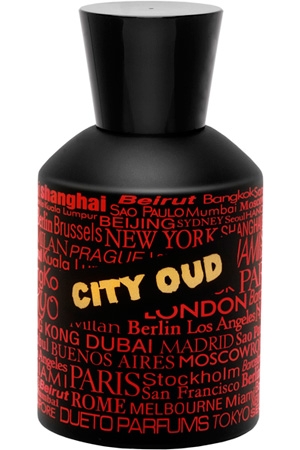
In contrast to the sporadic appearance of city names in the collections of several niche houses, a couple of new ventures have made cities the very basis of their entire oeuvre. Dueto, founded in 2010, boasts a grand total of four perfumes, the bottles of all of which are covered with a sort of city name wallpaper with dozens of different cities listed. Dueto's concept is that of the global city: we are all connected in our urban sprawls, wherever they happen fortuitously to be. It's not just that we're connected as citizens of the world, as the Stoics of ancient Greece maintained in espousing cosmopolitanism. No, we're connected in coolness, as is indicated by the names of the perfumes: City Oud, City Love, Lady Cool, and Golden Boy.


If the individual perfumes are not distinguished by specific cities, then why are cities' names on the bottles? one may with reason ask. The answer, to reiterate: globalization is this house's concept. I'm not entirely sure that pasting the names of some finite number of cities on all of the bottles of perfumes of a house is likely to be an effective marketing tack, but then again, what do I really know about marketing? I do know that Dueto currently has a promotion running through which a free smartphone case will be yours with the purchase of one of their perfumes. This is starting to look like a gimmick run amok. But who knows? Perhaps their perfumes are masterpieces. On ne sait jamais...

The crown for the most place-name launches in the shortest period of time has been usurped from Bond no 9 and now belongs to The Scent of Departure, the house recently founded by Histoires de Parfums' own Gérard Ghislain, who apparently ran out of literary inspirations a while back, having switched to the most literal of all possible names for his tuberose trio: Tubéreuse 1, Tubéreuse 2, and Tubéreuse 3—although it's true that descriptive subtitles were also given to the perfumes, presumably to prevent confusion. In my testing, I did not find those descriptions (respectively, Capricieuse, Virginale, L'Animale) to be accurate to my phenomenological experience of these perfumes, so the subtitles ended up being more confusing than helpful. The only way that I can remember which one is which is to go back and read my reviews...

In any case, Scents of Departure already boasts 19 perfumes, each said to be a destination for olfactory departure to be accessed through spritzing a bit of the named perfume on. This is gimmickry beyond belief. Does anyone think that cities smell like perfumes? Bond no 9 stretched credulity with its concept of mapping scents on places in and around New York City—to my nose one of the stinkiest cities in the First World, certainly in the United States—but at least there were some breathers in there, perfumes representing beaches and parks and gardens, all of which do have various kinds of scents. What, pray tell, does Dubai smell like? In reality, all big cities are teeming with all manner of smells. And yes, they are mainly smells, not sources of olfactory delight.

I recall that some perfumistas used to chide Bond no 9 as a tourist house, but that distinction, too, has been stolen away by The Scent of Departure, although Bond no 9 made a valiant effort to hold their own on that front with its series of I Love NY launches featuring no less than the t-shirt logo itself and offered at a slightly reduced price so as to be more accessible to, well, tourists. At one point they were even running a promotion offering a free t-shirt with the purchase of one of the bottles of I LOVE NY perfume.  


The Scent of Departure perfumes are modestly priced—well, okay, they're actually cheap relative to niche standards—which is bound to raise skeptical brows among niche snobs: $45 for 50ml? That would be a no-go for most people who frequent L'Artisan Parfumeur, Montale, Frédéric Malle, and the like. In fact, that price is so low that one suspects that the juice inside may be even less worthy than middling mainstream designer launches.

I have not tested any of the recent flurry of city perfumes (from either The Scent of Departure or Dueto), and I cannot decide whether I should. In some ways I'd rather protest with my wallet to gimmickry gone grossly awry by buying one really good perfume rather than a bunch of mediocre samples which will end up depressing me about the Fall of Western Civilization all over again. Maybe I'll test all of those fragrances after I've finished the Montales, the Kriglers, the Illuminum, and the Boadicea the Victorious perfumes waiting patiently in my queue. See you in 2014, The Scent of Departure, by which time either you'll have 60 city perfumes in your collection, or you'll have shuttered your store.


Are Perfumes of Place a Rejoinder to Flanker Madness?

The big houses have not generally (Guerlain being a noted exception) felt the need to get in on this particular gimmick game. After all, they have infinitely proliferating flankers to peel off of their massively marketed bestsellers, which provides a built-in name and new-launch generator. One takes the name of the original perfume, say, Dior Poison, and simply tacks on an adjective: Hypnotic Poison, Midnight Poison, Pure Poison. Of course, those perfumes were only nominally flankers, as each was entirely distinct and became an independently iconic perfume.


The real Poison flankers—flankers in name and spirit—were the second-order creations, whose names were made from the original names by attaching words such as “Elixir” to produce: Pure Poison Elixir, Midnight Poison Elixir, and Hypnotic Poison Elixir.

The most flankerized Dior perfume appears to be Addict, which has spawned Addict to Life, Addict Dior Twist, Addict 2, Addict 2 Eau Fraîche, Addict 2 Logomania, Addict 2 Sparkle in Pink, Addict 2 Summer Breeze, Addict 2 Summer Litchi, Addict Eau Fraîche, Addict Eau Sensuelle, Addict Shine, Addict Summer Peonies, Addict Limited Edition Collect It, and of course the eau de parfum. There also appears to have been a second, separate launch of a perfume by the name of Addict Eau Fraîche—just to keep Addict addicts on their toes (forget their nose...).

It seems clear that such flankers are intended to be one-bottle wonders, purchased once and then forgotten as new flanker launches capture the Addict-devotee's attention. It is their loyalty to the original Addict which must keep consumers coming back again and again to buy these new short-marketlife perfumes, because they are never around long enough to create a following of their own.

Other houses have engaged in massive flankerization of their most popular perfumes as well, including Calvin Klein, which since becoming a page in the Coty Prestige portfolio appears to be vying for the flanker folie award. All of the original, classic Calvin Klein fragrances have been flankerized, with CK One and Eternity having spawned, respectively (as of today...) 18 and 13 offspring, although if one counts the Eternity Man spores, then Eternity would win with 22 flankers covering both genders. (This comparison makes some sense because CK One is a unisex fragrance.)

Who needs place names with a virtual infinity of potential flankers, all of which sail on the tail of the wave of marketing success of their namesake? Given the proven economic efficacy of the flankers based on their famous perfumes, for a house such as Dior or Calvin Klein to begin by naming brand new perfumes after places doesn't make all that much sense. It is the name of the already famous perfume which the names of flankers are intended to evoke, filling the consumer with a warm feeling likely to generate a fumbling about one's purse or wallet in search of a credit card.


The geography idea has somehow, nonetheless, managed to infect even a few designer houses. Donna Karan, a mainstream house now under helm of the Estée Lauder Group, has gotten in on the place name game with four recent launches of Be Delicious LOVE THE WORLD apple perfumes said to be city-inspired: Rio, London, Paris, and New York. Isn't Rio de Janeiro the site of a documentary film about people who live in the garbage dumps situated around the perimeters of the city? So is that the scent of Rio, and if not, why not?

The Be Delicious apples had already been massively flankerized—by my count 19 times before the Cities series, which, inching ahead of Calvin Klein Eternity, brought its flanker total to 23 as of 10pm EST on October 5, 2012. If one gimmick is good, then are not three gimmicks three-times better? appears to have been the brilliant deduction of one of the marketing masterminds at DKNY—or perhaps all of the big ideas now erupt out of the Estée Lauder nerve center.

So why should an apple be associated with London, Paris, or Rio? Your guess is as good as mine. The concept is further confused by the visible name New York as a part of the name of the house: Donna Karan New York on all four of the flanker boxes. I suppose that in three of the cases the first could be the departure and the second the destination city, à la Guerlain's Voyages Olfactifs: Paris and New York, Rio and New York, London and New York. The fourth one just seems redundant. Or maybe it's a cleverly coded message that New York is where everyone really wants to be? Which brings us back again to Bond no 9. Oh well.

At this point, I think that it is fair to say that the Be Delicious flankers have essentially become disposable perfumes: one bottle will outlast the production cycle and is all you're ever going to get of these launches, so if you fall for one, you'd better stock-up early. I don't want to make sweeping generalizations about the quality of the Be Delicious perfumes, as I have yet to muster up the courage to test any one of them, but I suspect that they are not the sorts of compositions which inspire profound reverence among wearers. Perhaps I am wrong.


Multilauncher Madness?

For the multilaunchers, there are plenty of alternatives to the place-naming game. Montale perhaps offers the example of the least creative effort invested in naming. Produce a name by simply pushing together two nouns or adjectives which can be said to apply to the perfume inside—even in some vague or tenuous sense, but often in a most literal way. I confess that I have lately fallen prey to the Montale sample game, which involves acquiring as many Montale samples as possible to be able one day to say that one really knows this house. As a consequence, I happen to have lots of their unimaginative names ready at hand.


Montale Santal Wood

Montale White Musk
The good thing about Montale, of course, is that they actually produce quite likeable perfumes. They embody a predictable quality which keeps customers once hooked coming back for more and more, and the range is so vast that one cannot become easily bored. True, there is a lot of repetition, but I'm not convinced that this is a matter of concern in the case of Montale. Whichever “Aoud” perfume you choose will be closer to another Montale Aoud perfume than it will be to anything else, but no one ever said that each creation of a house had to be entirely unique, and the proliferating launches convey a different marketing philosophy altogether: profligacy over parsimony! If I may be so brazen as to paraphrase Montale/Shakespeare himself:  If some is good, is not more better? 

In reality, more is sometimes less, when it is created through the sacrifice of standards and the type of gestation period apparently common to most of the great perfumes of the past—back in “the good old days,” as vintage perfume lovers are wont to lament, reminiscing upon the time when a perfume launch was a bona fide event, rather than the metaphorical equivalent of a tweet.


The guiding idea behind all of the multilaunchers' efforts seems to be to produce a large set of fine niche perfumes into which consumers can dip with some confidence that they will be happy even with a blind buy, having once ascertained the quadrant—or octant—in which their preferences generally lie. It wouldn't really help consumers if Montale's perfumes were all completely unique, since no individual can possibly wear 60 or 80 or 100 different perfumes, so there's no real need to have them all. No, a couple or a few Montales will fill that Montale need quite well until those bottles have been drained. In the meantime, Pierre or Ammar will have produced a dozen or so more creations to satisfy the consumer's simultaneous yearnings for consistency and newness in one fell swoop.

Illuminum, a new British house, has pretty much followed Montale's lead, christening its perfumes using the same simple pairing system to produce such names as Black Musk, White Musk, Black Oud, Rose Oud, Vetiver Oud, White Lotus, White Saffron, Saffron Amber, White Gardenia Petals, etc. Established in 2011, this house already has a collection spanning 33 perfumes!

When you're out to compete with Montale and Bond no 9 in frequency of launches, other types of naming require too much work, it seems. Or perhaps one might surmise, more charitably, that more creative energy is being channeled into perfume composition than the advertising. Hope springs eternal. In reality, that's not such a good argument, because the people designing the bottles are not the same people designing the perfumes, so there's no reason for thinking that the two are somehow in competition with one another. The beautiful bottles used for mainstream fragrance launches do not cut into the perfume composition budget, which stays measly whether the bottle looks good or not.

Similarly, it does not seem to me that creative perfume naming in any way precludes creative perfume composition—nor on the other hand does it ensure it. The tendency appears to be to spend a lot of time on the concept and to wheel in a nose for hire to produce a scent—in time for the intricately orchestrated launch—which can be said in some sense to reflect the name. After that, the whole production is “revealed,” if you like, as a package to a broad sea of disparate consumers, some of whom are shopping for names, labels, and bottles, and others primarily for scent. Certain self-styled purists of course claim that they care only about the scent inside the bottle, but such a position is not obviously coherent, if in fact the reason we value perfume is, above all, for the pleasure it provides.

Surely the pleasing packaging can only contribute to the quality of the overall experience of holding a smooth sculptured bottle, removing a shiny weighted cap, spritzing the perfume on and perceiving how the notes and layers unfurl. Just as an excellent meal tastes better eaten off a porcelain than a paper plate, and a cup of coffee tastes better from a beautiful glass mug than from a styrofoam cup, it seems that perfume, too, should smell somewhat better when it has been properly stored and dispensed from a container equal in beauty to the liquid inside. Bottles, in other words, do seem to matter to our experience, and if they do not they should, it seems to me. Who wants to eat haute Italian cuisine using a plastic fork? I ask most sincerely.


Notes and Place Names as Metaphors

Getting back to the geography question: what in the world is going on here? Why the obsession with places all of a sudden? The jaded, crass view, of course, is simply that geographical locations offer a quick and easy way to generate names for a variety of distinct perfumes without too much creative input on the part of the marketing whizzes writing jingles and fabricating the names of new metaphorical notes behind the scenes at perfume houses.

Names are suggestive metaphors no less than are notes. We are told of the alleged notes of a new perfume in what are clearly intended to be poetic terms: cashmere wood, sparkling aldehydes, ... But even more literal-sounding “notes” are metaphors no less than are the names of perfumes said to have been geographically inspired. Does a perfume with “London” or “Paris” or “New York” or “Tokyo” in its name evoke memories of those places? Perhaps not in cases where the city is one with which the wearer has no familiarity, but even then, the name of a city famous enough to be included in geographical perfume series tends to evoke memories of imaginings informed by media images of the place.

Paris Las Vegas!
Place names gesture toward a hypothetical dreamscape where we might visit in our minds as we reflect upon the perfume. In this way, geographic names for perfumes convey a truth about the olfactory globe itself, a veritable parallel universe explored only by fragrant travelers who consider the value of perfume to inhere in the memories and associations it evokes, not in the approval or attention which it may be used to garner from other people.

The real mystery is why niche houses have felt the need to generate so many names so quickly. It seems that they have myopically decided to join in on the multilauncher craze, the strategy of which appears to be to produce so many different perfumes that every potential customer will be able to find at least one to his or her liking. 

In other words, what appears to be prodigality really has a pragmatic basis, grounded in the indisputable fact that different people like different “notes” and genres of perfume. If a house creates one single perfume, even if it is a masterpiece, there will be people who dislike the creation because of what it contains. Patchouli phobes exist. Violet phobes, aldehyde phobes, even rose phobes exist!

Niche perfume houses are trying to launch many different perfumes rather quickly in what seems to be an endeavor to be able to compete with the big houses as they rule the flanker game. But I sincerely wonder whether niche houses are not sabotaging themselves by putting out so many perfumes in such a short time that none of them is likely to enjoy sufficient market success to justify keeping in production.

This is a separate concern, purely pragmatic, about how niche houses can possibly win the multilauncher game against the corporate giants LVMH, Coty, Procter & Gamble, L'Oréal, and Puig, which seem intent upon swallowing up most of the perfume market one chunk at a time. The more substantive concern is whether niche houses are undermining their own ostensible raison d'être by spending less and less time on the composition of their new launches, which seems to be a mathematical inevitability, given their relatively small staffs and budgets.

Niche houses were born out of a desire to offer specialized, high-quality offerings with a cachet of exclusivity. When a house launches 20 perfumes in one fell-swoop, it's hard to believe that any of those perfumes could be truly original or exquisite. Perhaps one or two of them will be, but how many consumers (aside from the more OCD-afflicted perfumistas among our numbers...) will bother to give all of them a sniff?

The number of new perfume launches per year—having exceeding 1,000 in 2011 and continuing to grow—has reached the point where perfumistas may simply throw their hands up in despair, having recognized that their once noble goal of mastering knowledge of the perfume world has become a fully quixotic dream verging on delusion. No finite person can really keep up with the frequency of launches today. Even if one attempted to review three perfumes each day, that would still leave new perfumes unsniffed by the end of the year. Why bother? Who can remember them all? Who really cares?


The Bottle Half-full

Perfume sampling can be viewed, in fact, as a form of travel through the olfactory universe mapped out in greater and greater detail as more regions of formerly uncharted territory become appropriated in identifiable perfume forms. As multilaunches—of both designer flankers and niche series—continue to proliferate, more and more push pins become concentrated in more and more areas until every new launch must be squeezed into an already crowded corner, making it seem less and less likely that iconic perfumes can still be produced.

There are only so many qualities which one can put together in a perfume and expect people to wear. When compositions become too extreme, they simply become unpleasant, and no matter how original they may be, they are bound to founder sooner or later. True, radical concepts may enjoy a short-term success as the novelty value sustains sales, but no one is really going to be draining multiple bottles of them, so once everyone's curiosity has been satisfied, they'll go back to buying wearable perfume until once again their interest is piqued by the latest Big New Thing.


Ultimately, whether we are excited or disgruntled by the flood of new launches, including the new geography-inspired perfumes, will depend upon what it is that we are looking for in perfume. As the launches have proliferated, so has the sampling frenzy, with many perfumistas seeming to spend much of their fragrance wallet share on small decants and samples, rather than investing in full bottles. Have we become promiscuous because of the frequency of launches? Or are these perfumes being poured out so swiftly because of our sampling madness? Montale, Bond no 9, Keiko Mecheri, Boadicea the Victorious, and brand new houses such as Illuminum and The Scent of Departure are offering so many choices that we may find it difficult to commit, enticed as we are continuously by the new perfumes on the horizon waiting to be sniffed.

There is something admirable about wanting to know as much as possible about any area, including perfume, and with more and more new houses appearing, and more and more perfume being pumped out, perhaps the world of perfumistas will eventually subdivide into genre specializations. It might have been possible to be conversant will all of the important new launches in Paris back in, say, 1950—or even 1980. Is it possible today? Probably not as a hobby. Maybe only people who give their lives over totally to perfume sniffing are going to be able to achieve a real competence in the field.

For now, we have thousands of dilettantes sniffing whatever they happen to come across or whatever happens to grab their attention long enough to justify acquiring a sample, and publishing their opinions on the world wide web as though they were authorities. But of course they are no less than is anyone else, it seems to me. As of today, the Parfumo database contains nearly 21,000 perfumes, and that number continues to grow. Is there an end in sight? At some point, sooner or later, perfumistas are going to arrive at the conclusion that thousands upon thousands of perfumes are simply not worth our time. But which are the ones most likely to capture our attention? Those which are mass marketed in blanket media spam campaigns, of course.

Niche houses served in the past as an oasis, a repository of composed perfumes created by people with ideas transcending the curriculum of M.B.A. programs. I do believe that a few good perfumers are still putting out creations just as in the good old days, but it must be incredibly difficult for them to survive, which is why whenever we have the chance, it would behoove us to support the independent houses, since we know that “someone is home.” Where there is a perfumer in the house, let's do what we can to prevent him from becoming homeless.

Whatever may happen to the perfume world in the future, we will not have lost anything but some petty cash in traveling around the olfactory world sniffing one creation at a time, even if much of what we smell seems redundant. The real world, too, is filled with redundancy, but we can connect the dots from one destination to the next according to our own ideas and past. What else could we do?

No matter how much vat-produced mediocre juice is poured out, this will not prevent true perfumers from plying their trade. It's left to us only to seek them out. The overwhelming number of new launches—among even the niche houses—makes it more challenging to locate worthy perfumes, but it also makes it more rewarding when we do. Just as we can learn by traveling around the real, geographical world, through the process of traveling down what may sometimes prove to be dark alleys of perfume, we will have learned something, too.