Showing posts with label geography. Show all posts

Saturday, March 2, 2013

The End of Perfumery as We Know It? A Ciceronian Response


The “-ization” of Perfumery

I love to explore perfumes by house. My preference is to experience a cluster of offerings and see whether there is a theme or an approach or a style running through them, such that it becomes possible for me to have a basic grasp of the house's outlook or vision. This is becoming more difficult to do than it was back in the twentieth century for houses such as Guerlain, Acqua di Parma, and Dior, for a variety of reasons. François Demarchy, the head perfumer at LVMH, signs the perfumes of some of the formerly independent houses now operating under the umbrella of the conglomerate. Guerlain, however, has changed quite a lot for another simple reason: Thierry Wasser is not Jean-Paul Guerlain. On top of all of this administrative upheaval, nearly all twentieth-century perfumes seem to have suffered under reformulation, as perfumers “struggle” (more on this below...) to comply with the restrictions imposed by first the IFRA and now the European Union.

Some of the smaller—but still relatively big—houses, too, have been subsumed under the management apparatus of larger companies with the result that the offerings of formerly independent lines such as Marc Jacobs and Vera Wang, both currently under the aegis of Coty Prestige, appear to be moving closer and closer together through a compositional convergence process which may have something to do with the now shared sources of aromachemicals being produced by and coming from the same factories. I have noticed some convergence of patterns in the cases of Jean Patou and Rochas as well, which seem to have begun when they were added to the Procter & Gamble portfolio. The way in which the perfumes under such corporate umbrellas are being marketed also appears to be undergoing a process of homogenization.


Similar forces may be acting upon Guerlain and Dior, despite the fact that the creative director is not the same in those two cases. In addition to owning Sephora, LVMH is the overlord of several other formerly independent and quite distinct houses as well. Some of the trends which I've noted, such as the use of solid plastic sample vials, are no doubt superficial. Someone at LVMH thinks that it's better to protect the liquid inside than to use transparent glass, despite what are arguably the latter's aesthetically superior properties and practical superiority to the consumer, insofar as it is possible to see exactly how much—if any—liquid is really contained within the vial. The opaque plastic sprayers often seem to be defective and even more often contain an unexpectedly small amount of perfume. But, again, these sorts of practical business matters do not necessarily reflect anything about what is going on at the perfume end of things.

However, other trends, such as the rampant flankers being launched after the namesakes of the once-classic perfumes of both Guerlain and Dior do seem to have effects upon the world of perfume proper. I have not seen any Mitsouko or Diorissimo flankers yet, but Shalimar and Addict flankers abound, and all of the newer perfumes seem to be launched in waves of flankers: Insolence, Insolence eau de toilette, My Insolence, Insolence Eau Glacée. Insolence Blooming, Insolence Shimmering Edition.... Idylle, Idylle eau de toilette, Idylle Eau Sublime, Idylle Duet Rose-Patchouli, Idylle Duet Jasmin-Lilas. Idylle extrait de parfum, ...


Shalimar and Flankers

The mediocre quality and staggering number of Shalimar flankers does not inspire confidence in the once-glorious house of Guerlain: Fleur de Shalimar, Eau de Shalimar 2008, Eau de Shalimar 2009, Shalimar Initial L'eau, Shalimar Parfum Initial, Shalimar Parfum Initial L'Eau Sensuel, Shalimar Black Mystery 2007, Shalimar Eau de Parfum 2009, Shalimar Edition Charmes Eau de Parfum, Shalimar Fourreau du Soir, Shalimar Légère, Shalimar Ode à la Vanille, Shalimar Ode à la Vanille Sur La Route de Madagascar, Shalimar Oiseau de Paradis, Shalimar Parfum Initial à Fleur de Peau, Shalimar Talisman Byzantin. Shalimar Yellow Gold.

All of this flanker folie might not be a matter of concern, were it not for the unfortunate fact that the once-classic perfumes, including the original Shalimar, all appear to have been serially reformulated and some appear even to exist simultaneously in different versions marketed to different niches. Do the Guerlain boutique bottles of Shalimar contain a different perfume than what is found at discount drugstores such as Walgreens and CVS? I suspect that they do, and rumors to that effect abound.

What in the world is going on here? Why would a company do such as thing? Well, because they know that most of the people who purchase perfume at the Guerlain boutique know a thing or two about perfume, or at the very least are used to wearing the real thing, not some muzak facsimile tantamount to a flagrant act of self-desecration. As versions proliferate, the Tower of Babel problem of communication—already bad, given that we all seem to have divergent tastes and variable sensitivities to the many different components of perfume—can only grow worse.

As a business strategy, I cannot find fault with the practice, if indeed it is one, at least not in the short term. In the long term, however, I fear that such tactics are bound to lead Guerlain down the not-so-felicitous path taken by Coty and Halston before them. Coty did manage, it appears, to rebound financially from its early missteps by creating the Coty Prestige division and acquiring many well-regarded designer names. But Coty renounced its status as a great perfume house long ago, and there has been no looking back. Coty is a successful company not for creating great perfumes—though they did once upon a time—but because they have managed to sell lots and lots of mid-range and bargain bin bottles to many, many people over the years.

Guerlain and Dior bore the cachet of exclusivity in the past, but that glory has been slowly abraded by their very own practices in recent years. True, each of these houses has its niche-esque branch producing exclusive perfumes targeting more sophisticated perfume users separately from their big-profit mainstream launches. Nonetheless, I am finding it harder and harder to take these niche-esque launches very seriously. Many of them strike me as little more than gimmicks.

Guerlain Muguet is sold only on May 12th, for about $600 a bottle. Lily of the valley can only be constructed, so the perfume is obviously synthetic. No one is traveling to the ends of the earth to collect tiny, delicate, white bell-shaped lily of the valley cups for enfleurage in fresh goose fat by artisans back at Grasse. No, it is created in a lab. The mainstream launch Idylle is also a lily of the valley perfume, which costs about 10% of the price of the special edition “niche” perfume Muguet. I'm afraid that in this case I cannot find fault with one astute reviewer's plaint (at Fragrantica):

And I do think this "only for sale one day a year" concept is ridiculous. And for $580 it should include a big, juicy man to spray it on me whenever needed.

Guerlain issued a preemptive response to complaints on the part of such curmudgeons with this public relations statement to Allure magazine in May 2012:

"It's not the lily of the valley that's expensive; it's the addition of natural extracts," says perfumer Yves Cassar -- in this case, rose and jasmine. "These flowers require many petals to produce a tiny bit of oil."

Nice try. So why does this perfume cost five times more than either Nahéma or Chamade, both rose perfumes from the very same house? Why does it cost five times more than Chanel no 5, said to contain a fair dose of the precious natural jasmine of Grasse? In fairness, I should add that the 1,345 special edition bottles of Muguet for 2012 were decorated with “a removable green-glass-and-gold necklace from Gripoix, a 143-year-old jewelry house in France.” So the ultimate explanation of the price would seem to be not the natural jasmine and rose essences, but the bling.

At the same time that such gimmicks as necklace-wrapped bottles continue in a steady stream, the price of regular Guerlain perfumes has been plummeting, as they have flooded the discounter market. A 100ml bottle of Eau de Cologne Impériale can now be had for $40 or even $30, if one shops around. The Mitsouko reformulation, too, seems to be foundering, as bottles can be had at any of the discounters for a fraction of the original MSRP, which, I might add, was never anywhere near the prices being asked by Guerlain for the “niche” launches.

When I see such developments, I wonder, at the first level, how such companies can be both mainstream and niche, business savvy and artistically driven, at the very same time. The evidence is to me overwhelming that the suits have a lot more to say about what is going on at these houses than do the creative directors and the perfumers themselves. Or is that these days the creative directors and perfumers are business people first, and designers only second?

I also wonder about developments such as the “Private Label” phenomenon. Perhaps this idea originated at a board meeting of the Estée Lauder group, since not only the eponymous house but also that of Tom Ford, subsumed by the same group, have pursued this strategy with what appears to be resounding success. The first question which came to my mind upon encountering one of the Private Collection perfumes at Estée Lauder, Tuberose Gardenia, was: why do they cost more than the perfume whose name is Private Collection? Can someone please explain this to me?


To be honest, I've always found this sort of two-tier strategy to be in some ways preposterous. It may have started with Calvin Klein—a trendsetter in so many ways and in so many different realms, including perfume—who began mass-marketing jeans to a Levi's-obsessed culture now quite some time ago. Calvin Klein jeans never cost much more than Levi's, and yet they carried with them the prestige of a fashion designer, rather than the homey comfort of a dry goods store, and this, I believe was the secret to their success.

The colonization of the mass market by famous designers has approached ubiquity by now. But the nagging question remains: if a designer of haute couture has a line also at HLM or Target, does that not demonstrate that their designs can be effectively executed for very little money? So what accounts for the difference in price? In the case of perfume, the suggestion—usually implied but sometimes explicitly stated—is that the ingredients used in the “private” perfumes are far more costly and rare than those used in the “public” perfumes. Still, a puzzle remains: does not the success of the latter demonstrate that such costly ingredients are in fact dispensable, unnecessary to the production of great perfumes? Or perhaps the entire pretext is nothing but a lie. Think, again, of synthetic lily of the valley: how expensive can it possibly be?

Beyond the seeming illogic of claiming both exclusivity and accessibility to the masses under the very same label, I continue to wonder about it as a marketing strategy. I am reminded in some ways of Starbucks' decision to begin producing instant coffee, thereby cutting into their very own profits on the piping hot liquids served up at the cafés by real-live baristas. The explanation in that case is, I imagine, that some people are satisfied with instant coffee and prefer not to leave their homes or offices. But of course most people who drink instant coffee, drink cheap instant coffee, and the very thought of a cup of instant coffee may be anathema to those who drink real coffee such as Starbucks and related coffee dealers purvey. At the same time, the people who drink instant coffee are not about to pay $1 a cup to do so, which is about what the Starbucks packets cost at MSRP. Even purchased on sale, the packets cost multiple times that of a cup of Folgers or Taster's Choice crystals spooned from a glass jar.


Starbucks also partnered with Tassimo for a time (or maybe that's misleading, since they both appear to be owned by Kraft at this point, which for all I know may be owned by General Electric, which for all I know may have joined forces with Citibank by now...), offering coffee discs to be used in the home with the patented Tassimo machine to produce coffee said to be just as good as creations produced by live baristas at the store. I was “gifted” a Tassimo machine by the Gevalia company, oddly enough, after having ended my subscription to their coffee service some time before. The logic appeared to be to coax me back to Gevalia with this new machine, for which I would naturally need some discs, if I were to use it.

I did not bite, but I did indeed acquire some discs of Starbucks coffee and for a while was using the machine on days when I wanted a very quick and clean coffee preparation. The big virtue of the machine is that it produces no mess whatsoever, unlike my favored methods of pump expresso maker, Melitta drip filter, or Bodum French press. Is the coffee produced by a Tassimo machine as good as a fresh cup from Starbucks? No it is not, but it is pretty good, good enough, perhaps to have motivated Starbucks' termination of the relationship.

I was surprised to learn that Starbucks subsequently teamed up with Keurig, which has taken over the quick-brew-at-home market, it seems, though I must say that I was very unimpressed by the sample of Keurig coffee which I was offered one day when walking through Sears to enter the mall where I then proceeded to stop at Starbucks for a real cup of coffee.

What does any of this have to do with perfume? you may not without good reason be wondering. I see these as business tactics, one and all. I do not believe that Tom Ford Private Collection perfumes cost any more to produce than do Tom Ford Public Collection perfumes, though they cost four time more to own. I am basing this bold conjecture on a few recent testings of some of these perfumes, the most unbelievable of which to my nose was Tom Ford Neroli Portofino, a glorified version of Mauer & Wirtz 4711 Original Eau de Cologne. The two creations do not smell identical, and I own that the Tom Ford is probably a bit better, but it commands something like fifty times the price of the traditional eau de cologne launched back in 1792.


Perfumery Placed in Perspective

The “bling thing” obviously works, and I have no principled objection to bling, per se. While bling is not perfume, there are concept houses, I'm thinking especially of Bond no 9, for which bling is an essential part of their image. I don't have a problem with that. If bling makes some people happy, then bling is good. My point in the above critique is only that traditional houses such as Guerlain have been changing their strategies to focus more on bling and less on perfume.

Perfumery is firmly anchored in the world of companies and commodities. People buy and sell perfume just as they buy and sell any number of other things for all sorts of different reasons. What makes perfume unique among all commodities is that the liquids themselves—within the bottles, however they may be marketed—map out a distinct world of their own, a parallel universe, if you will: the olfactory universe. This is a universe unknown to the vast majority of people, because they do not think of perfume in any but functional terms.

The apparatus which sustains perfumery is intimately connected to this functional outlook, regardless of how religious perfumistas may begin to become about the object of their love. Perfume houses are run for the most part by business people, who enlist perfumers to produce market-worthy products for them to sell for profit. Many of these business people could be selling literally anything: zippers and buttons, cars and boats, cereal and milk.

This fact is easy to see in the strange partnerships formed in recent years as corporations have grown larger and larger, swallowing up all sorts of ostensibly disparate businesses into one über-entity with the power to squelch most competitors emerging from below. A favorite example of mine is Unilever. Believe it or not, Breyer's, once noted as an independent source of excellent ice cream, is produced by Unilever, famous especially for products such as body wash and deodorant.

In perfumery, one of the biggest stretches may be Procter & Gamble, which added the historic houses of Jean Patou and Rochas to its portfolio, leading many to fear the progressive toiletrification of the perfumes of those houses, a fear which may have been justified, given what happened in the reformulations of some of their perfumes. The general approach of the corporate sharks at places such as Proctor & Gamble and Unilever is ruthlessly to maximize profit. “Swim or sink” is the governing philosophy, and when a subsumed entity such as Rochas does not pull its weight, it will lose the protection of its “guardian” in short time, as was reported by some fragrance community members to have happened a while back, although this was never confirmed and may not be true... at least not yet.

These corporate realities are obviously not going away during our life time, but one nice thing about the world of perfumery is that it has an existence independent of that realm. There are no doubt plenty of perfume hacks, but there are also people who create beautiful perfume as an expression of their unique creativity. When the corporate takeovers begin to seem overwhelming, I pause to think always of the independent perfumers who against all odds continue to create original elixirs for us to enjoy. How they manage to stay solvent is a testimony not only to the excellence of their work but also to their belief in what they do.

I do not, however, naïvely believe that all niche houses are oriented toward the production of excellent perfume. My impression, especially in the last couple of years, is that self-proclaimed niche perfume houses have been rapidly proliferating like rabbits for the same reason that investors turned to cell phone developers some years back, anticipating the ever-greater role that such devices would play in people's lives. Being “niche” has itself become a sort of sales strategy or gimmick.

In the case of perfume, the advent of online fragrance community websites which permit people to converse and educate themselves about perfume has evidently been recognized by a number of savvy entrepreneurs, and new houses continue to emerge as the community of self-proclaimed perfumistas continues to expand. The avalanche of new launches is the result of a combination of factors, one of which is surely the sheer number of new niche houses whose ventures involve the production of a set of perfumes to coincide with the creation of the house.

I do not envy the struggle of artistically driven perfumers as their professional world becomes progressively populated by profit mongers who have arrived on the scene to seize upon this moment in history to benefit from this relatively new cultural fascination with perfume. The numbers are still small, relative to the other market niche populations for just about any other product, but the potential for growth is enormous, given the evident allure of perfume for people from all walks of life. The promotion of perfume as a luxury product potentially as profitable as upper-echelon timepieces or fine leather items—or even fine wine—does seem to hold a great deal of promise, in part because modern people have become fashioned to some extent into epicureans, unbeknownst to themselves.

Witness the very creation of the Food Network, an entire television channel dedicated to the art of food! Every middle class housewife today is familiar with trendy phrases for gourmet cuisine ingredients such as EVOO (extra-virgin olive oil), when only a couple of decades ago, those same women would have been firmly entrenched in Hamburger Helper and canned vegetables territory. The world of food has changed in part because of the opportunities laid out before us at supermarkets.

We can buy better food today for less money, and for this reason alone people's tastes have evolved. They may not change fundamentally—someone who hates anchovies or eggplant always did and always will—but the nuances and subtleties which even average people are now capable of appreciating has a great deal to do with what has been made available to them by business people attempting to profit from these new manufactured desires.

To return to the case of perfumery, I have to say that I do not understand many of the recent developments at all. Let's take, once again, the IFRA restrictions. As far as I know—and please correct me, if I am wrong—the IFRA is a self-regulating body comprising people from the perfume industry. So how can perfume houses blame the IFRA for the restrictions, if they are ultimately self-imposed? Now that government bureaucrats have gotten in on the regulation game, the rules are obviously going to change, and it's a whole different story when laws start being imposed with penalties for failure to comply. Nonetheless, before the bureaucrats began their officious meddling, the IFRA was a body of perfume professionals issuing guidelines to themselves, was it not?

All of this reminds me of a Twitter which I saw flitting about the world wide web a while back. Guerlain was sending out a message to the effect that Mitsouko was going to be reconstructed by Thierry Wasser and brought back to its former glory. Please correct me if I am confused in my logic here, but if it is true that it is possible to bring Mitsouko back to its former glory, then it is false that Guerlain was forced to reformulate the perfume as a result of the IFRA restrictions. By sending out that message, Guerlain effectively convicted itself of duplicity. Is it true, or is it not true that the mangling of Mitsouko was a result of an attempt to comply with IFRA restrictions? If it is possible to bring the perfume back to its former glory, then it is obviously false that it was ever necessary to mangle it in the first place. QED.


A Ciceronian Response

Enough lamentations. There is probably little if anything that any of us perfumistas can do to stop any of the above enumerated nonsense. The time has arrived at last, therefore, to adopt the approach of Cicero—both a Stoic philosopher and a statesman—and invert the Necker cube or switch our attention to the bottle half full. When one recognizes that one has no power to change the circumstances in which one is mired, it becomes time to change one's attitude toward those circumstances and to adopt a new perspective. I am happy to be able to share with you, my fragrant friends, that I recently experienced an epiphany of sorts which resolved all of the above quandaries in one fell swoop.

Flankers and multilaunchers and corporate conglomerate homogenization continue on, but we can adjust our attitude toward perfume just as easily as the big houses can pump out swill. It may sound bizarre at first, but the truth is that the bottle half empty is also half full, for our lives can be enriched by availing ourselves of the opportunities for enhanced olfactory experience afforded by the sheer fact that niche perfumery has become viewed by business people as a profitable endeavor over the past few years. All of the above complaints about the state of perfumery commence from a fundamental confusion: in reality, we do not love perfume, but individual perfumes. We do not love humanity, but human beings. We do not love perfumery, but some of the products of the enterprise of perfumery.

Out of all of the perfumes being produced at any given time, we can and do love only a few. So why should thousands of irrelevant and gimmick-laden launches matter to us in the least? So long as there are a few hold-outs—and there are—perfumers who continue to create the sorts of elixirs which we prefer to wear, is there any harm in millions of gallons of vat-produced chemical soup being pumped out at factories and poured into garish hat-topped flasks? Do we complain about the existence of Spam and pork rinds, though we would never eat them? Of course not.

The massive increase in perfume production in recent years is analogous to the explosion in recent decades in interest in wine, especially in the United States. While wine has a rich history in Europe, it took a while for it to be recognized as the beverage of choice to be imbibed with meals in this country. Today, wine connoisseurs abound, and perfume connoisseurs, too, are on the rise, for the very same reason. We are fortunate, I believe, to have these new universes to explore, and I mean that quite literally.

The olfactory universe has always been filled with smells, but in recent times it has become inhabited by more and more perfumes. We can travel through the olfactory universe by sniffing perfumes one after the other and pushing another pin into the grand olfactory map, penning reviews along the way. In this way of viewing perfume testing, not every perfume is a “final destination”, a place where we feel prepared to hang our hat for more than a very short time. No, the new, ever-more densely populated perfume world is full of dead ends and dark alleys. But how could it not be? So is the real world. We can travel through both of these universes with the expectation of learning more about ourselves and the inhabitants of these worlds. We may not need to revisit some of the places we've been, but we will have grown through the journey itself.


Just as world travel is not the same thing as looking for a home, we can test perfumes for the experience and then move on. The fact that a place to which I have traveled is “a nice place to visit but I wouldn't want to live there” does not make it any less valuable to have seen. And the same is true for perfumes which I may never choose to wear again, but from which I learned something though I wore it only once, even if only that I immensely dislike a certain combination of notes.

Perfumes and places and persons are all analogous in this regard, which can be seen by considering a third metaphor, that of personal relationships. We do not wish to marry every person whom we meet. Nor do heterosexuals or homosexuals wish to marry half the people whom they meet. Indeed, most of the people whom we will ever encounter will not rise above the status of passing acquaintance. We can regard perfumes in precisely the same way.

There are people who still today prefer to have a single signature scent, but perfumistas seem to be considerably more promiscuous, always on the look out for new prospects, so to speak. The fragrance community websites and Facebook groups devoted to the discussion of perfume are all encouraged by the unending flux of new perfume being poured out by the ever-expanding legion of houses.

For those of use who have moved beyond “perfume monogamy”—a strict loyalty to a single perfume or brand—the recent developments in the perfume industry, whereby some houses and perfumes may fall from our favor, simply opens up new avenues. Divorce is sometimes a good thing, permitting us to exit one chapter of our life in order to embark upon a new journey. Perfumes are destinations in one sense, but perfume testing is a journey, and we should perhaps be relieved that the vast majority of perfumes which we “visit” and “meet” are “places” and “persons” which we can do quite well without encountering ever again.

What makes a perfume special is that it stands out from the crowd. What makes the pursuit worthy is because it is so challenging in a sea of mediocrity to find something worth our sustained attention. The world is filled with things of every conceivable quality. It's up to each person to sift the proverbial wheat from the chaff and to select and distinguish true friends from everyone else. We will not and should not agree about which qualities mark a person or a place or a perfume as special. That's the beauty of heterogeneity and a reflection of human liberty.


Saturday, October 6, 2012

Perfumes of Geography: What's in a Place Name?


Perfumes with literal geographical references in their names have become quite fashionable of late. First came Bond no 9, whose founding mission and guiding idea was to “make scents of New York.” They've launched perfumes with the names of streets (Lexington Avenue, Fashion Avenue, Wall Street...) and parks (Central Park, Madison Square Park, Bryant Park...) and boroughs (Brooklyn and Manhattan, with Staten Island, the Bronx, and Queens no doubt to come!) and beaches (Fire Island, Coney Island...) and squares (Cooper, Union, Astor Place...)—and you name it (Harrods, Saks, Queen Elizabeth II, The Scent of Peace!). They even got a bit carried away—in what might however be regarded endearingly as the typical New Yorker way—with launches of perfumes whose names correspond to locations rather far from the Big Apple: Indianapolis, Boca Raton, Texas, and Las Vegas, among other places.


To New Yorkers, of course, all the world is a part of the big, melodramatic and metaphorical Broadway stage. To the rest of the country, New Yorkers may as well be for'ners—and many of them are, including Bond no 9 guru Laurice Rahmé, who in true Napoleonic style set out in 2003 to conquer the olfactory universe, one fine eau de parfum launch at a time. I mean that as a compliment, I really do. In this world of Pac-man like corporations gobbling up small houses left and right, it takes some real guts to embark on the construction of an independent perfume empire!

The geography idea soon caught on—though I must say that I haven't seen any credit given where credit would seem to be due... Of course, there have been subtle nuances in the various concepts now smattering the grand olfactory map of all perfumes present and past. 


Guerlain launched its Les Voyages Olfactifs series in 2009, the first three destinations (all originating, naturally, from Paris) being Tokyo, Moscow, and New York, the latter of which came close to encroaching on Bond territory, but hey: imitation is the highest form of flattery! In 2011, Paris-London was added to this series and, in 2012, Paris-Shanghai, so I gather that Les Voyages Olfactifs have enjoyed some market success, in spite of the fact that the original launches were offered only in 250 ml bottles.


Somehow this geography concept acquired a kind of momentum, and today several different niche houses have launched place-inspired perfumes. The Different Company recently launched Tokyo Bloom, and Keiko Mecheri has a few geographically inspired perfumes, including not only Tangeri, in the new Bespoke collection, but the set of four perfumes specifically marketed as evocative of distinct places: Tarifa, Taormine, Les Nuits d'Izu, and Mulholland Drive, the latter of which, too, seems to take its cue from Bond no 9—both in concept and compositional style. But in these cases, the isolated launches of place-named perfumes represent only a tiny fraction of the total creative output of the house—rather like the launch by Parfums de Nicolaï of New York in 1989, or by Yves Saint Laurent of Paris, way back in 1983. I should perhaps say that the name Paris appears in more than 100 perfumes, but that city is obviously a special case. And of course some of them refer to Paris Hilton!


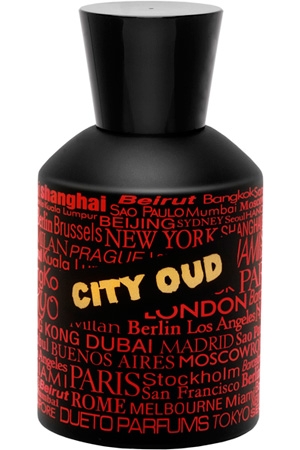
In contrast to the sporadic appearance of city names in the collections of several niche houses, a couple of new ventures have made cities the very basis of their entire oeuvre. Dueto, founded in 2010, boasts a grand total of four perfumes, the bottles of all of which are covered with a sort of city name wallpaper with dozens of different cities listed. Dueto's concept is that of the global city: we are all connected in our urban sprawls, wherever they happen fortuitously to be. It's not just that we're connected as citizens of the world, as the Stoics of ancient Greece maintained in espousing cosmopolitanism. No, we're connected in coolness, as is indicated by the names of the perfumes: City Oud, City Love, Lady Cool, and Golden Boy.


If the individual perfumes are not distinguished by specific cities, then why are cities' names on the bottles? one may with reason ask. The answer, to reiterate: globalization is this house's concept. I'm not entirely sure that pasting the names of some finite number of cities on all of the bottles of perfumes of a house is likely to be an effective marketing tack, but then again, what do I really know about marketing? I do know that Dueto currently has a promotion running through which a free smartphone case will be yours with the purchase of one of their perfumes. This is starting to look like a gimmick run amok. But who knows? Perhaps their perfumes are masterpieces. On ne sait jamais...

The crown for the most place-name launches in the shortest period of time has been usurped from Bond no 9 and now belongs to The Scent of Departure, the house recently founded by Histoires de Parfums' own Gérard Ghislain, who apparently ran out of literary inspirations a while back, having switched to the most literal of all possible names for his tuberose trio: Tubéreuse 1, Tubéreuse 2, and Tubéreuse 3—although it's true that descriptive subtitles were also given to the perfumes, presumably to prevent confusion. In my testing, I did not find those descriptions (respectively, Capricieuse, Virginale, L'Animale) to be accurate to my phenomenological experience of these perfumes, so the subtitles ended up being more confusing than helpful. The only way that I can remember which one is which is to go back and read my reviews...

In any case, Scents of Departure already boasts 19 perfumes, each said to be a destination for olfactory departure to be accessed through spritzing a bit of the named perfume on. This is gimmickry beyond belief. Does anyone think that cities smell like perfumes? Bond no 9 stretched credulity with its concept of mapping scents on places in and around New York City—to my nose one of the stinkiest cities in the First World, certainly in the United States—but at least there were some breathers in there, perfumes representing beaches and parks and gardens, all of which do have various kinds of scents. What, pray tell, does Dubai smell like? In reality, all big cities are teeming with all manner of smells. And yes, they are mainly smells, not sources of olfactory delight.

I recall that some perfumistas used to chide Bond no 9 as a tourist house, but that distinction, too, has been stolen away by The Scent of Departure, although Bond no 9 made a valiant effort to hold their own on that front with its series of I Love NY launches featuring no less than the t-shirt logo itself and offered at a slightly reduced price so as to be more accessible to, well, tourists. At one point they were even running a promotion offering a free t-shirt with the purchase of one of the bottles of I LOVE NY perfume.  


The Scent of Departure perfumes are modestly priced—well, okay, they're actually cheap relative to niche standards—which is bound to raise skeptical brows among niche snobs: $45 for 50ml? That would be a no-go for most people who frequent L'Artisan Parfumeur, Montale, Frédéric Malle, and the like. In fact, that price is so low that one suspects that the juice inside may be even less worthy than middling mainstream designer launches.

I have not tested any of the recent flurry of city perfumes (from either The Scent of Departure or Dueto), and I cannot decide whether I should. In some ways I'd rather protest with my wallet to gimmickry gone grossly awry by buying one really good perfume rather than a bunch of mediocre samples which will end up depressing me about the Fall of Western Civilization all over again. Maybe I'll test all of those fragrances after I've finished the Montales, the Kriglers, the Illuminum, and the Boadicea the Victorious perfumes waiting patiently in my queue. See you in 2014, The Scent of Departure, by which time either you'll have 60 city perfumes in your collection, or you'll have shuttered your store.


Are Perfumes of Place a Rejoinder to Flanker Madness?

The big houses have not generally (Guerlain being a noted exception) felt the need to get in on this particular gimmick game. After all, they have infinitely proliferating flankers to peel off of their massively marketed bestsellers, which provides a built-in name and new-launch generator. One takes the name of the original perfume, say, Dior Poison, and simply tacks on an adjective: Hypnotic Poison, Midnight Poison, Pure Poison. Of course, those perfumes were only nominally flankers, as each was entirely distinct and became an independently iconic perfume.


The real Poison flankers—flankers in name and spirit—were the second-order creations, whose names were made from the original names by attaching words such as “Elixir” to produce: Pure Poison Elixir, Midnight Poison Elixir, and Hypnotic Poison Elixir.

The most flankerized Dior perfume appears to be Addict, which has spawned Addict to Life, Addict Dior Twist, Addict 2, Addict 2 Eau Fraîche, Addict 2 Logomania, Addict 2 Sparkle in Pink, Addict 2 Summer Breeze, Addict 2 Summer Litchi, Addict Eau Fraîche, Addict Eau Sensuelle, Addict Shine, Addict Summer Peonies, Addict Limited Edition Collect It, and of course the eau de parfum. There also appears to have been a second, separate launch of a perfume by the name of Addict Eau Fraîche—just to keep Addict addicts on their toes (forget their nose...).

It seems clear that such flankers are intended to be one-bottle wonders, purchased once and then forgotten as new flanker launches capture the Addict-devotee's attention. It is their loyalty to the original Addict which must keep consumers coming back again and again to buy these new short-marketlife perfumes, because they are never around long enough to create a following of their own.

Other houses have engaged in massive flankerization of their most popular perfumes as well, including Calvin Klein, which since becoming a page in the Coty Prestige portfolio appears to be vying for the flanker folie award. All of the original, classic Calvin Klein fragrances have been flankerized, with CK One and Eternity having spawned, respectively (as of today...) 18 and 13 offspring, although if one counts the Eternity Man spores, then Eternity would win with 22 flankers covering both genders. (This comparison makes some sense because CK One is a unisex fragrance.)

Who needs place names with a virtual infinity of potential flankers, all of which sail on the tail of the wave of marketing success of their namesake? Given the proven economic efficacy of the flankers based on their famous perfumes, for a house such as Dior or Calvin Klein to begin by naming brand new perfumes after places doesn't make all that much sense. It is the name of the already famous perfume which the names of flankers are intended to evoke, filling the consumer with a warm feeling likely to generate a fumbling about one's purse or wallet in search of a credit card.


The geography idea has somehow, nonetheless, managed to infect even a few designer houses. Donna Karan, a mainstream house now under helm of the Estée Lauder Group, has gotten in on the place name game with four recent launches of Be Delicious LOVE THE WORLD apple perfumes said to be city-inspired: Rio, London, Paris, and New York. Isn't Rio de Janeiro the site of a documentary film about people who live in the garbage dumps situated around the perimeters of the city? So is that the scent of Rio, and if not, why not?

The Be Delicious apples had already been massively flankerized—by my count 19 times before the Cities series, which, inching ahead of Calvin Klein Eternity, brought its flanker total to 23 as of 10pm EST on October 5, 2012. If one gimmick is good, then are not three gimmicks three-times better? appears to have been the brilliant deduction of one of the marketing masterminds at DKNY—or perhaps all of the big ideas now erupt out of the Estée Lauder nerve center.

So why should an apple be associated with London, Paris, or Rio? Your guess is as good as mine. The concept is further confused by the visible name New York as a part of the name of the house: Donna Karan New York on all four of the flanker boxes. I suppose that in three of the cases the first could be the departure and the second the destination city, à la Guerlain's Voyages Olfactifs: Paris and New York, Rio and New York, London and New York. The fourth one just seems redundant. Or maybe it's a cleverly coded message that New York is where everyone really wants to be? Which brings us back again to Bond no 9. Oh well.

At this point, I think that it is fair to say that the Be Delicious flankers have essentially become disposable perfumes: one bottle will outlast the production cycle and is all you're ever going to get of these launches, so if you fall for one, you'd better stock-up early. I don't want to make sweeping generalizations about the quality of the Be Delicious perfumes, as I have yet to muster up the courage to test any one of them, but I suspect that they are not the sorts of compositions which inspire profound reverence among wearers. Perhaps I am wrong.


Multilauncher Madness?

For the multilaunchers, there are plenty of alternatives to the place-naming game. Montale perhaps offers the example of the least creative effort invested in naming. Produce a name by simply pushing together two nouns or adjectives which can be said to apply to the perfume inside—even in some vague or tenuous sense, but often in a most literal way. I confess that I have lately fallen prey to the Montale sample game, which involves acquiring as many Montale samples as possible to be able one day to say that one really knows this house. As a consequence, I happen to have lots of their unimaginative names ready at hand.


Montale Santal Wood

Montale White Musk
The good thing about Montale, of course, is that they actually produce quite likeable perfumes. They embody a predictable quality which keeps customers once hooked coming back for more and more, and the range is so vast that one cannot become easily bored. True, there is a lot of repetition, but I'm not convinced that this is a matter of concern in the case of Montale. Whichever “Aoud” perfume you choose will be closer to another Montale Aoud perfume than it will be to anything else, but no one ever said that each creation of a house had to be entirely unique, and the proliferating launches convey a different marketing philosophy altogether: profligacy over parsimony! If I may be so brazen as to paraphrase Montale/Shakespeare himself:  If some is good, is not more better? 

In reality, more is sometimes less, when it is created through the sacrifice of standards and the type of gestation period apparently common to most of the great perfumes of the past—back in “the good old days,” as vintage perfume lovers are wont to lament, reminiscing upon the time when a perfume launch was a bona fide event, rather than the metaphorical equivalent of a tweet.


The guiding idea behind all of the multilaunchers' efforts seems to be to produce a large set of fine niche perfumes into which consumers can dip with some confidence that they will be happy even with a blind buy, having once ascertained the quadrant—or octant—in which their preferences generally lie. It wouldn't really help consumers if Montale's perfumes were all completely unique, since no individual can possibly wear 60 or 80 or 100 different perfumes, so there's no real need to have them all. No, a couple or a few Montales will fill that Montale need quite well until those bottles have been drained. In the meantime, Pierre or Ammar will have produced a dozen or so more creations to satisfy the consumer's simultaneous yearnings for consistency and newness in one fell swoop.

Illuminum, a new British house, has pretty much followed Montale's lead, christening its perfumes using the same simple pairing system to produce such names as Black Musk, White Musk, Black Oud, Rose Oud, Vetiver Oud, White Lotus, White Saffron, Saffron Amber, White Gardenia Petals, etc. Established in 2011, this house already has a collection spanning 33 perfumes!

When you're out to compete with Montale and Bond no 9 in frequency of launches, other types of naming require too much work, it seems. Or perhaps one might surmise, more charitably, that more creative energy is being channeled into perfume composition than the advertising. Hope springs eternal. In reality, that's not such a good argument, because the people designing the bottles are not the same people designing the perfumes, so there's no reason for thinking that the two are somehow in competition with one another. The beautiful bottles used for mainstream fragrance launches do not cut into the perfume composition budget, which stays measly whether the bottle looks good or not.

Similarly, it does not seem to me that creative perfume naming in any way precludes creative perfume composition—nor on the other hand does it ensure it. The tendency appears to be to spend a lot of time on the concept and to wheel in a nose for hire to produce a scent—in time for the intricately orchestrated launch—which can be said in some sense to reflect the name. After that, the whole production is “revealed,” if you like, as a package to a broad sea of disparate consumers, some of whom are shopping for names, labels, and bottles, and others primarily for scent. Certain self-styled purists of course claim that they care only about the scent inside the bottle, but such a position is not obviously coherent, if in fact the reason we value perfume is, above all, for the pleasure it provides.

Surely the pleasing packaging can only contribute to the quality of the overall experience of holding a smooth sculptured bottle, removing a shiny weighted cap, spritzing the perfume on and perceiving how the notes and layers unfurl. Just as an excellent meal tastes better eaten off a porcelain than a paper plate, and a cup of coffee tastes better from a beautiful glass mug than from a styrofoam cup, it seems that perfume, too, should smell somewhat better when it has been properly stored and dispensed from a container equal in beauty to the liquid inside. Bottles, in other words, do seem to matter to our experience, and if they do not they should, it seems to me. Who wants to eat haute Italian cuisine using a plastic fork? I ask most sincerely.


Notes and Place Names as Metaphors

Getting back to the geography question: what in the world is going on here? Why the obsession with places all of a sudden? The jaded, crass view, of course, is simply that geographical locations offer a quick and easy way to generate names for a variety of distinct perfumes without too much creative input on the part of the marketing whizzes writing jingles and fabricating the names of new metaphorical notes behind the scenes at perfume houses.

Names are suggestive metaphors no less than are notes. We are told of the alleged notes of a new perfume in what are clearly intended to be poetic terms: cashmere wood, sparkling aldehydes, ... But even more literal-sounding “notes” are metaphors no less than are the names of perfumes said to have been geographically inspired. Does a perfume with “London” or “Paris” or “New York” or “Tokyo” in its name evoke memories of those places? Perhaps not in cases where the city is one with which the wearer has no familiarity, but even then, the name of a city famous enough to be included in geographical perfume series tends to evoke memories of imaginings informed by media images of the place.

Paris Las Vegas!
Place names gesture toward a hypothetical dreamscape where we might visit in our minds as we reflect upon the perfume. In this way, geographic names for perfumes convey a truth about the olfactory globe itself, a veritable parallel universe explored only by fragrant travelers who consider the value of perfume to inhere in the memories and associations it evokes, not in the approval or attention which it may be used to garner from other people.

The real mystery is why niche houses have felt the need to generate so many names so quickly. It seems that they have myopically decided to join in on the multilauncher craze, the strategy of which appears to be to produce so many different perfumes that every potential customer will be able to find at least one to his or her liking. 

In other words, what appears to be prodigality really has a pragmatic basis, grounded in the indisputable fact that different people like different “notes” and genres of perfume. If a house creates one single perfume, even if it is a masterpiece, there will be people who dislike the creation because of what it contains. Patchouli phobes exist. Violet phobes, aldehyde phobes, even rose phobes exist!

Niche perfume houses are trying to launch many different perfumes rather quickly in what seems to be an endeavor to be able to compete with the big houses as they rule the flanker game. But I sincerely wonder whether niche houses are not sabotaging themselves by putting out so many perfumes in such a short time that none of them is likely to enjoy sufficient market success to justify keeping in production.

This is a separate concern, purely pragmatic, about how niche houses can possibly win the multilauncher game against the corporate giants LVMH, Coty, Procter & Gamble, L'Oréal, and Puig, which seem intent upon swallowing up most of the perfume market one chunk at a time. The more substantive concern is whether niche houses are undermining their own ostensible raison d'être by spending less and less time on the composition of their new launches, which seems to be a mathematical inevitability, given their relatively small staffs and budgets.

Niche houses were born out of a desire to offer specialized, high-quality offerings with a cachet of exclusivity. When a house launches 20 perfumes in one fell-swoop, it's hard to believe that any of those perfumes could be truly original or exquisite. Perhaps one or two of them will be, but how many consumers (aside from the more OCD-afflicted perfumistas among our numbers...) will bother to give all of them a sniff?

The number of new perfume launches per year—having exceeding 1,000 in 2011 and continuing to grow—has reached the point where perfumistas may simply throw their hands up in despair, having recognized that their once noble goal of mastering knowledge of the perfume world has become a fully quixotic dream verging on delusion. No finite person can really keep up with the frequency of launches today. Even if one attempted to review three perfumes each day, that would still leave new perfumes unsniffed by the end of the year. Why bother? Who can remember them all? Who really cares?


The Bottle Half-full

Perfume sampling can be viewed, in fact, as a form of travel through the olfactory universe mapped out in greater and greater detail as more regions of formerly uncharted territory become appropriated in identifiable perfume forms. As multilaunches—of both designer flankers and niche series—continue to proliferate, more and more push pins become concentrated in more and more areas until every new launch must be squeezed into an already crowded corner, making it seem less and less likely that iconic perfumes can still be produced.

There are only so many qualities which one can put together in a perfume and expect people to wear. When compositions become too extreme, they simply become unpleasant, and no matter how original they may be, they are bound to founder sooner or later. True, radical concepts may enjoy a short-term success as the novelty value sustains sales, but no one is really going to be draining multiple bottles of them, so once everyone's curiosity has been satisfied, they'll go back to buying wearable perfume until once again their interest is piqued by the latest Big New Thing.


Ultimately, whether we are excited or disgruntled by the flood of new launches, including the new geography-inspired perfumes, will depend upon what it is that we are looking for in perfume. As the launches have proliferated, so has the sampling frenzy, with many perfumistas seeming to spend much of their fragrance wallet share on small decants and samples, rather than investing in full bottles. Have we become promiscuous because of the frequency of launches? Or are these perfumes being poured out so swiftly because of our sampling madness? Montale, Bond no 9, Keiko Mecheri, Boadicea the Victorious, and brand new houses such as Illuminum and The Scent of Departure are offering so many choices that we may find it difficult to commit, enticed as we are continuously by the new perfumes on the horizon waiting to be sniffed.

There is something admirable about wanting to know as much as possible about any area, including perfume, and with more and more new houses appearing, and more and more perfume being pumped out, perhaps the world of perfumistas will eventually subdivide into genre specializations. It might have been possible to be conversant will all of the important new launches in Paris back in, say, 1950—or even 1980. Is it possible today? Probably not as a hobby. Maybe only people who give their lives over totally to perfume sniffing are going to be able to achieve a real competence in the field.

For now, we have thousands of dilettantes sniffing whatever they happen to come across or whatever happens to grab their attention long enough to justify acquiring a sample, and publishing their opinions on the world wide web as though they were authorities. But of course they are no less than is anyone else, it seems to me. As of today, the Parfumo database contains nearly 21,000 perfumes, and that number continues to grow. Is there an end in sight? At some point, sooner or later, perfumistas are going to arrive at the conclusion that thousands upon thousands of perfumes are simply not worth our time. But which are the ones most likely to capture our attention? Those which are mass marketed in blanket media spam campaigns, of course.

Niche houses served in the past as an oasis, a repository of composed perfumes created by people with ideas transcending the curriculum of M.B.A. programs. I do believe that a few good perfumers are still putting out creations just as in the good old days, but it must be incredibly difficult for them to survive, which is why whenever we have the chance, it would behoove us to support the independent houses, since we know that “someone is home.” Where there is a perfumer in the house, let's do what we can to prevent him from becoming homeless.

Whatever may happen to the perfume world in the future, we will not have lost anything but some petty cash in traveling around the olfactory world sniffing one creation at a time, even if much of what we smell seems redundant. The real world, too, is filled with redundancy, but we can connect the dots from one destination to the next according to our own ideas and past. What else could we do?

No matter how much vat-produced mediocre juice is poured out, this will not prevent true perfumers from plying their trade. It's left to us only to seek them out. The overwhelming number of new launches—among even the niche houses—makes it more challenging to locate worthy perfumes, but it also makes it more rewarding when we do. Just as we can learn by traveling around the real, geographical world, through the process of traveling down what may sometimes prove to be dark alleys of perfume, we will have learned something, too.