
Thursday, January 31, 2013


Prolegomenon to any Future Phenomenology of Perfume Perception

Serge Lutens Wax Sample Haiku Project
For each entry, I am selecting a sample at random, without reading the name, and writing a haiku to reflect an image which comes immediately to mind. These short texts are not and are not intended to be reviews. They also are not intended to grasp the entirety of the perfume but only a momentary and immediate reaction upon application of the wax to the skin on the back of my hand. I find that these perfumes are not linear, so any momentary image cannot capture the complexity but only offer a glimpse of one time slice of a wear. In some cases the perfume eventually becomes much more appealing than my opening image construction suggests.
Haiku #1: Chypre Rouge
Haiku #2: Un Bois Sépia
Haiku #3: Un Lys
Haiku #4: Mandarine-Mandarin
Haiku #5: Santal Blanc
Haiku #6: Encens et Lavande
Haiku #7: Rahat Loukoum
Haiku #8: Fumerie Turque
Haiku #9: Fleurs de Citronnier
Haiku #10: Santal de Mysore
Haiku #11: Bois de Violette
Haiku #12: Cuir Mauresque
Haiku #13: Tubéreuse Criminelle
Haiku #14: Douce Amère
Haiku #15: Boxeuses
Haiku #16: Iris Silver Mist
Haiku #17: Bornéo 1834
Haiku #18: Bois et Fruits
Haiku #19: Bois Oriental
Haiku #20: Rose de Nuit
Haiku #21: El Attariine
Haiku #22: Chêne
Haiku #23: Une Voix Noire
Haiku #24: La Myrrhe
Haiku #25: Rousse
Haiku #26: Louve
Haiku #27: Miel de Bois
Haiku #28: Vétiver Oriental
Haiku #29: Sarrasins
Haiku #30: Fourreau Noir
Haiku #31: De Profundis
Haiku #32: Muscs Koublai Khan
Wednesday, January 23, 2013
Cliff's Notes to Coco Chanel
Skeptical
Reflections on History occasioned by my reading of
Famous Fashion
Designers: Coco Chanel
(2011), by Dennis Abrams

Having
recently viewed three feature-length films about Coco Chanel, all of
which emerged around 2009-—Coco before Chanel, Coco Chanel & Igor Stravinsky, and Coco Chanel-—I decided that it
might be nice to read a book about her, given that the sum total of
my knowledge of the topic was exhausted by the information relayed in those
films.
Little
did I know that there are hundreds of books about Gabrielle
“Coco” Chanel. Most of them are thick tomes with lengthy
bibliographies many of the entries of which are earlier biographies
of Chanel, and all of the hefty biographies which I took a look at
(but did not read) repeatedly cited texts from previous biographies.
The history of Coco Chanel has become a veritable industry with
scholars writing new biographies presumably to supersede previous
biographies, when in fact the primary source of most of the
information revealed in any of the books is also previous books.
That
is the nature of historical research, of course, which for that very
reason has never appealed to me. I am happy that other people are
willing to mine through mountains of earlier historians' books to try
to figure out what is true and what is false about what has already
been said, but I am far too much of a skeptic to be able dedicate my
life to that sort of task. Attempting to discern the false from the
true in the interpretations of previous historians about important
persons and events strikes me as otiose at best. What are the
criteria applied? Are not historians often seduced by
interpretations which have been artfully designed?
How
can a person write a book today about someone who died more than
forty years ago? Well, by studying all of the already existent books
and attempting to find a “new” angle. Or by locating previously
unknown sources of information, in newly discovered letters or
documents, or in archives not already mined. To be honest, I have
never really understood how people get grants for historical research
in archives. I realize that some of them are looking to answer a
specific question, but the notion that there is something in an
archive to be found, precisely the information needed to answer one's
research question, seems tendentious, at best. It also supposes that
previous treatments of the topic were inadequate, and the only
grounds I've been able to come up with for believing such a thing, in
a general way, as the basis of a profession, seem quite pragmatic to
me. Burgeoning historians wish to secure positions, and once in
academia, they wish to remain gainfully employed.
Since
coming up with a “new” angle is what historians are required to
do in order to survive professionally, it naturally behooves them to
diminish the value of earlier works on their subject so as to elevate
their own. It's a strange sort of paradox really, because students of
history must simultaneously pay the proper deference to their mentors
(also historians), while coming up with something new to say, which
seems to imply that at least some of their mentors were wrong. The
most interesting question in all of this to me is: why would one
believe a priori that there was a new or better angle to come
up with? Are new readings supposed to be better simply because they
are new?
In
the case of new translations of literary works, the thinking seems to
be that as language evolves and cultures change, translations need to
be updated. That is why translations of works as old as Plato's
Republic continue to appear with each new generation of
scholars. There are the so-called canonical translations, but young
scholars of both ancient Greek and philosophy sometimes put forth
newer translations, presumably regarded by them as necessary, which
would seem to imply that the currently available translations are in
some way inadequate.
In
the case of history, the situation seems far more puzzling to me.
Anyone who wishes to write a biography of Plato has commenced from a
biography-derived understanding of Plato. To modern people, Plato may
as well be a fictional character, since all that we have are dead
people's accounts of his life. So what could a new biography of Plato
possibly say which has not already been said without simply inventing
something new?
Needless
to say, the above skepticism clearly demonstrates that I would never
have made it through a graduate program in history, had I been
foolish enough to matriculate in one. How to adjudicate such a
delicate and untenable duality? How to both criticize as wrong while
paying deference to earlier historians at the very same time? No,
thank you all the same.
To
return to the case of Coco Chanel, I confess to having been a bit
overwhelmed by all of the scholarship on this topic, and it seemed to
me that there are basically two kinds of books on offer. First, there
are the loyalists, the true believers in Coco Chanel as a great
woman, and then there are the anti-loyalists, concerned to reveal her
arrant depravity and to expose her for the scoundrel she really was.
It makes sense that biographers should be polarized in this way,
because anyone who goes to the effort to write an entire book about a
topic tends to care quite a lot about it. Yes, passion seems to drive
the so-called dispassionate quest for truth in history as elsewhere.
Having
myself no interest in becoming a Chanel scholar, I finally decided to
opt for the most recently published book which was also as short as
possible, since I figured that I'd be sure to learn at least enough
from such a book to determine whether I find Coco Chanel a topic
sufficiently interesting to warrant reading a lengthier book about
her. The book I ended up checking out, Coco Chanel by Dennis
Abrams, was published in 2011 and spans a grand total of 124 pages,
including an index and chronology. “Perfect” I thought to myself
as I requested the book from the library online.
When
the book arrived, I was quite surprised to find that it looked an
awful lot like a school textbook. The print was large and there were
many sidebars and other clues that this little volume was intended
for educational purposes. For one thing, the blurb for the author,
Dennis Abrams, indicates that he has also written biographies of
Hillary Rodham Clinton, H.G. Wells, Rachael Ray, Xerxes, Albert
Pujols, Georgia O'Keefe, and Nicolas Sarkozy!
Apparently
Mr. Abrams, “a voracious reader since the age of three,” chews
through scholarly biographies of famous people and then spits out
short readable synopses of their lives. So this book, from the Famous
Fashion Designers series published by Chelsea House, is in effect a
Cliff's notes version of all of the big fat biographies which I was
not sufficiently motivated to read based only on what I had learned
about Chanel in three recent films.
I
initially hypothesized that this might be a book for vocational tech
students who are learning how to sew or perhaps for introductory
students at a college of fashion design, primarily because some of
Abrams' jibes at Coco seemed a bit too pointed for younger students.
He makes a rather big deal out of the fact that she often lied about
her life, particularly her lowly origins, and at one point he insists
that she was not a designer because she never designed anything in
the sense of drawing or sketching a design on paper.
Eventually,
after having read the book, I searched for Chelsea House online
and discovered that this book is intended for grades 6-12! As a true
testimony to my severe deficit in the Coco Chanel scholarship
department, I must confess that I managed to learn quite a lot from
this little book. Well, I think that I learned from it—-if what
Abrams has written is true. What he suggests is that the films which
I viewed were loosely based on history, with all sorts of
modifications made to increase the coherence of the films as works in
and of themselves.
Facts
about Chanel's beginnings in the world of fashion, how she supported
herself, and why she never married seem to have been distorted in the
films in order to make her seem more independent and admirable than
she may have been. According to Abrams, Chanel did not marry Hugh
Richard Arthur Grosvenor, but the reason seems to be that she was by
then too old to bear him an heir. This is a very different version of
the story than the one at least suggested in the films, which impart
the distinct impression that Chanel was fiercely independent and
refused to marry any man.
Another
disparity involves the notion that Chanel was some sort of a
feminist. Abrams explains that Chanel paid her workers poorly, and
models especially, about whom she is cited as saying, “They're
beautiful girls. Let them take lovers.” Again, when her workers
went on strike to be paid better wages, as Abrams puts it, “Chanel
felt that 'her girls' were getting paid quite enough as it was, and
if they weren't, well, there were always men available who could help
them.”
So
much for the feminist myth. According to this account, Coco Chanel
was definitely a liberated woman, but she was not a promoter of other
women's liberation. The major contribution she appears to have made
was to liberate women from their corsets, which was of course a good
thing, but it's a far cry from feminism.
I
learned a lot from this little book, as elementary as it is. The
writing is not the best, but the text is readable. It certainly
managed to pique my interest in this topic to the point where I now
feel sufficiently motivated to take a stab at one of the larger
tomes. I am especially interested in the story of the Wertheimer
brothers who completely controlled the Chanel perfumery business.
Coco Chanel apparently left everything to them when it came to
perfume, initially because she wanted to focus on fashion. Later she
regretted having signed off the rights to Chanel no 5, which
was a resplendent success under the Wertheimers' management, but
Chanel received only a small portion of the profits as a result of her contract with them. To find out more about
that story, I'll need to read a bigger book. And I shall.
I
do recommend this slim volume as a primer to people who are
completely ignorant about the life of Coco Chanel. It would be a
perfect lazy afternoon at the beach read as it offers enough of this
woman's extraordinary life to keep even those who generally steer
clear of biographies intrigued.
Saturday, January 12, 2013
Perfume Will Not Save You—Not Even Violet Perfume...
Ahora en español gracias a Gabriela Cortés!


Throughout the development of their friendship, the scent of violets becomes a bind that ties the girls together. Miriam brings a bar of soap to school to let Yessica smell, indicating that it is the same scent which she noticed in her hair on the day they first met.
 At Miriam's
house, Yessica is constantly spritzing herself with the liquids she
finds in spray bottles. They look to be cheap drugstore-type perfumes
or body sprays, but to Yessica they may as well be the nectar of the
gods. The girls also play with makeup, and dance around when they are together after school, but the story takes a lurching turn for the worse one day when Yessica is walking back home alone after having spent time at Miriam's.
At Miriam's
house, Yessica is constantly spritzing herself with the liquids she
finds in spray bottles. They look to be cheap drugstore-type perfumes
or body sprays, but to Yessica they may as well be the nectar of the
gods. The girls also play with makeup, and dance around when they are together after school, but the story takes a lurching turn for the worse one day when Yessica is walking back home alone after having spent time at Miriam's.

 This harrowing scene, in which Yessica is brutally
raped, was presaged by earlier conflicts. First, the girls had
resisted the advances of Yessica's stepbrother and his friend, a bus
driver, earlier in the week. In addition, Yessica and her stepbrother
are in constant conflict back home, engaged in a relentless power
struggle.
This harrowing scene, in which Yessica is brutally
raped, was presaged by earlier conflicts. First, the girls had
resisted the advances of Yessica's stepbrother and his friend, a bus
driver, earlier in the week. In addition, Yessica and her stepbrother
are in constant conflict back home, engaged in a relentless power
struggle.

Shockingly, the bus driver grabs the girl as she is walking down the street and forcibly drags her to and throws her into his bus, which is parked in an empty lot. Meanwhile Yessica's stepbrother sits outside the bus, essentially guarding against any passersby who might approach and take note of what is transpiring inside.
 The
rape leaves Yessica badly bruised and battered. When she returns to
school, the blood on her backside is noticed by some of the students
during gym class. She is taken by the teacher to the school
principal's office, where she is upbraided by both women, incapable
as she evidently is of explaining what has happened to her. The
principal looks eerily like Condoleezza “We don't want the smoking
gun to be a mushroom cloud” Rice, and she conducts herself with
great hostility, verbally abusing Yessica and thus adding insult to
her horrific injuries.
The
rape leaves Yessica badly bruised and battered. When she returns to
school, the blood on her backside is noticed by some of the students
during gym class. She is taken by the teacher to the school
principal's office, where she is upbraided by both women, incapable
as she evidently is of explaining what has happened to her. The
principal looks eerily like Condoleezza “We don't want the smoking
gun to be a mushroom cloud” Rice, and she conducts herself with
great hostility, verbally abusing Yessica and thus adding insult to
her horrific injuries.
Despite all that she has been through, Yessica pulls herself together and manages to continue on, refusing to let her spirit be daunted.

 But
the rape has taken its toll on the girl, and when she goes with her
boyfriend to La Fuente,
a sort of lovers' lane where couples apparently often meet to make
out, she abruptly pushes him away when he attempts to touch her. She
jumps up and runs off, leaving the boy behind puzzled by her
behavior. Of course, it all makes perfect sense, given what recently
happened to her.
But
the rape has taken its toll on the girl, and when she goes with her
boyfriend to La Fuente,
a sort of lovers' lane where couples apparently often meet to make
out, she abruptly pushes him away when he attempts to touch her. She
jumps up and runs off, leaving the boy behind puzzled by her
behavior. Of course, it all makes perfect sense, given what recently
happened to her.

Miriam and Yessica continue to pal around and at one point they are looking at hair ties at a kiosk when Yessica steals a small bottle of violet perfume which she seems to find irresistible. The girl runs away with the bottle, leaving Miriam behind to contend with the wrath of the shop clerk.
 Miriam pays for the perfume and, in a state of shock that her best friend could have done such a thing, she goes to the store where her mother works to tell her what happened.

After his friend the bus driver raped Yessica, her stepbrother, who appears to regard the incident as having been humorous, warns her not to tell anyone what happened “or else...” He was offered and accepted money by the rapist for having stood guard during the violation, and he uses the money to buy himself a pair of fancy new athletic shoes.

Throughout the film, the fascination which these relatively poor people have with commodified objects of desire is illustrated over and over again. Symbolically, it is Miriam's mother who sells the shoes to the young man, entirely unaware of his connection to Yessica.
The
friendship between Miriam and Yessica has suffered a severe rupture
because of Yessica's theft of the violet perfume, and the humiliation
and shame it caused to Miriam. It seems as though there is no way to
repair the damage done, but Yessica creates a collage of pictures of
her and Miriam and returns to her house, expressing sorrow and regret at what happened.

The girls are relieved to be reunited once again, and Miriam flouts her mother's counsel to have nothing to do with Yessica. She also lets her into the house, against her mother's prohibition.

Unbelievably, the bus driver and Yessica's stepbrother abduct her yet again for yet another rape in the bus (and it appears that this has become a serial event, although only two of the incidents are shown explicitly in the film). This time, Yessica is dazed and confused and manages to make her way back to Miriam's house but finds no one there.
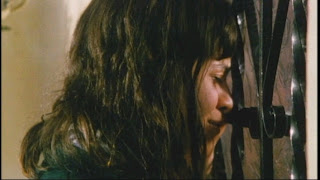
All of the doors and windows have been chained shut to prevent anyone's entrance. When it starts to rain, Yessica hides under the stairwell, where she falls asleep.
 The
next day, Yessica manages to drag herself to school, where Miriam's
mother has been meeting with the principal to discuss the thefts
committed by Yessica—both the violet perfume and the money—and
Yessica is summoned to the office, but two of the school staff
members recognize what has happened to her (her knees are badly
bruised and her neck is bleeding).
The
next day, Yessica manages to drag herself to school, where Miriam's
mother has been meeting with the principal to discuss the thefts
committed by Yessica—both the violet perfume and the money—and
Yessica is summoned to the office, but two of the school staff
members recognize what has happened to her (her knees are badly
bruised and her neck is bleeding).
At last, someone at the school acknowledges to Yessica that “No one has the right to do that to you.” While the girl is in the school infirmary, Miriam shoots a paper airplane through the window with a note telling her to meet her in the bathroom.

 Yessica
goes to the bathroom expecting a reunion with her friend. Instead,
Miriam assaults her verbally, repeating the words applied to Yessica
by Miriam's mother: thief, traitor,
tramp!
The two girls, both angry, get in a shoving match, culminating
tragically with Miriam's death when she falls backwards and bangs her
head on the porcelain toilet.
Yessica
goes to the bathroom expecting a reunion with her friend. Instead,
Miriam assaults her verbally, repeating the words applied to Yessica
by Miriam's mother: thief, traitor,
tramp!
The two girls, both angry, get in a shoving match, culminating
tragically with Miriam's death when she falls backwards and bangs her
head on the porcelain toilet.

Yessica runs away from the scene and heads back to Miriam's house where she lays down on Miriam's bed.
 When
Miriam's mother returns home that night, she finds the door ajar and
is visibly worried about her daughter until she sees that her bed is
occupied. She lays down next to Yessica, who is completely covered
with a blanket in the darkness. Thinking that the person in the bed
is Miriam, the mother is deeply relieved to have found her back home,
safe and sound. The film ends with the phone ringing, a call from
someone at the school bearing the horrific news of her daughter's
death.
When
Miriam's mother returns home that night, she finds the door ajar and
is visibly worried about her daughter until she sees that her bed is
occupied. She lays down next to Yessica, who is completely covered
with a blanket in the darkness. Thinking that the person in the bed
is Miriam, the mother is deeply relieved to have found her back home,
safe and sound. The film ends with the phone ringing, a call from
someone at the school bearing the horrific news of her daughter's
death.
 How
might this tragedy have been averted? Perhaps only if Yessica had
felt it possible to report the first rape as soon as it happened. She
did not do so because she was living in a culture where the
presumption was against females, who were to accept whatever was
dished out to them. The behavior of females toward females throughout
the film reveals that they, too, have been infected by insidious
sexism.
How
might this tragedy have been averted? Perhaps only if Yessica had
felt it possible to report the first rape as soon as it happened. She
did not do so because she was living in a culture where the
presumption was against females, who were to accept whatever was
dished out to them. The behavior of females toward females throughout
the film reveals that they, too, have been infected by insidious
sexism.


 Perfume
also serves as a temptation. Yessica steals the small bottle of
violet perfume from the kiosk because she wants it so badly but has
no money to buy it for herself. In this way, the perfume serves as a
potential source of danger, for it causes Yessica to act in ways
which disrupt the best thing she has ever had up until then: a
friendship with a loving and kind girl who is so innocent that she
does not yet make social and economic class divisions between
different people.
Perfume
also serves as a temptation. Yessica steals the small bottle of
violet perfume from the kiosk because she wants it so badly but has
no money to buy it for herself. In this way, the perfume serves as a
potential source of danger, for it causes Yessica to act in ways
which disrupt the best thing she has ever had up until then: a
friendship with a loving and kind girl who is so innocent that she
does not yet make social and economic class divisions between
different people.
reflections on
Nadie te oye: Perfume
de Violetas (2001),
a film by Maryse Sistach*

The Story
Perfume
de Violetas is set in
modern-day Mexico City, where two adolescent girls, Yessica and
Miriam, strike up an immediate friendship upon Yessica's arrival at
her new school. She was expelled from her previous school for bad
behavior and is generally strong willed, but her conflicts
with authority seem to arise more often than not out of an abundance
of energy conjoined with her refusal to docilely submit to bullies.

Yessica
is a sensitive girl with a great joie de vivre and this is
illustrated especially in the development of her friendship with
Miriam. The first thing that Yessica notices upon sitting in the
chair directly behind Miriam is that her long black hair smells
wonderful. She looks at Miriam in awe from the moment of their first
encounter, and from there on they become the best of friends.

Yessica
lives in a poor part of Mexico City, so poor that the doors on her
house, located below street level, are but hanging sheets, a clear
indication that the family has nothing of value to protect from
theft. Her mother toils her days away doing other people's laundry,
and whenever Yessica is home, she is working too, either washing
clothes or dishes, or caring for her mother's younger children. Her
stepfather and stepbrother are stereotypical Latin macho males, and
both seem to have little esteem for either Yessica or her mother.
As the
friendship between Yessica and Miriam develops, the class distinction
between the two girls becomes quite graphic. Miriam lives in a
second-floor flat protected by barred windows and doors—what is
typical for middle-class neighborhoods throughout Latin America. All
of the bars may at first seem shocking to visitors from more
prosperous countries where the general level of security obviates the
need for such means. In upper-middle-class neighborhoods in Latin
America, there are typically security guards stationed at street
corners, and in especially affluent areas, each house may be
individually guarded.
Miriam's standard of living would be considered closer to the working poor in the United States, as her mother works long days selling shoes at a Payless-type store, but from Yessica's perspective, Miriam lives in the lap of luxury.
Miriam's standard of living would be considered closer to the working poor in the United States, as her mother works long days selling shoes at a Payless-type store, but from Yessica's perspective, Miriam lives in the lap of luxury.


The first time that the girls go to Miriam's home, Yessica is filled with delight at the opulent sights of such “luxuries” as a refrigerator and a bathtub. The two girls indulge in a bath together, playing with bubbles and generally palling around. Aside from their mutual love of makeup and perfume, Miriam and Yessica are connected by the fact that neither has ever met her own father, having been raised by single mothers, although Yessica's is now remarried.

Throughout the development of their friendship, the scent of violets becomes a bind that ties the girls together. Miriam brings a bar of soap to school to let Yessica smell, indicating that it is the same scent which she noticed in her hair on the day they first met.



Shockingly, the bus driver grabs the girl as she is walking down the street and forcibly drags her to and throws her into his bus, which is parked in an empty lot. Meanwhile Yessica's stepbrother sits outside the bus, essentially guarding against any passersby who might approach and take note of what is transpiring inside.

Despite all that she has been through, Yessica pulls herself together and manages to continue on, refusing to let her spirit be daunted.


Miriam and Yessica continue to pal around and at one point they are looking at hair ties at a kiosk when Yessica steals a small bottle of violet perfume which she seems to find irresistible. The girl runs away with the bottle, leaving Miriam behind to contend with the wrath of the shop clerk.

Miriam's
mother has been worried about the friendship from the beginning,
having noticed among other things that the two girls were smoking
in the apartment, which incenses her, given the difficulty she had in kicking the habit.

After his friend the bus driver raped Yessica, her stepbrother, who appears to regard the incident as having been humorous, warns her not to tell anyone what happened “or else...” He was offered and accepted money by the rapist for having stood guard during the violation, and he uses the money to buy himself a pair of fancy new athletic shoes.

Throughout the film, the fascination which these relatively poor people have with commodified objects of desire is illustrated over and over again. Symbolically, it is Miriam's mother who sells the shoes to the young man, entirely unaware of his connection to Yessica.

The girls are relieved to be reunited once again, and Miriam flouts her mother's counsel to have nothing to do with Yessica. She also lets her into the house, against her mother's prohibition.
While
visiting this time, Yessica steals a roll of money hidden in Miriam's
mother's jewelry box, which she gives to her own mother, who has
complained over and over again about the family's financial woes. The
stolen money had been saved up slowly by Miriam's mother from her
low-paying shoe store job to buy a new television, and when she
discovers that it is missing she becomes irate. At one point she
launches into a tirade about Yessica, insisting that she is not only
a thief and a traitor but also a tramp. Basically, her explanation of
what happened to Yessica (the rape) is that “she asked for it.”

Unbelievably, the bus driver and Yessica's stepbrother abduct her yet again for yet another rape in the bus (and it appears that this has become a serial event, although only two of the incidents are shown explicitly in the film). This time, Yessica is dazed and confused and manages to make her way back to Miriam's house but finds no one there.
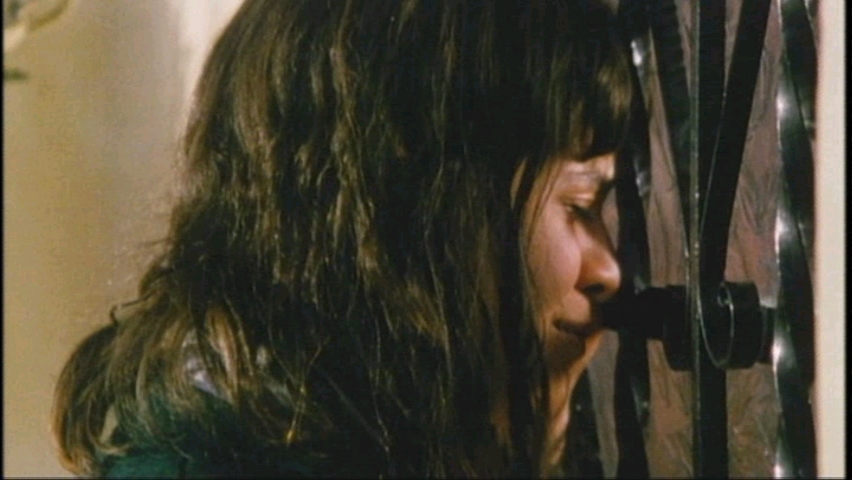
All of the doors and windows have been chained shut to prevent anyone's entrance. When it starts to rain, Yessica hides under the stairwell, where she falls asleep.

At last, someone at the school acknowledges to Yessica that “No one has the right to do that to you.” While the girl is in the school infirmary, Miriam shoots a paper airplane through the window with a note telling her to meet her in the bathroom.


Yessica runs away from the scene and heads back to Miriam's house where she lays down on Miriam's bed.

Discussion
Perfume
de Violetas is a
depressing, almost nihilistic film. It is certainly an extreme
example of film noir, albeit set in Mexico City, in that corruption
suffuses the entire story. The only person among all of the various
characters who appears to be entirely innocent is Miriam, who is
killed as a result of all of the evil forces acting around her.

My
initial reaction to this film was that the ending was unduly and even gratuitously sinister, stretching credulity past its breaking point.
The dénouement in fact reminded me a lot of what is probably my favorite
film noir (also in blazing technicolor!): Plein Soleil [Purple Noon] (1960), directed by René Clément. The trauma which Miriam's mother will experience upon realizing that the
girl in her daughter's bed is not Miriam, who is in fact dead, is
truly painful to imagine.
The
film is well made and well paced, covering an amazing amount of ground in only 90 minutes. It is clearly a low-budget
production but is well directed, and the acting is also quite good. I was equally impressed by the artful selection and use of music. My primary gripe with the film was only that the plot was so
horrible as to be too unrealistic. To my shock, I learned upon
visiting IMDB.com (the Internet Movie Database) that Perfume de Violetas is
based on a true story. So as unrealistically awful as the story was,
it turns out that the events which it depicts really happened, which in some ways makes the
whole thing even worse.
Perfume de Violetas is an important work. It highlights the living conditions of the poor and working poor in Mexico City and follows in a tradition of Spanish language film auteurs, including Luis Buñuel, who during his years in Mexico directed Los Olvidados [The Young and the Damned] (1950), a gritty black-and-white film also concerned with the plight of the poor of Mexico City, but people much worse off than either Miriam or Yessica (and with no access to or knowledge of perfume). Las Hurdes [Land without Bread] (1933), directed by Buñuel in Spain, also dealt with a much lower level of poverty than that depicted in Perfume de Violetas.
In this film, perfume plays an important role. Perfume is what first attracts Yessica to Miriam—or rather the scent of her hair, which has been washed with violet soap. Perfume serves throughout the story as a means for Yessica to escape from her own sordid conditions to a world of olfactory delight.
Perfume de Violetas is an important work. It highlights the living conditions of the poor and working poor in Mexico City and follows in a tradition of Spanish language film auteurs, including Luis Buñuel, who during his years in Mexico directed Los Olvidados [The Young and the Damned] (1950), a gritty black-and-white film also concerned with the plight of the poor of Mexico City, but people much worse off than either Miriam or Yessica (and with no access to or knowledge of perfume). Las Hurdes [Land without Bread] (1933), directed by Buñuel in Spain, also dealt with a much lower level of poverty than that depicted in Perfume de Violetas.
In this film, perfume plays an important role. Perfume is what first attracts Yessica to Miriam—or rather the scent of her hair, which has been washed with violet soap. Perfume serves throughout the story as a means for Yessica to escape from her own sordid conditions to a world of olfactory delight.


Perfume represents promise and hope. It also serves as a salve to soothe the violated girl's pain. After having been raped, as Yessica attempts to get her wits about her, she refuses to be crushed but instead reaches for perfume, as though traveling to a fantasy world, where the evil people who mistreated her do not exist.

Miriam
accepts Yessica as she is, without questioning whether she is from
“the wrong side of the tracks,” so to speak. Even when Yessica
acts in ways which harm Miriam, she is able to forgive her. But in
the end, she loses not only her friendship but her life, and that is
why this film seems so nihilistic. The hope and beauty is all
crushed, like Yessica's bottle of perfume by her angry mother, who
throws it to the ground in a senseless display of outrage. In
effect she says to her daughter through this gesture that she has no
right to perfume, because they are poor.
What
is the point of this film, for privileged perfumistas such as
ourselves whose in some ways laughable monetary concern is whether we
can afford the latest überniche
luxury launch? How
should we interpret this disturbing story?
To be
honest, I sometimes wonder whether we are not living in a big fat
scented bubble. When we complain about the price of perfume or bicker
amongst ourselves over whether perfumery is an art, we are indulging
in a luxury which is so far beyond the reality of most of the people on the planet, some of whose conditions are depicted in this film,
that it verges on obscene.
Despite our elevated socioeconomic status—as evidenced by the
fact that we are even capable of having perfume appreciation as a hobby—we are
very much like Yessica in our fascination with perfume. We are
willing to forgo other things in order to have our coveted perfume.
But there is a positive message here as well.
In
reality, it appears that we enjoy perfume in precisely the way in
which Yessica does. Perfume is a source of pleasure for us, as it is
for her. Does it matter whether we describe that source of pleasure
in one way or another? Why can we not simply accept that perfume
gives us pleasure? Why must there be more to it than that? Are we
afraid of our own hedonism?
I also
sometimes wonder whether the energy being currently directed to
defend the claim that perfumery is one of the beaux arts is not
disproportionate to what would be the consequences of that view, if
it were affirmed by an elite few to be true. Clearly the experience of perfume by people such as Miriam and Yessica would not be altered in the least.
Would our own appreciation of perfume change if we were to describe it in the lofty terms of some abstruse theory? I think not. We would still love perfume for precisely the same reason and in precisely the way in which Yessica does. Why? Because it smells good.
Would our own appreciation of perfume change if we were to describe it in the lofty terms of some abstruse theory? I think not. We would still love perfume for precisely the same reason and in precisely the way in which Yessica does. Why? Because it smells good.
*Caveat: If you happen to number among the millions of persons currently attempting to wean themselves off SSRIs—having at last realized in what must have been a painful epiphany that it was all an elaborate ruse devised to pad the pockets of Pharmafirm CEOs while getting you to shut up—then I advise you to stay very far away from this grim, nearly nihilistic film.
Sunday, December 30, 2012
Can We Talk? About Perfume? Part 2

What
does disagreement
about the value of a perfume really mean?
Perfume
reception is the consummate expression of subjectivity. This is how
and why two different perfume enthusiasts can disagree vehemently
about the value of the very same perfume. Chandler Burr hails as
masterpieces Diptyque Eau
de Lierre and Dolce &
Gabbana Light Blue.
Turin & Sanchez deride both of those perfumes as one-star
failures. If the value of a perfume were a matter of objective fact,
then one of two critics who held diametrically opposed views would
have to be wrong.

So
is Light Blue
a triumph of modern perfumery? Or is it a hopeless wreck, less a
perfume than it is swill or dreck? Perhaps it all comes down to
idiosyncratic tastes. Burr likes clean scents, which Turin &
Sanchez appear generally to abhor. Burr appreciates streamlined
scents, while Turin & Sanchez are easily bored. Burr likes amber
and hails Prada Amber
as a masterpiece. Turin & Sanchez dislike amber in general and,
logically enough, Prada Amber
more
specifically. A
chacun son goût.
One
person's masterpiece is another person's disaster. End of story.

Or
perhaps the critics who disagree in their most basic evaluations
really disagree because they actually smell different things, owing
to the natural range of variations in scent sensitivity within a
human population for all of the components of the complex mixtures known as perfumes.
Perhaps those who despise some perfumes fail to detect their beauty
because they do not smell everything that is there. Another
possibility is that they smell more than most other people do. They
may smell substances the presence of which would ruin another
person's experience of the perfume, if only he were capable of
detecting them. A
chacun son nez.
If this way of understanding
aesthetic disagreement about perfumes is true, then in seeking out
the opinions of critics, we would do well to hew to those who seem to
share our basic sensitivities. Otherwise, we'll be led astray by the
advice of people different enough from us to make it the case that we
actually smell different objects when we smell perfume even drawn
from the very same bottle.

Given
the considerable evidence of heterogeneity in human scent perception,
the effort to point outward, attempting to taxonomize perfumes as
stable things in the world alongside other stable things—whether
various types of paintings or the products of less-exalted crafts
such as cooking or winemaking—would seem ultimately to be an otiose
endeavor. To do such a thing is to walk down a path to a dead-end,
because the primary value of perfume—beyond its simple inducement
in us of pleasure—is not artistic but philosophical. The
aforementioned critics want to uphold the objective reality of
perfumic masterpieces. But they cannot even agree amongst themselves
about what the pillars of perfumery are supposed to be.

The
best—and most charitable—way of understanding profound
disagreements about perfume among self-proclaimed experts is simply
to accept the intrinsically subjective nature of perfume perception:
A chacun son goût
et son nez! This
vindicates the critics—they are neither incompetent nor
anosmic—while however simultaneously implying that no one is really
a better expert than anyone else when it comes to perfume, a
conclusion which will likely make the self-styled experts bristle. If
their opinions are no more worthy than anyone else's, then why should
anyone listen to what they have to say? For what, precisely, are
professional perfume critics being paid?
I
think that the answer is clear: they are promoting some perfumes
which will be bought because many ignorant people will simply accept
the self-appointed experts' advice as authoritative. They end by
serving as marketing shills when they hail certain perfumes, holding
them up as objective masterpieces, and effectively advise their
readers to avoid those which they either omit from mention or
vociferously decry. The “experts” become marketing tools—whether
wittingly or not—because perfume, being essentially and
inextricably enmeshed in an economic context, is consumable and
commodified. People pay to wear perfumes, and they choose to buy some
but not others on the basis of the so-called experts' advice. Or am I
giving the critics too much credit? How many of the millions of
perfume consumers out there even know their names?
Probably
not that many, I'd surmise. But another bottle sold is still another
bottle sold, so marketers will support those who support the products
which they are trying to sell. This explains how and why mutually
beneficial arrangements such as The Art of Scent Exhibit at the
Museum of Arts and Design can arise under the guise of objective art
appreciation when in fact the works being exalted are already
best-selling perfumes.
What
do perfume marketers do?

Christian Dior does not use screen captures of Charlize Theron from the film Monster (2003) to advertise their best-selling perfume J'Adore.


Instead, they seduce consumers into believing that they, too, will be bathed in a golden light of glamour, if only they buy and wear the perfume.
J'Adore has been reformulated, but the advertisements remain more or less the same and are apparently just as effective as—if not more than—they were at the perfume's launch.
J'Adore has been reformulated, but the advertisements remain more or less the same and are apparently just as effective as—if not more than—they were at the perfume's launch.


In advertisements for perfumes, we are told, in effect, that we will be beautiful and glamorous or sexy and alluring, if only we don the product which the advertisement is attempting to persuade us to buy. There is no logical connection between the models who pose in perfume advertisements holding bottles and the liquid inside. All of this is no more and no less than a game of sleight of hand.
Similarly,
the application to perfumes of labels borrowed from the visual arts
such as Neo-romanticism
and Surrealism
is essentially equivalent to what marketers have always done. In
other words, one way of understanding the current exhibit at the
Museum of Arts and Design is as an innovative and ingenious marketing
scheme. Perfumistas may wish to believe otherwise, but perfumery is a
business, and anyone who has even the faintest grasp of the nature of
the enterprise of enterprise should be well aware that the managers
who agreed to invest money in the Art of Scent exhibit were concerned
above all with one thing: selling more of their perfume.
Perfumistas
see this:


and
hail the dawning of a new age, in which perfume is finally given the
recognition it deserves as one of the beaux arts.
In
contrast, the people at the corporate headquarters of the perfume
conglomerate giants making financial investment decisions—whether
or not to fund The Art of Scent exhibit and donate free perfume to
the Museum of Arts and Design—see, instead, this:


As they deliberate over whether to fund such an initiative, they may rub the palms of their hands together while dreaming gleefully about upcoming second-quarter returns.
I do not mean to suggest that there is anything wrong with any of this. Savvy businessmen have always succeeded through such schemes. Indeed, the very point of marketing—its raison d'être—is to persuade people to believe that they need what they do not need, and to buy what they would not otherwise have bought. We have a wide range of choices in deciding how to dispense with our wallet share available for nonessential expenses, including luxuries such as perfume. Marketers' job is to see to it they we spend our money on their products, not those of the competition.
I do not mean to suggest that there is anything wrong with any of this. Savvy businessmen have always succeeded through such schemes. Indeed, the very point of marketing—its raison d'être—is to persuade people to believe that they need what they do not need, and to buy what they would not otherwise have bought. We have a wide range of choices in deciding how to dispense with our wallet share available for nonessential expenses, including luxuries such as perfume. Marketers' job is to see to it they we spend our money on their products, not those of the competition.
The
marketing masterminds who agreed to promote the event are well aware
that the fact that the perfumes on display in “The Art of Scent”
are not being sold in the museum's gift shop certainly will not
prevent enthusiastic exhibit goers from stopping at the nearest
Sephora or other retail perfume purveyor on their way home. As for
the countless people who have no way to travel to New York City to
see the exhibit, they can console themselves by purchasing bottles of
the “masterpieces” online.
The
reason why all of this should matter, to supporters of independent
perfume houses, is because consumers only allocate a portion of their
budget to perfume, and once that money has been spent, it will not be
spent again. Judging by some of the gushing I've seen around the
blogs, some perfumistas have come to believe that exalting
bestselling perfumes as artistic masterpieces will somehow help independent perfumers, when in fact nothing could be
farther from the truth.
In
reality, the more money people spend at the big houses funding the
exhibit and whose works are being heralded as masterpieces, the less
they will spend on the unnamed houses not being celebrated. The irony in
all of this is that the perfumistas who rush to lavish praise upon
Chandler Burr and his initiative seem to be entirely unaware of the
likely economic outcome of this scheme: to buoy and promote the
ongoing corporatization of perfumery. If Chandler Burr's funding, including his own salary, derives from the megacorporations controlling the houses whose works are currently on display at the Museum of Arts and Design, then he works for them. If his initiative succeeds in improving those companies' bottom line, then he will keep his job. If not, he will not.
The
Good News
Can
we talk about perfume? Yes, of course. Why? Because we do. Hundreds
of new perfume reviews are written online every day, and people are reading
them. The reviews combine personal anecdote and feelings with
references to terms recognizable to other perfume lovers because they
derive from what has emerged as a full-fledged perfume culture. The
discourse among members of fragrance communities is informed by an
idiom used by perfumers themselves. This makes perfect sense because
perfumers know more than anyone else what their own intentions are in
developing a new creation with particular aesthetic properties.

Certain conventions have already been widely embraced. Because perfumistas often commence from the text created by perfumers and marketers themselves, they have become fond of talking about the objects of their devotion in triangular hierarchies, as though there really were a distinct and distinguishable top, middle, and base to perfumes.

The
complex evolution of a perfume over time can also be compared to the aging process of a person. Each person is born an
infant, grows and transforms continuously over the decades comprising
his or her life, until old age and finally death, at which point
there is little—if any—resemblance to the person's appearance at
birth. At any moment in time we can describe how the person looks:
her size, weight, and shape; the color of her hair and eyes; the
texture of her skin; the presence or absence of skin pigmentation,
etc. Just as in the case of perfume, we can decide to divide the life
into three parts: childhood, adulthood, and old age, but those are in
some ways arbitrary divisions, although they can be useful in certain circumstances.
Despite
its somewhat fictional quality and the grayness of its boundaries,
the tripartite hierarchy in perfume profiles may be nonetheless
helpful because in fact the opening stages in a perfume's development
are detectable but also transient, ceding quickly to the later
stages, the longest and most memorable part of which we refer to as
the drydown.
In
discussing what they perceive during their experience of a perfume,
reviewers sometimes lament not “getting” this or that note, but
in reality the notes are nearly never ingredients, as some of them are
explicitly claimed to be by the perfumers themselves in
self-consciously minimalist perfumes such as Escentric Molecules
Molecule 01
and Molecule 02
and Juliette Has A Gun Not
A Perfume.

Those
who know the difference between the scent of cedar and the scent of
the aromachemicals used to confer a cedar-like quality to a perfume,
may say that they do not detect cedar in a perfume which lists cedar
as a note. And they are right. Others may have arrived at a concept
of cedar which is more open and includes the scent of the
aromachemicals used to mimic the scent of cedar in nature, just as
the perfumer intended them to.

No perfume literally contains a cedar tree. Even those which contain substances derived directly from cedar wood are abstractions. Why are certain substances included in perfumes while others are not? Why do perfumers choose to produce a cedar scent, or one which smells like ambergris? For their effects on our sensory apparatus.

When we identify notes, we are sharing with others our own
subjective experience of a perfume. Likewise, when we laud a perfume as
beautiful or great, we may be saying something about its aesthetic
properties, but we are also saying something—indeed, much
more—about ourselves. The reason why we perfumistas have been
flocking together to discuss perfume is that we have established a
language through which to share our experiences with others who also
appreciate these same sorts of insights made possible by perfume.
By
penning reviews and commenting on them, explaining how our own
experience coheres or does not with that of another perceiver of the
same perfume, we broaden our understanding of not only perfume, but
also ourselves. We come to see what it means to perceive different
facets of a perfume and how two equally valid experiences may arrive
at divergent judgments about the value of the very same thing, as a
result of each individual's distinct history, memories, personality,
and tastes.
Perfume
language should be exactly what develops among perfume lovers
informed by perfumers and marketers because the only reason why we
have any understanding of perfume at all is because it is sustained
through the perception by some people of perfume as profitable. If no
one believed that they could make money from selling perfume, then
they would sell something else, and we would not be meeting to
discuss perfumes—the good, the bad, the beautiful, and the ugly—because they would not exist at all.

It does not matter whether other people disagree with our taste in perfume, although it would be decent of us, whenever possible, to make an effort not to offend others or induce in them undue strife, as a courtesy to our fellow community members, by which we express our respect for and tolerance of difference. Within the privacy of our home, anything goes: we are the kings and queens of our scented castle!
What
are perfume reviews?
Perfume
is a cultural artifact, but it has no meaning unless it is
experienced, and for many people, the perfume story ends at pleasure. It is no coincidence that perfumes lauded as “great” are also
thought by many to be delightful to smell. But perfume perception can
also serve as a phenomenological tool, providing insight into our
place in the universe and how we in fact construct it, conceptually
speaking. Because of the intimate connections in our nervous system
between the processes of olfaction, cognition and emotion, perfume
immediately elicits memories of our past and may trigger in our mind
a cascade of emotions, images, and ideas.
 There is no question that marketers attempt to shape those images through advertising, but any positive label or image attached or implied points the consumer in the very same direction: to reach for his or her credit card.
Looking beyond the perceiver, to the established art world in trying to make sense of perfume, is to turn away from the profound philosophical insights to which perfume may give rise. It is also to diminish or deny the value of the uniquely intimate engagement which forms the very basis of our love of perfume. We do not love a perfume because someone else has labeled it in one way or another or hailed it as a masterpiece. No, we love a perfume, when we do, for the pleasure it provides and the richness it adds to our mental life, thanks to its ability instantly to evoke ideas and images in our mind.
Looking beyond the perceiver, to the established art world in trying to make sense of perfume, is to turn away from the profound philosophical insights to which perfume may give rise. It is also to diminish or deny the value of the uniquely intimate engagement which forms the very basis of our love of perfume. We do not love a perfume because someone else has labeled it in one way or another or hailed it as a masterpiece. No, we love a perfume, when we do, for the pleasure it provides and the richness it adds to our mental life, thanks to its ability instantly to evoke ideas and images in our mind.

Some
perfume reviewers take themselves to be offering advice to their
readers about which perfumes are good and which are not. Others,
however, regard their task as a more modest one: to record the
subjective experience of their own encounter with a perfume. Such an
experience can never, strictly speaking, be replicated, even within
the very same perceiver who spritzes on the very same perfume. Why?
Because the perceiver will have changed, and the conditions in which
the perfume is being used will be different, too.
In
fact, the two different kinds of reviewers may inhere in the very
same person, someone who chronicles his or her subjective experience
in order to inform other people that there is someone somewhere who
has experienced the perfume thus. In other words,
the review expresses one possible reaction to the perfume, which may
or may not cohere with other people's experience. It is interesting,
all the same, because it reveals how other people may perceive what
we perceive in an entirely different way. Therein lies the profound
philosophical importance of perfume.
Subscribe to:
Posts (Atom)