Showing posts with label Coco Chanel. Show all posts

Sunday, June 2, 2013

Coco sans Parfum


Reflections on Coco avant Chanel  (2009), 
directed by Anne Fontaine

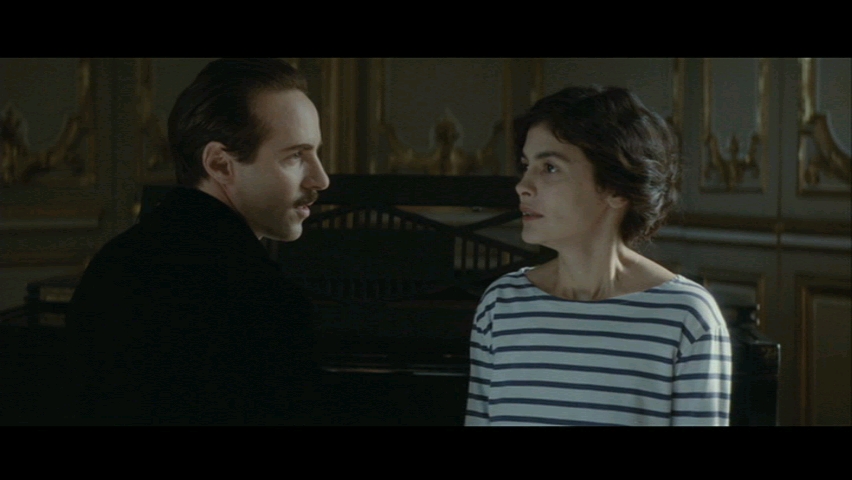
Historical fictions are tricky. Whether books or films, they play with and shape the facts in order to present a more pleasing work. The truth of what really happened may be sacrificed under the guise of poetic license. Because history is so complex, the decision to include or omit mention of certain parts of a story can completely change the overall portrait of controversial figures such as Gabrielle “Coco” Chanel. Before watching Coco avant Chanel, one of three films about the fashion designer released at about the same time (around 2009), I knew nearly nothing about her. This version of the story, in which Audrey Tatou plays the lead role, focuses on a simple idea: after her mother's death, little Coco was consigned by her father to an orphanage where she was raised by nuns. A single image of the young girl serves to determine the rest of the story:


Not much time is devoted to this segment of her life, but we learn that on visiting day, Coco would go wait outside for her father to come, which he never did. The image of this innocent child, devoid of any parental love and left to her own devices is referenced throughout the rest of the film.

Flashing forward to her young adulthood, Coco is singing at night for tips at a cabaret while working by day as a seamstress. She makes the acquaintance of Etienne Balsan, a rather boorish but extremely wealthy “old money” Frenchman, with whom she has a brief fling. 


Balsan arranges an audition for the young woman to obtain a regular position as entertainer, but Coco does not impress the judge with her performance. 

Her hopes of succeeding as a singer and dancer are dashed, and she returns to her apparent fate: to work as a seamstress.


When her sister (this is a composite character in the film, whose story does not accurately depict what happened) takes leave to live with a man whom she hopes to marry—though this seems unlikely ever to happen and indeed never happens, as a result of her membership in the French equivalent of an undesirable social caste—Coco decides to pay Etienne a visit at his estate, under the pretext that she is on the way to visit her sister and has decided to stop by. 


Needless to say, he is surprised to see her in this context, where she does not belong, as they met in the demimonde.


Chanel ends up staying at the Balsan estate as a live-in concubine whose true status is revealed when she is required to remain hidden from sight during parties with the social elites whom Balsan entertains. The arrangement is degrading, to put it mildly. 


Even when Balsan takes Coco to the horse races, he abandons her while he goes to sit with his upper-crust friends in the stands.


Probably the most shocking part of this arrangement is that Balsan “loans” Coco for the weekend to one of his British friends, Arthur “Boy” Capel, who has become slightly smitten with the attractive and obviously intelligent woman who has taken up residence chez Balsan. 


Coco and Arthur become romantically involved despite Balsan's presence during a costume party, and when they take off to the seashore, Coco begins to dream of life as the wife of this wonderful British nobleman, who far from hiding her away, puts her on display, taking her to dance at a fancy ball and treating her like a genuine lady rather than a low-class live-in domestic servant, as she is accustomed to being treated by Balsan.


Alas, Coco's dream is shortlived, as she is curtly apprised by Balsan that Capel is soon to be married to a high-society English lady. Arthur attempts to persuade Coco to believe that two people can be in love without marrying, and that his marriage is nothing more than a matter of social convention—from which he is apparently too weak to demur—but Coco is crushed by the news.


Coco's True Calling


Throughout her years at the Balsan estate, Chanel has been developing her unique pared-down, minimalist style, transforming men's clothes into innovative pieces for herself. By wearing these new creations, she flouts the reigning trends, which emphasize opulence and “busy” designs and patterns, perhaps most graphically illustrated by the huge hats being donned by women, but also by the obligatory corset worn by all true ladies.


Coco avant Chanel focuses on a couple of distinctive trends begun by the fashion designer, including the use of black, formerly restricted to mourning contexts, and the stripping out of excessive embellishment such as feathers and flowers. Chanel is portrayed in the film as a women's liberator of sorts, insisting that they should be able to breathe and move freely in their dresses. In several scenes she is depicted unlacing women's oppressive corsets.

In reality, according to other sources, Chanel's sympathies with women's liberation began and ended with the abolition of corsets. She paid her own workers very poorly, and when they complained, she remarked, "let them take lovers." She vehemently opposed unionization to the point where she preferred to withdraw from the fashion industry for a number of years rather than accede to the demands being made by her workers. All of this is omitted from the story as depicted in Coco avant Chanel, which ends up seeming more like a statement on the conditions of lower-class women in the early twentieth-century than a faithful portrait of Gabrielle Chanel.

In this film, the image of innocence is nursed from start to finish, and well-conveyed by Audrey Tatou, as she portrays a woman whose at times objectively disgraceful behavior is rendered comprehensible, and even a cause for sympathy, given her humble origins.


The truth is that Gabrielle Chanel would never have become a fashion icon had she been born into a family with money. She would have married a gentleman and borne his children, and we would know nothing of her today. Instead, she became associated with wealthy gentlemen who provided her with the means she needed to begin her own boutique in Paris. Coco avant Chanel skillfully presents the impediments to success to women in what until only recently has been a man's world, making Chanel's eventual triumph seem all the more remarkable.

In this film, Arthur Capel is credited with being the primary supporter and benefactor during Chanel's early years as a fashion designer. (In reality, it may have been Etienne Balsan, who is depicted as something of a scoundrel here.)  Despite Arthur's marriage to someone else, he is painted as the love of Chanel's life, and their affair continues torridly on. 


When Capel is killed in an untimely automobile accident, Coco plunges into despair.


The rest of the film portrays Chanel working indefatigably, apparently as an outlet to replace the lost love of her life. At the end she is presented as a strong and independent woman who never married because, it is strongly implied, she loved only one man, Arthur “Boy” Capel.


This, too, is a matter purely of poetic license, for we know for a fact that Coco Chanel had affairs with many other men. Indeed, in another film released also in 2009, Coco Chanel and Igor Stravinsky (to be reviewed here imminently), the fashion designer is portrayed as one of the inspirations and benefactors of the great composer! More infamously and less controversially (no one seems to know for sure whether Chanel ever had an intimate affair with Stravinsky), it is a matter of historical record that during the Nazi occupation of France, she lived in the Ritz Carleton hotel among German officers, one of whom was her lover for many years.


The Perfume Angle

What does any of this have to do with perfume? you may by now be wondering, and not without good reason. In fact, the word 'perfume' is nowhere pronounced in Coco avant Chanel. Nor is there is a single image of any woman (or man) reaching for a bottle of perfume. There are not even any images of bottles of perfume anywhere in sight—not even in the fancy boudoirs at the estate of Etienne Balsan. 


There is, however, one plausible candidate for perfume wearer in the story, Emilienne d'Alençon, an actress who has had a longer-term and somewhat higher-level affair with Etienne Balsan. This woman did exist in history, and was notorious for attaching herself to men of means, sometimes to the point of their ruin.


Rather than Coco telling Emilienne that “women have no business smelling like flowers,” in the story as depicted in the film, Coco designs streamlined hats for the flamboyant woman, in effect telling her that “women have no business wearing birds' nests on their head.” 


No mention is made of Emilienne reeking of violets or honeysuckle or any of the other soliflores which Chanel is reputed to have denounced during her design with perfumer Ernest Beaux of Chanel no 5.

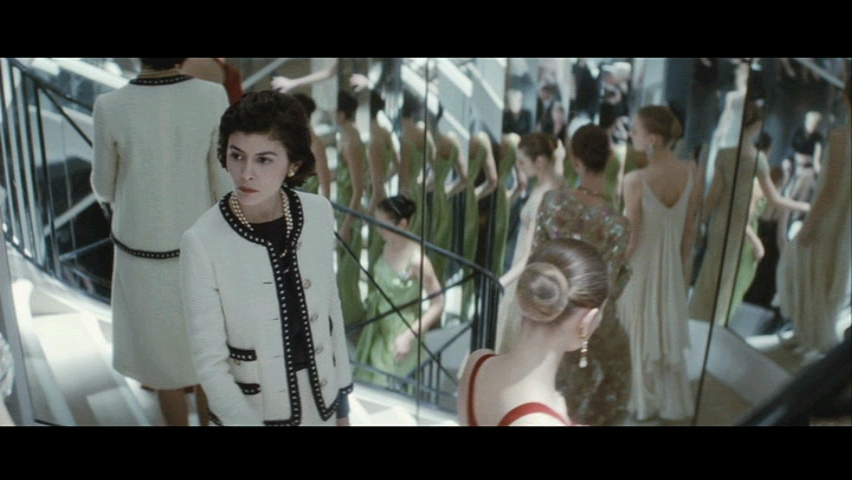
It is striking that there should be no mention of perfume whatsoever, though the film spans the duration of Gabrielle's life from her earliest days at the orphanage through the triumphant post-war comeback, where Chanel is shown inspecting her models from the vista of her famous mirrored staircase.


What are we to conclude? Someone ignorant about perfumery would come away from this film with no knowledge that Gabrielle Chanel brought into existence the most iconic perfume of the twentieth century. We perfumistas of course know this to be the case. Could a woman completely devoid of any interest in scent have done such a thing?


I should say that scent is not entirely absent from this film, as Coco is chain smoking in many of the scenes, from her days at the cabaret to her nights working alone in her atelier. While designing in her boutique, with customers present, she is repeatedly depicted with a cigarette dripping from her lip, to the point where one may not unreasonably wonder how an errant spark never caused the whole place to burn down in a blazing conflagration of black lace, silk, and wool.


Cigarette smoke has a strong and even overwhelming odor, which will modify, if not entirely mask, all subtle perfume. So one message which we could glean from this film, devoid though it is of any explicit mention of scent, is that when Chanel set about designing perfume, for her nose to be satisfied, it had to be a declarative, penetrating scent which would be detectable even in the presence of cigarette smoke. Perhaps therein lies the true reason why Chanel thought that women have no business smelling like flowers. A simple floral soliflore could never compete with the chimney stack of cigarette smoke which she was constantly pumping out!

Another message to take away from the omission of any mention whatsoever of Chanel no 5  is that Chanel was first and foremost a fashion designer, and perfume for her was a type of accessory. The fact that she farmed out her perfumery interest to the Wertheimer brothers would seem to corroborate that idea. Later, when Chanel no 5 became enormously successful, as a result of the marketing savvy of her partners, Coco attempted to reappropriate that part of her business, but her reasons appear to have been economic, not olfactory.

Perhaps the most obvious message to glean from the omission of any mention of perfume from Coco avant Chanel is that the director, Anne Fontaine, has no interest in perfume and so, to her, it seemed unnecessary to treat the topic at all in this version of the story. That a perfume-free film about Chanel could be made at all should serve as an important reminder to those of us ensconced within the subculture of perfume aficionados. There are countless people in the universe who do not care at all about perfume and find it even less interesting and valuable than fashion. Small wonder, then, that nearly no one takes it seriously as one of the beaux arts.


Monday, March 11, 2013

I fell head over heels with Lanvin Arpège...


It happened, as it were, completely by chance, as I suppose these things always do. Who can predict what new arrival at the forefront of one's mind—a flickering image, a faint idea, a vague prospect heretofore unrecognized—may inspire an outpouring of passion? Does anyone possess the wherewithal, the sheer power to turn such a force of nature away?

Lanvin Arpège was the farthest thing from my mind back then, when I was still wearing Chanel Allure: sweet, nice, and linear—a scent for every time and every place, and my favorite especially to don right before embarking on a journey to a land far away. Gambling on new perfumes was never really an option. Subject my fellow passengers to the latest Dior Poison flanker? Or some blue aquatic nonsense which might be even more emetic than the food served on board?

No, and as a seasoned traveler, I knew that every single duty-free shop in the world carries Chanel, before anything else. Let's put it this way: if there were a duty-free shop in an airport in even the remotest corner of the universe, it would contain tester bottles of Allure eau de toilette and eau de parfum within arm's reach. It's as though Chanel has underwritten the very existence of such stores—along with the Toblerone chocolate company.

Not that I'm complaining, mind you, for it is indeed true that in my many travels abroad to destinations far and wide, I have come to depend upon Allure as a dose of serenity, a way to calm my frazzled nerves before boarding a plane which might in fact—it's all a numbers game—experience a malfunction, impelling in a flash all of the passengers in the congested cabin to dredge through the many otherwise meaningless prescriptions inscribed in the deepest fissures of their brain to locate this phrase, relevant at most one time in any person's life:


Affix your own air mask before helping a fellow passenger.


A prescription which I confess to have found equally applicable, mutatis mutandis, to my attitude in the morning when opting first to prepare coffee before acknowledging the existence of anyone else. It is also the basis—whether sound or not—of many a person's refusal to help another person in dire need, even the proverbial damsel in distress. Remember Kitty Genovese? Probably not. But that's another story.

Allure was perhaps the precursor to the twenty-first-century SSRI scents now flooding the market, impossibly inoffensive, while at the same time a pleasure to wear. A beautiful blend of floral and light oriental notes into a seamless, indivisible layer of sweet niceness. “Linear” they called it, and linear it was, indeed, as dependable as a German or a Japanese train. Nothing rank, nothing obtrusive, nothing ugly. The perfect solution for long journeys spent in close quarters with complete strangers brought together fortuitously by nothing more and nothing less than their shared desire to be somewhere else and virtually anywhere but there, suspended in air, 30,000 feet above the surface of the earth.

My first bottle of Allure was purchased in Toronto, where I spent a few days alone and found that I really did wish to don a perfume, though I had neglected to bring any along. I acquired the bottle blind from an upscale department store from which I was buying a red cardigan, having discovered that the temperature in Toronto even in the summer months was quite a bit cooler than I had been led to expect. Did I become attached to Allure because of the comforting companionship it provided during that short trip? Whatever the explanation may be, I went on to drain bottle after bottle of both the edt and the edp, habitually reaching for Allure as a safe yet simultaneously endearing scent.

To be honest, I do not recall the circumstances of my first encounter with Arpège, but it certainly was not in a duty-free shop in a land far away or nearby, as I have yet to see any perfume by Lanvin being sold in any airport store—or virtually anywhere, for that matter. Perhaps the glimmering globes are hidden on some lower shelf in a dark corner of some of these establishments, but no one makes any real effort to sell Arpège, in particular, unlike the pro-active, seemingly ubiquitous Chanel sales associates, as hopeful as the barefoot Hare Krishnas with their tambourines, who will spritz even unwilling passersby with Chanel no 5. Which is not however to deny that the ploy appears more often than not to have worked, a part, as it is, of a grand, five-hundred-year master plan for marketing No 5 as not just the best-selling perfume of the twentieth century, but of all time.

Arpège, in contrast, is quite a bit more caddy, perhaps even coy. One must seek Arpège out, and if one fails to do that, well, you may rest assured that Arpège could not care less. I was one of the chosen few, the truly fortunate ones to happen upon this splendid and arcane creation. Yes, it is true: I felt blessed. I emphatically did not seek Arpège out and did not even really know what I had found for quite some time after having acquired a bottle, which is probably why I do not recall when precisely that was. Arpège was somehow delivered to me, a scent literally heaven sent, as though someone somewhere, a metaphysical matchmaker of sorts, had determined that it was meant to be.

Yes, somehow those beautiful bulbous bottles made their way onto the top shelf of my armoire, as though conveyed by supernatural forces beyond my power to control. But all of the history leading up to the big event proves irrelevant in the face of what transpired next.

I fell head over heels with Lanvin Arpège and, yes, I fell hard. How did it happen? you may well be wondering. From nothing to love in the blink of an eye, it happens every time, as the world is transformed beyond recognition all over again.

I began to see what had seemed to be his icy stare—at times a piercing glare—for what it really was: clarity. The lucidity of a mind capable of penetrating the inner secrets of the soul through the application of logic alone.

In the beginning, Arpège did not seem to have much interest in me, and to this day I wonder whether he ever did. Always cold and aloof in our initial meetings, he was sometimes brusque to the point of being rude. Never one to hug and kiss à la française, Arpège was more apt to refuse even to accept an outstretched hand. Some no doubt thought that he was rude, like the drunk who approached me as I was preparing one afternoon to depart from my table in a restaurant bar where I had stopped for a quick snack after a strenuous shopping trip.

He bumbled his way over, managing even in his stupor to see that there was only one body there, not two, and that it was a woman, not a man. He extended his hand, introducing himself, as though I should be happy to see such a slob standing before me with leering bloodshot eyes. I signed my check, picked up my things and dashed to the door while he lingered behind exuding what he took to be righteous indignation that I should be so uncouth.

That, too, is perhaps how some, even many, may have viewed Lanvin Arpège, but I knew that there was more to him than that abrupt façade, so I adamantly refused to retreat. Fortunately, I ,unlike the pathetic drunk who accosted me on that otherwise peaceful day in a restaurant bar, was not hopelessly confused.

I learned to brace myself before each encounter, and soon found that if I gave him some time, his layers of complexity would unfold, unraveling like infinite bolts of silk before my eyes until at last I realized that he had crept into my heart, and I could not live without him anymore. I began to regard his brusqueness as endearing, his way of fending off what might otherwise be the hordes of suitors unworthy of him. Was he elitist? Without a doubt, but it was this, perhaps, I cannot tell a lie, which drew me to him before anything else.

In the beginning I wanted nothing more than the modest privilege of being but one among his little club of followers. As time progressed, however, I began to want more and more, until at some point I realized that I was ready to turn my life over to him. I fantasized about him constantly, while knowing that most everyone else was satisfied with Chanel no 5, what they had been indoctrinated to believe and indeed took to be the greatest perfume of all time. Like the throngs of couples assembled together to take their marriage vows before Sun Myung Moon, they incessantly gloated as though No 5, which they happened by chance to have found lying around, were the best new discovery since sliced bread. Wonderbread, I hasten to add...

They had not yet met Arpège, and having tied the knot to No 5, perhaps they never would. To me, of course, all of this was perfectly fine, and many of them to this day remain mired in their abject state of ignorance, the corridors of their mind as dark as the remotest recesses of Plato's Cave. I knew all along, deep down inside, that they were wrong, but I had no desire to disabuse them of the errors of their ways.

They had all been tricked by the hype, the slinky black dresses flaunting vast areas of bare skin, Chanel bling, and the promise of a luxury of which their lives were otherwise entirely devoid. They were sucked in, like lambs to the slaughter, completely unaware of what they were missing. I haughtily and, I suppose, selfishly declined to correct their mistakes. By now it should be obvious: I wanted Arpège all to myself.

Aldehydes, yes, we all loved our aldehydes, but Arpège offered so much more, so much complexity and depth on top of the aldehydes that there was really no point in comparing the two. Yes, aldehydes; yes, jasmine; yes, rose. But those were only the beginning for the noble Arpège, a treasure thankfully never tied to images of blonde bimbos and the nouveaux riches. So why in the world would I want to share with all of the No 5 bots the truth about Arpège:


top notes: aldehydes, neroli, bergamot

middle notes: ylang-ylang, rose, iris, jasmine, cloves, coriander, geranium, tuberose, lily of the valley

base notes: patchouli, vetiver, vanilla, sandalwood, styrax


Instead, Arpège could remain my private—or near private—stock while all of the wearers of No 5 would smell the same. Did they smell like Marilyn Monroe, like Catherine Deneuve, like Carole Bouquet, Nicole Kidman and Audrey Tatou? To me, if the truth be known—and why not, after all?—the odor wafting off their bodies was quite a bit closer to that of Brad Pitt after three days of hitchhiking on a dusty desert highway, cigarette butts and empty beer cans rolling and jostling about like tumbleweeds in the wind.

To me, more than an arpeggio, Arpège was the olfactory equivalent to Bach's Goldberg Variations, which, too, had drawn me in and seduced me to believe for a time that nothing in the world could be nobler and more worthy of my life than perfecting such a magnum opus. Could it be accomplished in a single lifetime? Evidently not, but nothing would stop me from trying.

So, yes, I openly admit to having become completely obsessed with Lanvin Arpège, so much so that I began to believe in the house of Lanvin, not just this one particular perfume, but the entire family. I suppose that I might have been a bit like the man I know who married the sister of his former wife after she was inexplicably murdered one day while doing nothing more than walking home from work in a neighborhood not too far from mine. I shuddered upon hearing the story of this crime which, like the one-out-of-three murders in the United States never solved, implies that cold-blooded killers are roaming free throughout our streets.

I shuddered because I wondered—and still do to this day—whether the man who married his wife's sister might have had something to do with his former wife's death. Perhaps the idea was planted in my mind by Woody Allen's Crimes and Misdemeanors, a modern-day film noir in which a “well-regarded” ophthalmologist enlists the aid of his seamy brother to hire a hit man to dispose of his mistress, as she has become “troublesome”. Or was it Double Indemnity or The Postman Always Rings Twice which caused these nagging questions to arise in my mind? I don't know. All I know for sure is that this woman was in fact killed by someone, for reasons which remain obscure, and hit men do in fact exist, so there must be people who use them. Therefore, it is indeed possible that this man had something to do with that death. Have I watched too many movies? Perhaps. But I digress...


The In-laws


I decided to order other Lanvin perfumes, first Eclat d' Arpège, which came in the clear spherical bottle stamped with the same iconic image of mother and child but in silver rather than gold. The perfume inside was purple, not brown, and the cap, too, had been newly designed. The presentation was stunning: the perfume and a body lotion to match were housed in a lavender-colored leather hat box with a zipper closure. Alas, despite all of these beautiful trappings, the perfume itself never worked for me, albeit not for want of trying. 

Later, I bought a bottle of Rumeur blind, still convinced that the noble name Lanvin sufficed to justify such a purchase scent unsniffed. To my disappointment, the opening of Rumeur was empirically indistinguishable from the smell of an organic chemistry laboratory. I worked in one for some years, and so, no, this is no metaphor. All of the fumes mingle together as they waft out of the many hoods, each with its artfully constructed distillation apparatus, shimmering glass bulbs and joints assembled to achieve the specific task at hand: to isolate and purify some precious chemical substance under precisely controlled temperature and pressure conditions by removing all of the unwanted “stuff”.

No, the fume hoods never seem to work very well in those laboratories, which is one reason why some of my colleagues occasionally joked that there was a reason why men in organic chemistry have a higher tendency toward baldness than do men in the general population. For decades, no one even knew that benzene was a carcinogen, so it was splashed about like water, along with countless other liquids presumed but never proven to be safe.

Rumeur improves over the course of a wear, but the opening is so difficult for me to bear that waiting for the magnolia at the end of the journey is not really a possibility. I swapped the attractive thick-glassed milk bottle facsimile away. I am aware that there are people who love and cherish Rumeur, but to me, the opening smells simply too close to carcinogens—or other toxins—for comfort.


After those two poor purchases, I began to become wary of Lanvin. I had heard tales of the reformulation of Arpège and decided that I'd best be satisfied with the bottles in my collection, since the very persons responsible for the new perfumes were undoubtedly those, too, who reformulated the love of my life at the time, Arpège.


I gave the house one final chance when they launched Jeanne Lanvin, which was not to my liking either and, having apparently been composed under the influence of the “muse” of marketing data, seemed to be more of an insult than a tribute to its noble namesake. After that, I wrote Lanvin off forever and stopped wearing even Arpège, ironically because I did not want to run out. I simply could not bear the specter of another tragic reformulation of what once was a masterpiece.

Alas, as a result of my very own attempt to grasp too many grapes, the story, I'm afraid, took an Aesopian turn for the worse...


A Change of Heart

I regret in some ways to admit, but it's true: over time, I eventually fell out of love with Arpège, as I began to wear more and more chypre perfumes and then became seduced even by the modern sweet patchouli chypres—La Perla was one of my favorites (until its reformulation)—to the point where Arpège began to smell wrong or off. Had my bottles turned? Or did I? Perhaps I'll never know.

Had I stuck with Arpège through thick and thin, 'til death or drained bottle did we part, then perhaps I would not have noticed the mutual transformations taking place in each of us. We might have been like the old couples celebrating their thirtieth, fortieth, even fiftieth anniversaries, who simply do not notice subtle changes from one day to the next—the flaking dead skin cells, the graying hair, the creaky voice, the flabby flesh, the wrinkles creeping like cobwebs—though the sight of their loved one at the beginning was quite different from that at the end.


What's done is done; what's gone is gone. But I can and do here attest: once upon a time, I fell head over heels with Lanvin Arpège. Of course, it is true: I was different person back then. Now I've pretty much moved on, though I'll pull out a bottle every once in a while, to take a short walk down memory lane.

I was reminded of my former love recently upon donning Lubin Nuit de Longchamp, which seems to be close to an Arpège facsimile to my nose. But I must confess that today it smells to me rather old. Do twenty-first-century women have any business smelling like aldehydes? Gabrielle Chanel and Jeanne Lanvin passed away long ago, so long ago, in fact, that I wonder whether it is not simply time for perfumery, too, to move on to the next big thing.

Overdoses of aldehydes now seem to me as old-fashioned as floral soliflores did to Gabrielle Chanel back when she insisted that her new perfume smell not like flowers but like a woman. Do women smell like aldehydes? Well, many certainly tried to for a full century, seduced by the idea that they were more glamorous than flowers. But they were seduced to accept the dictates of marketers no less than they are today. Was I, too, on some level, in some intangible way? It's hard to say.

Was I wrong to fall in love with Lanvin Arpège and then to fall back out of love again? What could that mean? They say that “all good things must come to an end,” and I do believe that it is true. But that doesn't prevent us from imaginatively rehearsing fond memories of them. And it certainly doesn't preclude the possibility of its happening again... Could I, should I rehabituate myself to aldehydes, so that I might fall back in love with Arpège?

The paradox of morality and the inexplicable unpredictability of love are two facets of the very same crystal: no one can argue anyone else into changing sides. It simply happens, like a gust of wind arriving on the scene to sweep one away into yet another fantasy for a brief period of time, a drop in the pool of eternity, until at last what was once passion becomes but a plaintiff sigh.


Friday, February 15, 2013

A Tendentious History of the World's Most Hyped Perfume


Reflections on the state of perfume writing occasioned by my reading of

The Secret of Chanel no. 5: 
The Intimate History of the World's Most Famous Perfume (2010)by Tilar J. Mazzeo


There is a serious dearth of books on perfume. Trust me, I've looked. A short stack of books are read and praised by perfume lovers because only that short stack exists. To be honest, most of the best of a bad bunch are not really up to snuff, if compared to works about other cultural phenomena written by serious critics with the appropriate theoretical background to support their claim to expertise regarding the topics about which they write.

Part of the problem in the area of perfume—aside from the gushing enthusiasm which seems to substitute in some cases for training and education—appears to be a general deficit of critical acumen among people who are really quite good at self-promotion but much less good at digging very deeply into the topic of perfume. They exalt themselves as experts and then, because there is no one around to dispute such claims, readers simply accept that the authors are what their publishers vociferously proclaim: the experts.

Perfumistas brush all of this aside. They don't care about credentials. “All you need is love” is what many apparently think. Guide groupies bristle at anyone's attempt to point out that personal attacks on perfumers and houses are not a form of valid criticism—and indeed exemplify fallacious reasoning. It all becomes ugly when critics attempt to criticize the pseudo-critics. That, it seems, is not permitted. We must love all perfume lovers who are attempting to elevate the object of our love—no matter how inept and self-defeating their efforts may be in the grand scheme of things, beyond the cloistered community of full-fledged fragrance fans.

Chandler Burr studied business and economics before studying, well, Luca Turin, after which Burr was curiously named the perfume critic for the New York Times. Was that appointment, too, like his current post as The Curator of the Department of Olfactory Art at MAD, his very own idea and a result of his own pitch to have himself appointed to the position? I ask because it has been years since Burr departed from The Times, and no person has yet been named to fill the “vacancy”. Is it that no one can fill his shoes? Or is it that no one else has dared to assert that their undying love of perfume qualifies them to bear the impressive title “The New York Times Perfume Critic”?

The nearly total absence of serious intellectuals directing their energies to the topic of perfume has given rise to what looks rather like a Lockean property first-dibs expertise schema, whereby the first people to have the bravura to label themselves “experts” become through that very act accepted by the ignorant masses as “the experts” about perfume.

There has been no need for intellectual rigor in writing about perfume to this point in history for the simple fact that there are so few perfume books in existence that virtually anything which anyone manages to get published will be praised as great by a small cluster of perfume enthusiasts—dare I say fanatics? In a culture which continues to regard perfume as a mere toiletry—or, at best, an accessory—anyone who cares (obsesses?) enough about perfume to be buying books about the subject is not going to be all that selective. They do not have that luxury, again, for the simple reason that perfume has yet to be taken seriously as an object of sustained intellectual critique.

There's a chicken-and-egg problem here: no one—aside from perfume junkies and geeks—seems to be taking perfume very seriously as a cultural phenomenon, one worthy of sustained critique, precisely because no one aside from juice-addicted perfumistas takes perfume seriously at all, with the notable exception, of course, of those who are in the business of perfumery for the bountiful profits which it reaps.

There are a few astute bloggers here and there, but in the published book category, not much has happened yet. Pseudo-intellectual drivel spewed out about perfume by slick public relations teams deployed in the service of a few aspirants to wealth and fame (and free perfume!) does not help in this regard. Outsiders, the non-perfumistas, cannot take diaphanous perfume marketing campaigns masquerading as high theory seriously. And why, after all, should they?

So there is Perfumes: The A-Z Guide, which portends to be a work of criticism and vaunts being the “only” book of its kind. I've said it before, and I'll say it again: the only book of its kind is both the best and the worst of its kind, and until better books come along, many people will continue to praise that work as great. In reality, Turin and Sanchez do no more in that book than to broadcast their own tastes and promote some perfumers and their creations, while demoting others in rude and sometimes vicious terms.

This point is obviously lost on many perfumistas, but in every other realm of inquiry there is a clear distinction between criticism, on the one hand, and slander and insults, on the other. Unfortunately Turin and Sanchez do not appear to recognize that distinction and brazenly and boorishly conflate the two, offering ad hominem attacks and personal insults in lieu of arguments or principles of aesthetic criticism. An abundance of passion and enthusiasm is not an effective substitute for reason, and being ready and willing to yell louder than anyone around does not imply that one is right.

Books for and by perfume lovers tend to show their bias—and pretension—on their covers. Turin and Sanchez allowed their musings to be published under the highly misleading title Perfume: The A-Z Guide, when it is nothing of the kind. The title is in fact triply mendacious. Fortunately, members of online fragrance communities are slowly becoming more savvy through their exposure to a wide range of reviews written by many different people. As a result, even some of the former Guide groupies appear to be coming to the recognition that, however passionate Turin and Sanchez (and Chandler Burr after them) may be about perfume, they are ultimately, at the end of the day, attempting to persuade readers that idiosyncratic and subjective values and tastes are objective truths.


Another Case in Point

Provocative titles sell books, as many consumers do judge a book by its cover. Tilar Mazzeo's The Secret of Chanel no. 5: The Intimate History of the World's Most Famous Perfume (2010) offers another example of the same. To sell books, one must have a claim to exclusivity and expertise—or pay deference to those who have made that their claim to fame. Chandler Burr's name is emblazoned prominently as the author of the first blurb on the back cover of The Secret of Chanel no. 5. Mazzeo thanks Turin and Sanchez on her acknowledgment page for having taken the time to speak with her. This is how the “expert” system works, too, in academia, where the back-cover blurb industry is frankly laughable, so perhaps I should not be surprised. The difference is that there are no checks and balances of any kind in the tiny universe of entirely self-appointed perfume critics.

What is odd about this book is not that Mazzeo is a true believer in the greatness of Chanel no 5—who but a true believer would bother to attempt to write the cultural history of a single perfume? No, what is a bit surprising is only that her preaching to the choir should be so very flagrant. Leaps of logic abound throughout the story of Chanel no 5 as told by Mazzeo, as she sets up what appear to be genuinely intriguing possibilities, and then in a short phrase resolves the question at issue with the bald statement, in effect, that Chanel no 5 is great, what is both the first premise and the conclusion of this work.

In this regard, Mazzeo provides a book-length example of the informal fallacy known as “begging the question”: to assume as a first premise what one is attempting to demonstrate. (As an aside, in the vernacular, “begging the question” has come recently to be used by people as a substitute for “raising the question”. So one often sees the observation that “this begs the question..., after which a question is posed.)

Unfortunately, all of the leaps in Mazzeo's “history” lean toward the protectionist side, minimizing any detraction from the hypothesis of the greatness of this perfume and its creator, all of which leads one to suspect that this is not at all “The Unauthorized Biography,” as the inside jacket of the book enticingly boasts, but the “thoroughly approved by the suits at Chanel” version of the story. Devotees will complain (as did Guide groupies before them): "So what? If you want a better book, why don't you write one?”

This sort of response, according to which it is somehow gauche or inappropriate to criticize already published books, that the only acceptable response is to publish another one to replace it, misunderstands the nature of criticism. You publish a book, and you put it out there in the world to be read. Some people will disagree with what you say and call you out on your false, and in some cases fraudulent, claims. That's the chance that you take.

Is the solution to stuff critics' mouths with socks and duct tape them shut? No, it is not. Is the only acceptable response to a mediocre book to publish a better book on the same topic but which avoids making the same mistakes? No, it is not. A critic may not have the interest or desire to devote the years of research needed to get to the bottom of the question. That does not mean that she is required to accept as gospel whatever the shucksters say.

There is a genuinely interesting question here: why is Chanel no. 5 so popular and famous? Well, to anyone familiar with even the broadest contours of the business of perfumery—or business more generally—it might seem that the obvious answer, superlative marketing and hype, should indeed be the best explanation of this perfume's phenomenal success. But, no, Mazzeo “informs” the reader: it is not just marketing; it is not just hype. It is that Chanel no 5 is something somehow transcendent. But is it, even according to Mazzeo's own marshaling of the facts?

Gabrielle Chanel granted control of the perfume branch of her eponymous company to the Wertheimer brothers in exchange for a percentage of profits paid back to her. Why? Because she wanted to focus on fashion, not the production and distribution of perfume. When the perfume became more popular and profitable than her haute couture, Chanel came to experience seller's remorse. This sort of thing is not at all uncommon in the history of business. The person who came up with the idea of Victoria's Secret, a company amazingly devoted solely and unashamedly to lingerie, so that ordinary women could walk into the store without feeling like a whore, sold the idea to someone else who developed it to resounding success. The woman who masterminded the root idea of The Body Shop, also sold her rights, and we all know how that story ended, with stores in cities all over the world. Even Facebook is said to have derived from the root idea of a couple of Mark Zuckerberg's cohorts at Harvard. (See The Social Network (2010), if you are unfamiliar with the story.) What matters in all of these cases is not the bright idea, but how it is nurtured and capitalized upon. Bright ideas are a dime a dozen. Entrepreneurs take such ideas—wherever they came from—and run with them hard and fast.

In the case of Chanel no 5 perfume, the Wertheimer brothers were incredibly savvy at business, more so even than Coco Chanel. The brothers, being Jewish, expatriated right before the German occupation of France to avoid—well, extermination—having sold the majority of the company to an Aryan partner, Félix Amiot, under whose management the company, too, could continue to survive. Under the law at the time, Jewish persons were not permitted to own businesses, and Coco Chanel was ready and willing to do what she needed to regain control of what had by then become a thriving perfumery business. But she was not quite as savvy as her partners, for they beat her to the punch, selling the company before she wrote her infamous letter to carry out her “civic duty” by reporting the Jewish ownership of the perfume branch to the appropriate authorities.

Working in the United States, the Wertheimers continued to devise ingenious marketing strategies. They got the needed Grasse jasmine smuggled out of France and delivered to humble Hoboken. Mazzeo describes how the brothers also decided to stop advertising in the 1940s in order to cut costs. As she tells the story, the natural materials needed to keep the perfume top quality required that corners be cut elsewhere. Of course, they did not reformulate—that would have been to ruin the perfume! Let's see, what would the Chanel company line on reformulation be, I wonder? I believe that it would be in their best interests to deny that the perfume was ever reformulated in any way. Until, of course, that becomes impossible. With the end of the use of natural musk in perfumery, reformulation became ineluctable, but Mazzeo assures the reader near the end of her tale:

Chanel No. 5 fans need not worry, though, because Chanel No. 5 still has those rich, warm scents of skin and that note of intense sensuality that Coco Chanel always wanted. As Christopher Sheldrake explains, while those nitromusks were wonderful, powerful, and inexpensive, they were not irreplaceable. There are ways to re-create their warmth and powdery textures in a perfume. It's just that they can't be replaced on the cheap, and most fragrance houses aren't prepared to spend the money. And, as perfumer Virginia Bonofiglio quips, "You can't make cheap that smells like Chanel No. 5."

In discussing the restrictions imposed by the IFRA regarding the use of jasmine in perfume, Matteo assures the reader, again:

New IFRA allergy restrictions won't threaten the perfume either, because for several years researchers at Chanel have been committed to finding a permanent solution. Among those hundreds of molecules in natural jasmine, it is only one or two that have the potential to cause even the most sensitive among us any problems. Creating a synthetic jasmine as nuanced and subtle as the natural jasmine of Grasse would be an impossible undertaking, but breeding just one or two molecules out of a plant or finding a technique to remove one or two molecules from an extract is entirely possible. Soon, Chanel hopes simply to have resolved the problem of jasmine sensitivity entirely. They hope that, eventually, the jasmine from Grasse will be something anyone can wear without hesitation—no matter how daringly high the doses.
For now, the legacy of the perfume is safe. Despite changes around it, the world's most famous fragrance remains essentially unchanged and timeless.

Goodbye scholarship. Hello, marketing text! And three cheers for GMOs!

To return to the World War II scenario, Matteo explains that rather than compromising the quality of the perfume through cheapening its formula, the Wertheimers instead undertook an initiative which made Chanel no 5 not just profitable, but universally loved: they distributed the perfume through the same channels—the military commissaries or PXs—which delivered food and cigarettes to the troops abroad, wherever they were stationed. Soldiers bought up the perfume for their mistresses or their loved ones back home, and by the end of the war, every woman, it seems, as Mazzeo tells the story, wanted nothing more ardently than a bottle of Chanel no 5—perhaps even more than world peace!

The question which Mazzeo does not answer is this: if it is true that the Wertheimers were so keen to sell as many bottles as possible, and if they knew that their new and vast client base had no perfume sophistication whatsoever, then why in the world would they not reformulate, so as to cut costs further and dramatically increase profits? No, Mazzeo insists. They would never have done such a thing.

Throughout the book, Mazzeo deflects any worries about any possible compromises to the formula of Chanel no 5 in exactly the same way: by flatly denying that they ever took place. Unfortunately, her grounds for this denial appear to be no and more less than her own fervent belief in the continuous integrity of the perfume, through thick and thin, and even at its low point, when the perfume had come to be broadly distributed through American drugstores.

As we all know, the other perfumes which went the drugstore route—consider the sad case of what once were the Coty classics—were horrifically reformulated and never restored. Reformulation in other cases has been a one-way street. Mazzeo simply denies that it ever took place at all in the case of Chanel no 5—despite the fact that it was being sold alongside other ghastly reformulations at the drugstore at the same time.

It is true, of course, that Chanel no 5 is in much better shape today than, say, Coty Muguet des Bois or Emeraude or Nina Ricci L'Air du Temps or... the list goes on and on. But that does not show that Chanel no 5 was never being sold in an inferior formulation while being mass-marketed at drugstores. Instead, it suggests that under subsequent management, the perfume was brought back to its luxury status—and, one surmises, was re-reformulated to the point of at least approximating the original perfume.

What can the grounds be for Mazzeo's insistence on the perfume's uninterrupted integrity beyond the fact that the company denies that reformulation ever took place? The Wertheimers were businessmen, not believers in the sacred immortality of the product which they were peddling. To them, it was a commodity like any other, so why would they cut into their own profits by producing Chanel no 5 at a quality level likely to go altogether unnoticed by the sorts of people—soldiers and their lovers—to whom it was being sold? No answer is given to this question by Mazzeo, because it should be obvious to any of her readers—most of whom are no doubt already true believers—that such an aesthetic crime would be tantamount to murder.

To return to the question of how Chanel no 5 ascended to universal icon status, what Mazzeo does not address is whether the distribution of the perfume to emotionally fraught and love-starved troops—allied and axis alike—would not have done the same for any other perfume distributed in that way. This was what catapulted Chanel no 5 to its status as the number-one selling perfume, where it has stayed since World War II, and what secured what Mazzeo seems to think will be its eternal fame. In truth, the wild popularity of this particular perfume could be explained by the ingenious distribution scheme alone—the creation of this perfume as a coveted object replete with profound significance as a symbol of survival and the scent of victory and relief.

After spending the entire book beating back any possible suggestion to the effect that Chanel no 5 might not be a sacred and transcendent object worthy of our eternal worship—akin to a religious totem—Mazzeo waffles in her final chapter, ascribing the greatness of this perfume to its legion of fans and attempting to anchor it in individual wearers' subjectivity. She writes:

Instead, the secret at the heart of Chanel No. 5 and its continued success is us and our relationship to it. It's the wonderful and curious fact of our collective fascination with this singular perfume for nearly a century and the story of how a scent has been—and remains—capable of producing in so many of us the wish to preserve it. Think of that number: a bottle sold every thirty seconds. It is an astounding economy of desire.

The root problem with this account is that the author simply ignores what would seem to be the real reason why throngs of fans wore and continue to wear this perfume. They were lured by marketing and hype to buy the perfume, or their lovers or husbands were seduced to purchase it for them. Once a bottle of the perfume had found its way to their vanity tray, these women wore Chanel no 5 and then, of course, it did become their own—for many it was and remains a signature scent.

The problem with Mazzeo's logic is that she supposes that the inherent properties of the perfume are the explanation for the perfume's fan base. If that were the case, why in the world would Chanel need to pay Brad Pitt $7 million to jump start sales? Clearly Chanel no 5 does not sell itself. It requires a huge marketing outlay and ingenious schemes for its continuing success. The first generations of wearers are now dead or moribund. What to do next?

Today, in the twenty-first century, as World War II fades from people's memories, the company is trying once again to drum up enthusiasm for a perfume whose time may have come. An overdose of aldehydes combined with precious essences of jasmine and rose was new and exciting in 1921, and the popularity of the perfume was renewed with each successive marketing scheme, but as the last World War II soldiers and survivors take leave of this world, so will the profound existential significance with which Chanel no 5 was infused throughout much of the twentieth century. We still associate this perfume with images of Marilyn Monroe, dead now for more than fifty years, and the models who represented it in subsequent decades: Catherine Deneuve, Carole Bouquet, Nicole Kidman, Audrey Tatou, and now Brad Pitt. Perhaps Pitt will be the nail in this coffin.

Needless to say, I am not a believer and was not converted by Tilar Mazzeo's book to the view that the resplendent success of Chanel no 5, a good perfume to be sure, has more to do with its allegedly divine beauty than with how it was promoted and distributed throughout the twentieth century. If you are a true believer, then you'll surely read this book as the welcome revelation of gospel. You may enjoy Mazzeo's attempt mystically to link the pristine white sheets at Coco's orphanage to the glacial plains of Siberia and the prominent aldehydes featured in Chanel no 5. No harm in that—don't we all like to read what we already believe? But for everyone else, the most plausible answer to the question What is the secret to Chanel no 5's success? remains unchanged by the publication of this book. The answer, in a phrase, is: marketing and hype.