Showing posts with label design. Show all posts

Friday, February 28, 2014

Tom Ford Philosophizes in and on Film: Carpe Diem—with Style!


Review of 

A Single Man

a  2009 film directed by Tom Ford


Tom Ford: fashion designer, perfume house creative director, provocateur ... film director? Yes, indeed, his début film effort, A Single Man, starring Colin Firth and also featuring Julianne Moore, has established that the creative director of Tom Ford Beauty is also an accomplished film director—and a screen writer to boot!

I must confess that I came to this film with rather low expectations. I was very pleasantly surprised at how good the work ended up being. Critics have grumbled that A Single Man is "boring". They lament specifically the lack of plot and the hyper-aestheticism, but those are precisely the central themes of this film. The naysayers somehow missed in their visceral disdain that A Single Man, based on a novel by Christopher Isherwood, is on its face and by intention much more about style than substance.


The message of A Single Man is a simple one, and for that reason some may find it banal: Carpe Diem. Live each day to the fullest, as though it might be the last. Tom Ford's embellishment of this cliché—if indeed it is one—is to focus on all of the aesthetic minutiae of which every life is filled, provided only that one has eyes to see. And, of course, a nose to sniff.

Perfume appears in only two short segments of the film. Near the opening, what looks to be a bottle of none other than Tom Ford perfume sits on the protagonist's vanity. The bottle is turned to the side, so we are left to guess which member of the Private Collection George Falconer, the troubled English professor played by Colin Firth, might be wearing. One thing is clear: he does not have the entire collection but a single signature scent, along with two bottles of what look to be classic cologne or after shave. One of the “goofs” of this film listed at the IMDB database is that the bottle of spirits consumed by the protagonist was created in 1999, but the action takes place in 1962. No one seems to have noticed that Tom Ford Perfume did not exist at that time, either. In fact, Tom Ford himself was born in 1961!

The second scene in which perfume is briefly referenced is when the professor is speaking with a departmental secretary, whose beauty he is praising in a rather inappropriate way—and not only because he is gay. George is enraptured by the woman, whose physical beauty is enhanced by her scent, which he recognizes and identifies outloud: Arpège.


This scene effectively conveys an idea sometimes lost sight of: that sex and aesthetics are two completely different things. George, being a gay man, has no physical attraction to the woman whose beauty he admires. He finds her to be an exquisite sight to behold, something to gaze upon in awe, an object of reverence, not desire.


Some would say that women should be regarded as neither sex objects nor art objects or repositories of aesthetic value. But that sort of view supposes that human beings have essences. I favor a more existential approach: that people are what they choose to become. If a woman decides to focus on aesthetics or to render herself physically attractive—whether as a work of art or as an object of desire—that can be a perfectly valid choice, it seems to me, provided only that it is a genuine choice. Different people have different strengths and weaknesses. Work with what you've got.

The problem with beautiful women is not that they are beautiful, but that for most of the history of humanity, women have been excluded at the outset from roles beyond those of sexual partner, mother, and aesthetic object. More recently, as women have been afforded the opportunity to do other things as well, those three roles have become (and remain) choices for some.


My impression is that "beautiful" men have to deal with many of the same prejudices as do beautiful women. Stated starkly: many people have a hard time believing that a person can be both comely and intelligent. It's fine to be one or the other, but handsome, intelligent, and talented all at once? That would be way too many good genes concentrated in a single set of chromosomes!


Charlotte or "Charlie", the woman played by Julianne Moore in the film, has spent her life in the role of the beautiful young woman. She was married for nine years and raised a child. Her husband eventually left her—the implication being that he moved on to someone younger and more beautiful than she. Charlotte aged over the course of the decade of their relationship to become someone other than the woman she appeared earlier to be.

Charlie is the classic example of the woman who dedicated everything to her husband and focused primarily upon her beauty and his needs. She has no career, and now that her husband has abandoned her, she finds herself without moorings, a wealthy middle-aged woman who drinks heavily and wonders what she should do now that she is no longer a nubile young thing, and her child has also left the nest. (It is a bit unclear in the film, but the child may have been from a previous marriage.) Charlie never developed her talents nor pursued a career because she was too busy being the beautiful wife of her husband and the mother of a child.

The film is set in Los Angeles in 1962. At that time, women had many fewer options and opportunities than they do today. It is becoming more and more rare to find women like Charlotte in that sort of predicament, although it certainly does happen and is far more common in other parts of the world. But none of this is really what A Single Man is about. This becomes abundantly clear in a scene where George and Charlotte lie juxtaposed on the floor, wallowing in their respective state of despair. George is a college English professor. Having this credential, a successful career outside of the home, has done nothing to save him from his fate.


Charlotte may never have experienced true love, but George did, and he lost the love of his life after a relationship of sixteen years. The film focuses upon the existential despair of George, not Charlotte, though they are friends in part because they share the very same plight. Both have been left bereft: Charlotte because her husband abandoned her, and George because his long-term partner, Jim, has died in an automobile accident. The very identities of these grieving survivors have become bound up with people who are no longer a physical part of their lives but continue to dominate them psychologically from afar.

One appealing aspect of A Single Man is that it is intentionally and repeatedly ambiguous about a wide range of provocative questions regarding homo- and heterosexuality. Tom Ford leaves enough unanswered questions to allow the viewer to draw his or her own conclusions about the meaning of the bare facts of the story. To some, the fact that George and Jim were truly in love, and Charlotte never was, may be interpreted to mean that the love between two males is somehow higher or more exalted or more authentic than the business-like relationships which so many heterosexual marriages become as couples balance the demands of child-rearing and household maintenance.

In some ways Charlotte exemplifies the stereotypical “fag hag,” who ardently wishes, against all physical reality, that her gay male friend might finally see the heterosexual light. (They did have a physical relationship in the past but it did not work out—because George was really gay.) Yet the message in the film is not unequivocally that women are somehow inferior or incapable of true love. Heterophobes may read the text in that way, but a more catholic interpretation would be that love is very rare, between any two people, whether two men, a man and a woman, or two women.


Tom Ford manages to depict the relationship between George and Jim as one of true love, but also as natural as can be. While that sort of depiction may no longer seem revolutionary, given the recent social advances on this front, there was a time when homosexual love was regarded by a swath of the populace as pathological, something to be hidden and corrected or cured.


Homosexual love is presented as normal in this film, while the so-called normal “all American” family is depicted as somewhat unbalanced. George's next door neighbors, a typical suburban family of the early sixties, are cast in a rather negative light. In one brief segment, the young daughter, a blond child with a Rhoda Penmark-like demeanor (see The Bad Seed), catches a butterfly and destroys it between her hands by rubbing them together, crushing the delicate creature's wings to dust. (Animal rights lovers rest assured: the Humane Society monitored the production of this film and has certified that no cruelty was done!)


The juxtaposition of this somewhat boorish and coldly brutal family with the gentle homosexual couple next door seems to be a way of objecting to the erroneous attribution to homosexuals throughout history of psychological and sexual perversion. Again, a heterophobe might read too much into such examples, but a more liberal reading would perhaps acknowledge that cruelty and pathology transcend all demographic and gender-orientation lines.

The film offers a “sexual-preference-less” conception of love (analogous to “color blind”), though the only two characters who achieve true love happen to be two males. The message is not that every liaison between any two men is automatically better than any relationship between a man and woman. This becomes clear as George is confronted with two prospective “replacements” for his long lost love, but neither can fill the void in his soul. Jim was not just a sex object for George, as becomes obvious when he rejects the repeated advances of two different and very attractive potential suitors.


A Single Man plays out over the course of a single day. George has decided to end his own life, and he moves through the morning, the afternoon, and the evening with this idée fixe in mind. He goes to the bank and removes his insurance policy and other papers from a safe deposit box, returning to his home and laying everything out with the suit in which he wishes to be dressed while lying inert in his coffin. He attaches a note to the necktie to make sure that his last sartorial wishes will be respected: tie in a Windsor knot


He leaves a stack of money in a loaf of bread for his housekeeper, and cleans out his office at the university in preparation for his final departure from this world. Once all of the arrangements have been settled in his mind, George attempts repeatedly to shoot himself with a pistol in various parts of his home. 


He is unable to settle on the appropriate arrangement, where he should be when a bullet from the gun fires through his mouth into his head. 
After multiple failed efforts: sitting on the bed, lying on the bed, standing in the bathtub, and even buried within a sleeping bag, George gives up in exasperation, distracted by the phone ringing, which he knows to be his friend Charlotte, who has been awaiting his visit, bottle of Tanqueray gin in tow.

Eventually, after spending some time with a student who has been pursuing him relentlessly, George finally renounces his plan to take his own life. 


It is not quite clear in the film whether the two men slept together or not—the sequence of floating in water could be a reflection of either a physical experience or a dream—but something about the time spent with this sensitive young man changes George's view. 


He replaces the gun back in the desk drawer and turns the key to lock it in, ending what seemed to have been his inexorable quest to commit suicide. George then makes his way back to his bed, where immediately after experiencing a neo-Leibnizian "best of all possible worlds" epiphany, he proceeds to suffer a fatal heart attack.


This dénouement, like the rest of the film, can be read in a variety of ways. One is that what George and Jim had was sacred and should not be desecrated through George's involvement with another, younger man. Another way of understanding the film is as a profound expression of romanticism: that George and Jim's life together was complete, and once Jim had departed, it was George's turn to follow, not by his own hand, but by a force beyond his control. He died not because he was too weak to face the world without Jim, but because it was time for him to go.


Every single shot of this film is perfectly composed, not because Tom Ford was attempting to be artsy-fartsy, but because he really is. The extreme attention to detail, to making sure that every single thing is in its place and properly arranged with balance and symmetry, is an expression of an aesthetic vision of life. The highly stylized quality of this film reflects a desire not only to control the environment in which one spends one's time, but also to be able to gaze upon all within one's view in awe of the beauty to be found in even the smallest of things.


Wednesday, January 23, 2013

Cliff's Notes to Coco Chanel


Skeptical Reflections on History occasioned by my reading of

Famous Fashion Designers: Coco Chanel (2011), by Dennis Abrams


Having recently viewed three feature-length films about Coco Chanel, all of which emerged around 2009-—Coco before Chanel, Coco Chanel & Igor Stravinsky, and Coco Chanel-—I decided that it might be nice to read a book about her, given that the sum total of my knowledge of the topic was exhausted by the information relayed in those films.

Little did I know that there are hundreds of books about Gabrielle “Coco” Chanel. Most of them are thick tomes with lengthy bibliographies many of the entries of which are earlier biographies of Chanel, and all of the hefty biographies which I took a look at (but did not read) repeatedly cited texts from previous biographies. The history of Coco Chanel has become a veritable industry with scholars writing new biographies presumably to supersede previous biographies, when in fact the primary source of most of the information revealed in any of the books is also previous books.

That is the nature of historical research, of course, which for that very reason has never appealed to me. I am happy that other people are willing to mine through mountains of earlier historians' books to try to figure out what is true and what is false about what has already been said, but I am far too much of a skeptic to be able dedicate my life to that sort of task. Attempting to discern the false from the true in the interpretations of previous historians about important persons and events strikes me as otiose at best. What are the criteria applied? Are not historians often seduced by interpretations which have been artfully designed?

How can a person write a book today about someone who died more than forty years ago? Well, by studying all of the already existent books and attempting to find a “new” angle. Or by locating previously unknown sources of information, in newly discovered letters or documents, or in archives not already mined. To be honest, I have never really understood how people get grants for historical research in archives. I realize that some of them are looking to answer a specific question, but the notion that there is something in an archive to be found, precisely the information needed to answer one's research question, seems tendentious, at best. It also supposes that previous treatments of the topic were inadequate, and the only grounds I've been able to come up with for believing such a thing, in a general way, as the basis of a profession, seem quite pragmatic to me. Burgeoning historians wish to secure positions, and once in academia, they wish to remain gainfully employed.

Since coming up with a “new” angle is what historians are required to do in order to survive professionally, it naturally behooves them to diminish the value of earlier works on their subject so as to elevate their own. It's a strange sort of paradox really, because students of history must simultaneously pay the proper deference to their mentors (also historians), while coming up with something new to say, which seems to imply that at least some of their mentors were wrong. The most interesting question in all of this to me is: why would one believe a priori that there was a new or better angle to come up with? Are new readings supposed to be better simply because they are new?

In the case of new translations of literary works, the thinking seems to be that as language evolves and cultures change, translations need to be updated. That is why translations of works as old as Plato's Republic continue to appear with each new generation of scholars. There are the so-called canonical translations, but young scholars of both ancient Greek and philosophy sometimes put forth newer translations, presumably regarded by them as necessary, which would seem to imply that the currently available translations are in some way inadequate.

In the case of history, the situation seems far more puzzling to me. Anyone who wishes to write a biography of Plato has commenced from a biography-derived understanding of Plato. To modern people, Plato may as well be a fictional character, since all that we have are dead people's accounts of his life. So what could a new biography of Plato possibly say which has not already been said without simply inventing something new?

Needless to say, the above skepticism clearly demonstrates that I would never have made it through a graduate program in history, had I been foolish enough to matriculate in one. How to adjudicate such a delicate and untenable duality? How to both criticize as wrong while paying deference to earlier historians at the very same time? No, thank you all the same.

To return to the case of Coco Chanel, I confess to having been a bit overwhelmed by all of the scholarship on this topic, and it seemed to me that there are basically two kinds of books on offer. First, there are the loyalists, the true believers in Coco Chanel as a great woman, and then there are the anti-loyalists, concerned to reveal her arrant depravity and to expose her for the scoundrel she really was. It makes sense that biographers should be polarized in this way, because anyone who goes to the effort to write an entire book about a topic tends to care quite a lot about it. Yes, passion seems to drive the so-called dispassionate quest for truth in history as elsewhere.

Having myself no interest in becoming a Chanel scholar, I finally decided to opt for the most recently published book which was also as short as possible, since I figured that I'd be sure to learn at least enough from such a book to determine whether I find Coco Chanel a topic sufficiently interesting to warrant reading a lengthier book about her. The book I ended up checking out, Coco Chanel by Dennis Abrams, was published in 2011 and spans a grand total of 124 pages, including an index and chronology. “Perfect” I thought to myself as I requested the book from the library online.

When the book arrived, I was quite surprised to find that it looked an awful lot like a school textbook. The print was large and there were many sidebars and other clues that this little volume was intended for educational purposes. For one thing, the blurb for the author, Dennis Abrams, indicates that he has also written biographies of Hillary Rodham Clinton, H.G. Wells, Rachael Ray, Xerxes, Albert Pujols, Georgia O'Keefe, and Nicolas Sarkozy!

Apparently Mr. Abrams, “a voracious reader since the age of three,” chews through scholarly biographies of famous people and then spits out short readable synopses of their lives. So this book, from the Famous Fashion Designers series published by Chelsea House, is in effect a Cliff's notes version of all of the big fat biographies which I was not sufficiently motivated to read based only on what I had learned about Chanel in three recent films.

I initially hypothesized that this might be a book for vocational tech students who are learning how to sew or perhaps for introductory students at a college of fashion design, primarily because some of Abrams' jibes at Coco seemed a bit too pointed for younger students. He makes a rather big deal out of the fact that she often lied about her life, particularly her lowly origins, and at one point he insists that she was not a designer because she never designed anything in the sense of drawing or sketching a design on paper.

Eventually, after having read the book, I searched for Chelsea House online and discovered that this book is intended for grades 6-12! As a true testimony to my severe deficit in the Coco Chanel scholarship department, I must confess that I managed to learn quite a lot from this little book. Well, I think that I learned from it—-if what Abrams has written is true. What he suggests is that the films which I viewed were loosely based on history, with all sorts of modifications made to increase the coherence of the films as works in and of themselves.

Facts about Chanel's beginnings in the world of fashion, how she supported herself, and why she never married seem to have been distorted in the films in order to make her seem more independent and admirable than she may have been. According to Abrams, Chanel did not marry Hugh Richard Arthur Grosvenor, but the reason seems to be that she was by then too old to bear him an heir. This is a very different version of the story than the one at least suggested in the films, which impart the distinct impression that Chanel was fiercely independent and refused to marry any man.

Another disparity involves the notion that Chanel was some sort of a feminist. Abrams explains that Chanel paid her workers poorly, and models especially, about whom she is cited as saying, “They're beautiful girls. Let them take lovers.” Again, when her workers went on strike to be paid better wages, as Abrams puts it, “Chanel felt that 'her girls' were getting paid quite enough as it was, and if they weren't, well, there were always men available who could help them.”

So much for the feminist myth. According to this account, Coco Chanel was definitely a liberated woman, but she was not a promoter of other women's liberation. The major contribution she appears to have made was to liberate women from their corsets, which was of course a good thing, but it's a far cry from feminism.

I learned a lot from this little book, as elementary as it is. The writing is not the best, but the text is readable. It certainly managed to pique my interest in this topic to the point where I now feel sufficiently motivated to take a stab at one of the larger tomes. I am especially interested in the story of the Wertheimer brothers who completely controlled the Chanel perfumery business. Coco Chanel apparently left everything to them when it came to perfume, initially because she wanted to focus on fashion. Later she regretted having signed off the rights to Chanel no 5, which was a resplendent success under the Wertheimers' management, but Chanel received only a small portion of the profits as a result of her contract with them. To find out more about that story, I'll need to read a bigger book. And I shall.

I do recommend this slim volume as a primer to people who are completely ignorant about the life of Coco Chanel. It would be a perfect lazy afternoon at the beach read as it offers enough of this woman's extraordinary life to keep even those who generally steer clear of biographies intrigued.  


Wednesday, December 26, 2012

Can We Talk? About Perfume?


What is the Language of Perfume?


Perfume is made to wear, just as food is made to eat. However, there is an important distinction between the two: people must eat to survive. Perfume, in contrast, is a luxury product with which the vast majority of human beings past and present have very little experience, if any at all. Most everyone can smell scent and appreciate the olfactory beauty of a field of lavender or a grove of orange trees, just as they can appreciate the sight of those things. But the practice of perfuming oneself arises only in rather complex cultural contexts.

Created scents, or perfumes, like the combinations of sound known as music, are infinitely nuanced and not limited to the objects delineated by us as numerically distinguishable denizens of reality. In nature and in society, scents occur in groups and layers and can be partitioned in various ways, but often they are not, although particularly striking scents become instantly recognizable intersubjectively and can serve as evidence of the presence of a thing. The scent of a cigar lingers for hours in a hallway though the person who puffed on it disappeared long before. The scent of smoke really does signal the likely presence of fire, and natural gas is made by its providers to waft of a rather acrid odor precisely so that people will notice it before they succumb to its deadly effects.

Like burning cigarettes and car exhaust, cough drops and cheese really do have scents. Cherry cough drops smell different from honey lemon cough drops, and some people will know that swiss cheese has a different scent from that of cheddar. True epicureans may even be able to distinguish Jarlsberg from Emmental by scent alone, and yet they may agree that “cheese” in general has a scent which binds various cheeses together more than any of them is bound to anything else.

The same thing happens with perfume, of course. Untutored perfume enthusiasts may rave that a perfume smells “just like Chanel no 5!” even though it contains no aldehydes and in fact smells nothing like it at all to someone with a wider range of experience with perfumes. But sophisticates and dilettantes alike probably can all agree that composed “perfumes” have a smell which makes any two of them closer to each other than either is to the scent of cheese. I am talking here not about facsimile scents such as produced by the house of Demeter, but perfumes composed so as to stand out as distinct from the smells occurring in nature or in human society. (The recently launched perfume Eau de Pizza Hut apparently does not really smell like Pizza Hut, but that's another story.)

We manage somehow to talk about perfumes by appealing to a combination of mutually familiar scents in nature and makeshift fictions devised largely for marketing purposes. In order to sell his perfume to a client, who will then hopefully produce the creation for general consumption, a perfumer must seduce the prospective buyer through the use of provocative metaphors. It will not do to leave it at “this is a beautiful perfume.”

The perfumer needs to weave a story to convince the prospective producer of the perfume that it meets the producer's own criteria for what constitutes beauty. It is also necessary, of course, that the client actually like the scent and believe that others will too, but the perfumer may offer an appealing framework of metaphors through which to understand the new creation and the sorts of images and feelings it is intended to evoke.

The perfumery business has developed in a certain direction in recent decades, with fewer and fewer independent perfumers working in their own atelier-businesses, and more and more contractual arrangements being struck between self-appointed creative directors—often themselves working under the aegis of a large corporation—and the noses whom they enlist to realize their dream. When a perfumer is not given complete creative license but issued a brief of conditions to be satisfied, then it is the perfumer who must produce a scent which somehow reflects the metaphorical dictates of the client. Miuccia Prada, for example, apparently dislikes dirty, skanky scents, which is why all of the members of the Prada Infusion series, created for Prada by Daniela Andrier, smell clean and elegant.

Because the language in which we discuss perfumes was essentially invented by perfumers and their collaborative marketers, it is not really feasible to think about perfume without its attendant scaffold of concepts, including what have come to be termed “notes”. To talk about notes is not to talk about ingredients. In a few cases, perfumers have “shown their cards,” so to speak, by brazenly disclosing that minimalist perfumes such as Escentric Molecules Molecule 01 and Molecule 02 essentially comprise iso-E-super and ambroxan, respectively. In such cases—Juliette Has A Gun Not a Gun is another minimalist ambroxan perfume—the notes are identified as ingredients. But those are exceptions to the general rule.


Usually, in identifying notes, perfumers are not disclosing ingredients, although it is true that all-natural perfumers may be keen to fully list, to the best of their ability, all ingredients on the labels of their creations so that consumers can see which specific chemical substances are found inside the bottle. Marketing and labeling are distinct activities, of course, but in marketing an all-natural perfume, the list of ingredients itself becomes a selling point to those consumers who have decided to make a conscious and concerted effort to avoid poisoning themselves. Far more often than not, however, in both mainstream and niche perfumery, notes are in fact no more and no less than metaphors.

All of this makes it seem rather curious to me that some people—most vociferously and visibly, Chandler Burr, and I am not at all sure whether anyone else agrees with him—should decry, in public displays of apparently righteous indignation (he studied under Luca Turin...), attempts to have meaningful discussions about perfume in terms of notes as somehow insulting to perfumes and their creators. I'm inclined to think precisely the opposite: to claim, as Burr does, that the language of visual arts is the best or most desirable language of discourse to use in coming to terms with perfume would seem to imply that perfume is somehow parasitic on the other arts, when in fact it is entirely independent and sui generis.

No one would use the language of music theory to talk about architecture, and to attempt to do so strikes me as a category mistake. Do buildings have “keys” and “tempos” and “time signatures” and “movements”? Those terms can be applied metaphorically, I suppose—metaphors are infinitely applicable to anything—but to have a meaningful discussion about architecture with other people, rather than simply talking to oneself, it seems best to use the language which has developed along with the enterprise of architecture itself, by the very people who know architecture best: architects.


One can, if one so desires, label Guerlain Jicky as a work of Romanticism; Givency L'Interdit as Abstract Expressionism; Clinique Aromatics Elixir as a product of the “Early American” school; Guy Laroche Drakkar Noir as a work of Industrialism; Thierry Mugler Angel as an example of Surrealism; Issey Miyake L'eau d'Issey as Minimalism; Estée Lauder Pleasures as Photo Realism; Dolce & Gabbana Light Blue as Kinetic Sculpture, Prada Amber as Neo-romanticism, Hermès Hermessence Osmanthe Yunnan as a work of Luminism, and a perfume created by Daniela Andrier for Martin Margiela, Untitled, as an example of Post-brutalism. Why not?

Yes, indeed, one can apply language to anything in any way one likes. However, if one is simply making up the terms as one goes along, appropriating the well-developed discourse of an entirely disparate enterprise in a vain effort to come up with something new to say, then one will end up occupying a rather solipsistic space. Why? Because the art critics who are experts on the various schools of visual art have developed their language and criteria of critique in a particular context to which perfume simply does not belong, and they may or may not have any personal interest in and knowledge of perfume.

At the same time, from the other side, perfume enthusiasts—both perfumers and consumers—may in many cases be altogether ignorant of such movements in visual art. To expect them to become versed in the theory of another, rather erudite discipline before they're able to say anything meaningful about their direct experience of perfume seems dubious, to say the least.

The truth is that perfume lovers have come to their knowledge of perfume through their personal experience of perfume, to which the terms of visual art may or may not bear any relevance. If people are to have meaningful discussions about perfume with other people, they must together accept the terms of the debate rather than simply submitting to the proclamation of a single man that a completely foreign set of concepts and labels are the best way to discuss perfume.

The terms Romanticism, Abstract Expressionism, Early American School, Industrialism, Surrealism, Minimalism, Photo Realism, Kinetic Sculpture, Industrialism, Neo-Romanticism, Luminism, and Post-Brutalism are all a part of a discourse which applies to a particular range of human activity. In order to succeed at hijacking this theoretical apparatus and applying it to perfume, one would have to simultaneously convince the art theorists and the perfumistas that they are all completely wrong: in the former case, for “failing to see” that, appearances notwithstanding, perfume is akin to the visual arts; in the latter case, for “failing” to use the prescribed language of visual art in talking about perfume.


I have noticed recently that many bloggers seem to be supportive of Chandler Burr's efforts, having apparently been hoodwinked into believing two manifest falsehoods. First, perfumistas continue to labor under the misconception that to deny that perfumery is an art is somehow to pay it a grave insult, when in fact nothing could be farther from the truth. To claim that perfume is a product of design is to appreciate the cultural context in which it arises and to acknowledge that, if not for business interests, we could have no knowledge of or access to perfume. To own that perfume is a product of design is to affirm what most everyone already does, that “Perfume must smell good,” just as as “Food must be edible.”

The constraints placed upon contracted perfumers are such that they are tasked with producing creations which satisfy the values of other people, not the creator him- or herself. If this enterprise can be said to be art, then it is a deeply coopted form of art. Why not simply acknowledge, then, that contracted perfumers are in the business of design? Just as the people who write advertising copy for companies are not, strictly speaking, literary writers, not all perfumers are olfactory artists—in fact, most of them are not. But perfumer is not a dirty word or a term of derogation.


To return to the basic confusion here, it simply does not follow from the fact that “Perfume is good” that “Perfume is art.” The value of perfume is an independent question from its status as a conceptual object. This is what the art critics and sophisticated perfumistas who scoff at Burr's ambitious and arguably befuddled initiative already know. Those bloggers who deride the art critics as somehow benighted in their failure to appreciate the artistic quality of perfume are in fact the ones who would seem to be confused.

If they actually knew what the terms Luminism, Photo Realism, and Kinetic Sculpture meant, in the deep way in which people who have dedicated their lives to learning about art have done, then they would recognize immediately that Burr's appropriation of this discourse constitutes no more and no less than a long series of category mistakes. Burr may have successfully linked himself with the “pro-perfume” camp, but one can be “pro-perfume” without being pro-Chandler Burr. The fates of the two are not linked, as much as he may wish for them to be.

My primary concern here is not with the economic implications of selecting a set of best-selling perfumes to essentially market in a new way by labeling them masterpieces. Suffice it here to make a simple economic observation: that every bottle of Light Blue or Pleasures purchased by a consumer in response to having learned that those perfumes have been exalted as masterpieces by someone who seems to be situated so as to competently make such claims, is one less bottle purchased from an independent house. Consumers have finite wallet shares.

The second falsehood seemingly embraced—whether wittingly or not—by anyone who supports Burr's initiative is that, up until now, both perfumistas and perfumers have somehow been confused in making use of the language devised by perfumers themselves in order to communicate with one another and their clients about perfume. In fact, Burr himself erroneously conflates ingredients and notes, as is illustrated by this excerpt from a New York Times piece (in which Burr is quoted) on "The Art of Scent" exhibit:


"I am completely opposed to this idiotic reductionism of works of olfactory art to their raw materials, which is as stupid as reducing a Frank Gehry building to the kind of metal, the kind of wood and the kind of glass that he used."

Burr may know a lot about the business of perfume (which, to be honest, makes me wonder how he of all people could believe that client-contracted perfumery is art), but simply to repeat over and over again that a perfume such as Diptyque Eau de Lierre is “an extraordinary work of photorealism,” and that perfume is art because it is a product of artifice, is not enough. Dryer sheets are a product of artifice. Are they then works of art, too?

Unfortunately for Burr, his greatest virtue, the ability to persuade people to believe in him enough to invest in him, is also his worst vice. It was Burr himself who proposed the very idea of the Department of Olfactory Art at the Museum of Arts and Design, with none other than himself as its curator! If the package is pretty, that's all well and fine, but if this ambitious initiative is to survive, there must also be something inside. It's hard to imagine that many art critics are going to embrace with starry eyes Burr's makeshift apparatus and his slapping onto perfumes decreed by him to be masterpieces (and produced by his funders) of labels seemingly pulled out of a hat.

In order to succeed in this venture (and it is, let us be frank, a business venture), Burr's having persuaded perfume companies to donate to his cause will not alone suffice. He must also somehow wipe the theoretical slate clean of both the history of art and the history of perfume, and that, far more difficult task, would seem to be altogether beyond his means.


Friday, November 16, 2012

What happens at IFF doesn't always stay at IFF: Gottlieb and Grojsman face off


Of Vats and Vaults, Toilets, Truffles and Top notes


As a part of my admittedly quixotic quest for olfactory omniscience, I have made it my mission to watch every single film with any perfume or scent reference. (Please leave comments with any suggestions you may have!) Using perfume as a search term in my library's database, I recently happened upon an obscure PBS Nova miniseries episode produced back in 1995. The Mystery of the Senses: Smell is not a feature-length film but a 56-minute educational video intended for people like me who are interested in learning about scent.

Even knowing all of this, I must confess that I found my thumb hovering threateningly over the eject button of my DVD player's remote control as I watched and listened to the cringe-worthy opening of this production. The text is narrated by Diane Ackerman, author of The Natural History of the Senses, in a truly annoying tone befitting of a junior high school biology teacher. For your pleasure, I provide the text and a few images from the opening scene:


We're about to embark on a journey through the world of smell. And we're going to start at the Statue of Liberty, of all places, where a real smell-celebration is in full swing.


The fireworks are for Champagne, a new Yves Saint Laurent perfume.

This is Champagne's gala coming out party—the perfume, not the drink.


It's amazing how much sensing happens at a snazzy shindig in the dark. There's lots of conversations to hear, and sights to see, and there's plenty of tasting ... to work off. There's touch.


This is a fabulous party, 
and all for the sake of a smell!


That should suffice. You always know that what you're watching is really lame when your eyes shunt back and forth between the minute counter clock on the DVD player and the screen. Nonetheless, I decided to stick it out. How bad could it really be? I asked myself as I calculated the remaining 53 minutes left to endure. In the end, I was very happy to have invested just under an hour of my life to learn what I learned from this film.

It wasn't watching male cockroaches attempt to copulate with a rod just dipped in female cockroach hormones which redeemed The Mystery of the Senses: Smell. (Sorry: no screen shots, as I have a deep fear and loathing of insects and also prefer not to draw entomologist traffic to this site. Porn enthusiasts already flock here in search of “group orgy”, “prostitutes”, and the like. Believe it or not, such search terms bring more new visitors to the salon de parfum than even “Luca Turin divorce”!)


Nor was I especially smitten with the smart scene where Ms. Ackerman, in her bright red dress and facial foundation two shades too light, sashays into a steam room and does a quick twirl toward the camera amidst several hairy-chested, virile-looking, towel-clad men to proclaim, after drawing a deep breath through her nostrils: 


It really does smell good in here!


Nor was I particularly impressed by the scuba diving clip in which Ms. Ackerman dodges sharks while she explains, with increasingly irritating and inappropriate voice inflections (anyone who has ever listened to AM radio knows what I am talking about...) in a didactic and corny narration along the lines of the above, that undersea creatures such as the lobster which she brings up to eat for lunch are capable of navigating their course underwater by following scent trails.


I felt that the segment on drug-sniffing dogs working for the Feds at an airport and a shipping dock could have been edited out without loss since on the day of the filming the dogs found nothing, making it all seem rather anti-climactic, especially given the suspenseful musical score playing in the background.


An olfactory scientist's ability to literally wave his nose back and forth over the opening of a Chanel no 5 perfume bottle was, I own, mildly amusing. He apparently has extra muscles in his nose or has somehow trained it to move as though it had joints!


I confess, too, to having enjoyed the repeated and graphic demonstrations that skin chemistry is very important to scent perception. 


A brief segment on olfaction instructs viewers as to the process by which we recognize scents: it's a matter of molecular shapes inserting themselves like keys into receptor “locks”.


I enjoyed traveling with a Bedouin-like man by camel over desert terrain to find gnarled trees in which frankincense is hidden. 


He harvests some of the blobs of this resin and then returns home to negotiate a price with a big frankincense dealer. 


This segment was truly educational to me, as I did not formerly know that frankincense was a resin tapped from trees like sap. 


A short excursion to Oman, the true source of the current oud fad  (pace Pierre/William/Ammar) is equally rewarding.


But the undeniable highlights of this film are three. First, the segment featuring a perky little sow on the hunt for truffles, which—I had no idea before this viewing—are sought because they happen to bear the scent of boar musk within them!


Yes, believe it or not, female pigs burrow into the ground to dig out truffles because they believe themselves to be finding a mate! What a revelation. I honestly had no idea. 


A friendly French farmer preparing a truffle omelette slyly confides with slanted eyes that truffles have aphrodisiac effects upon human beings as well!  Ooh, là, là!


All of this excitement and talk of pheromones naturally got me thinking about the possibly biological basis of the age-old “Cats or Dogs” dichotomy. Perhaps it really does come down, in the end, to pheromone receptors! The people who dislike cats often love dogs, and vice versa. Some people, of course, go both ways.

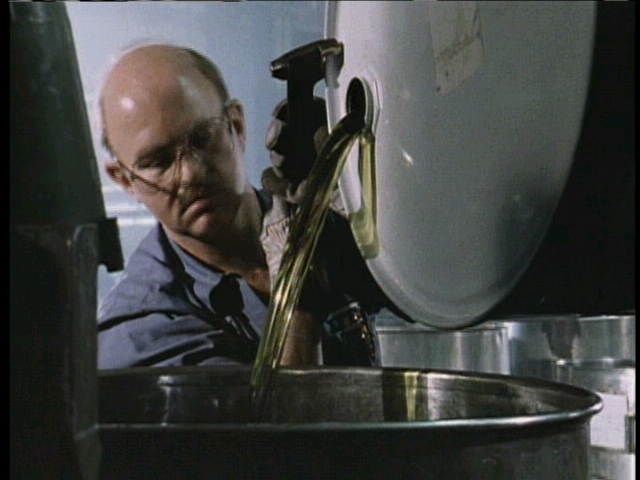
The second big eyeopener of this little film involved a visit to a factory where fragrances are produced. I have often referred to “vat-produced chemical soup” in my negative reviews of what I find to be unwearable fragrances (not worthy of the name perfume...), and in The Mystery of the Senses: Smell, all of my suspicions were confirmed about the various kinds of errors which may arise when factory workers mix together perfumes in large vats.


Ever wonder about batch variations? The nearly infinite possibilities for mistakes are revealed in a few snapshots of the inside of one of the places where fragrances are produced in bulk volumes. All it would take would be one tiny error: a mix-up on the tank, the spigot number, the measurement line for the proper amount to add, a distracting cellphone call, a foreman's illegible scrawl...


After this incredibly insightful look at the inside of one of these fragrance factories, I realized that it's very nearly a miracle that any two different batches ever smell anything alike! 


Small wonder that big perfume houses feel that they can reformulate with impunity. Mistakes are and can only be made! Oh well.


The third, and by far most important part of this educational film, for perfumistas, is the rare glimpse which it offers into the behind-the-scenes workings at International Flavors and Fragrances (IFF). 


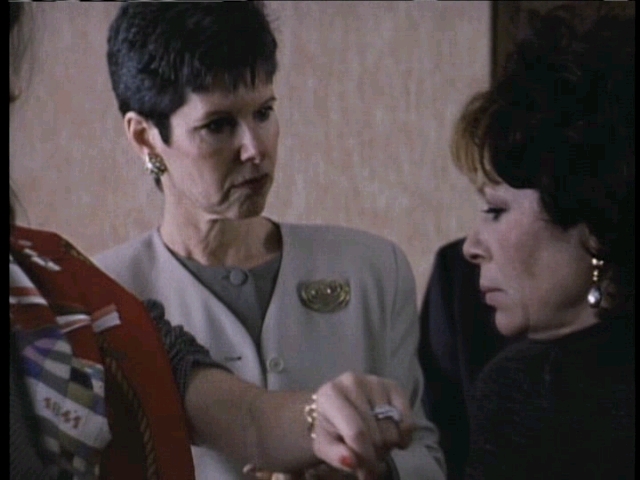
Viewers are treated to such exquisite sights as a perfumer and his manager arguing animatedly over a toilet about whether a new cleaning scent contains too much pine—and (because the manager thinks that it does) what to do about it.


Again, a perfumer and his supervisor hover over a freshly shampooed head, which, they come to agree, smells too sophisticated, too floral, and needs more fruit to be able to appeal to younger consumers! 


So there you have it, my fragrant friends: the ultimate source of the fruity-floral tsunami of fragrances being put out today. These supervisors and managers working behind the scenes at IFF—and elsewhere, I presume—are requiring perfumers to modify their creations to fit prior shared conceptions of what toilets and young women should smell like!

La crème de la crème of The Mystery of the Senses: Smell is without question the portion devoted to perfumer Sophia Grojsman as she struggles to compose a perfume which will please fellow perfumer Ann Gottlieb who, rather than working as a perfumer, wears the client's hat, as she is representing the company for whom Grojsman has been enlisted to produce the perfume on behalf of IFF.


Grojsman expresses manifest frustration at having been asked by her employer to produce a men's fragrance, given that she specializes in women's floral accords. She also complains at one point that the powers that be at IFF have decided that she works better under pressure, so now they all “step on my neck”!


That what Grojsman says is indeed true becomes clear in the scene in which she and Gottlieb face off over Grojsman's fragrance submission. Gottlieb has the power in this relationship, representing as she does the company who will have the final say on whether Grojsman's new composition will be launched as a perfume. 


Gottlieb complains that Grojsman's fragrance needs a fresher top note, and she provides a liquid example of what, as she puts it, “we'd like to see built into your submission.”


All of this takes place on Friday afternoon. The group comprises representatives from both sides: the client, led by Gottlieb; and IFF, with Sophia Grojsman as the target of criticism for having produced a perfume (gasp!) unacceptable to Gottlieb! The group decides to reconvene to evaluate Grojsman's modified submission on Monday afternoon at 2pm. The Friday meeting is thus adjourned and, from there, presumably all of the bureaucrats and Tzar Gottlieb go home to enjoy the weekend. 


Meanwhile, Grojsman toils away nonstop in her laboratory, assistants by her side, attempting to produce Gottlieb's desired fragrance by the looming deadline.


Grojsman's weekend struggle is ultimately for naught, as the fragrance is rejected and the formula relegated to the vault of perfumes composed but never launched, an official failure. Why? 


Because the client rejected what Grojsman produced for having failed to be what the client wanted it to be.


Discussion

In The Mystery of the Senses: Smell, Gottlieb comes off looking like something of a villain, towering over Grojsman and browbeating her into producing what Gottlieb wishes to smell. Given this derogatory depiction, I feel obliged to observe here that I myself am in fact a fan of perfumer Ann Gottlieb, who was the nose behind two quite original creations: Sarah Jessica Parker Covet, a bizarre lavender-chocolate fougère, and Calvin Klein Contradiction, an oddly indescribable and equally appealing eucalyptus-fruity-oriental perfume. 

Both of these compositions are admired and even loved by me and, perhaps precisely for their sheer eccentricity, both have been discontinued. Gottlieb created these innovative and challenging perfumes and obviously had the gumption to stand up to her clients. Covet and Contradiction, albeit now discontinued, were in fact launched. Alas, these perfumes fell prey to the tyranny of the market, to whom the companies which produced them are beholden. Businesses, lest anyone forget, are intrinsically profit-seeking entities.

In the scene in which Gottlieb appears in The Mystery of the Senses: Smell, she is the boss, exerting near tyrannical power over Grojsman, whom many, however, regard as a better perfumer. Certainly, Grojsman's résumé boasts far more success stories: Estée Lauder White Linen and Beautiful, Calvin Klein Eternity, Yves Saint Laurent Paris and Yvresse (originally launched as Champagne, the perfume being celebrated at the opening of this production), Lancôme Trésor, Bvlgari Bvlgari pour Femme. The list of Sophia Grojsman-designed bestselling perfumes literally goes on and on and on...

I must reiterate that the face-off between Gottlieb and Grojsman presented in this video was very surprising to me, as I have always regarded Sophia Grojsman as the perfume artist par excellence, if any perfumer is an artist at all. That is, in effect, the question pointedly raised by The Mystery of the Senses: Smell, and it makes the short film well worth any perfumista's time to see the reality of what perfumers are doing when they agree to work for clients who have the final say on whether a new creation makes the grade, deserves to be launched and therefore exist.

The fact that Ann Gottlieb, a considerably less well-known and less well-regarded perfumer than Sophia Grojsman should be able to issue a fate-sealing judgment on one of Grojsman's creations constitutes a serious reality check for those who persist in insisting that perfumery is an art. Watch this film, please, if you can find a copy somewhere—anywhere—and then ask yourself whether the kind of pressure under which Grojsman is placed, forced to modify her creative output to reflect the values of other people—and ultimately to please their, not her tastes—can properly be considered artistic creation. To me, this little film provides an iron-clad, definitive proof of what Bryan Ross over at From Pyrgos has been saying all along:

Client-commissioned perfumery is design.

What all of the perfumers at IFF are doing—whether they work in the toilet bowl cleaner area or around the shampoo sinks or in an elaborate workshop such as Sophia Grojsman's, where iconic perfumes are born—is the same. Yes, scents for toilet bowl cleaners and shampoos are created in the same way, with negotiations and concessions being made by clients and contracted perfumers. Should we say, then, that all of the perfumers working at IFF are artists?

One thing is clear: if the word artist is to mean anything, then it must delineate a contrast class. The question becomes: who are the non-artists among all perfumers? If, as Chandler Burr ("The Curator") suggested in an interview for a piece at the Daily Beast regarding his new "olfactory art" exhibit (at the Museum of Arts and Design), even the person who created the scent for Coppertone suntan lotion is an artist, then it starts to sound as though anyone who produces new scents is automatically an artist. In the case of this naïve—or ignorant, if you like—use of artist as an emotive form of approbation, the term simply refers to anyone who produces something which we appreciate. What many in the "perfumery is art" camp fail to grasp is that the question of whether perfumery is art is not a question about whether perfume is a good or worthy thing. It is, rather, a conceptual question.

If every perfumer is an artist, then why not every chef and gardener and wine producer? Are candle and soap makers and bakers also artists in this sense? Well, then why not everyone else who does anything else we value, too? Why not farmers, civil engineers, school teachers, and heads of state? All of these people apply their intellect to generate creative solutions and reach certain goals: crop rotation, irrigation systems, interdisciplinary classroom curricula, five-year plans. Are these all supposed to be artworks, too?

We should not blind ourselves to the implications of this sort of promiscuous application of the term artist to everyone and his mother, brother, sister, father, cousin, niece and nephew.... In the end, if everyone is an artist, then no one is an artist. The label has been evacuated of all meaning. Why not, then, simply honor the perfumers who excel at their trade by identifying them as “great”?