Showing posts with label history. Show all posts

Thursday, June 13, 2013

A Perfumista's Perfect Coffee Table Book


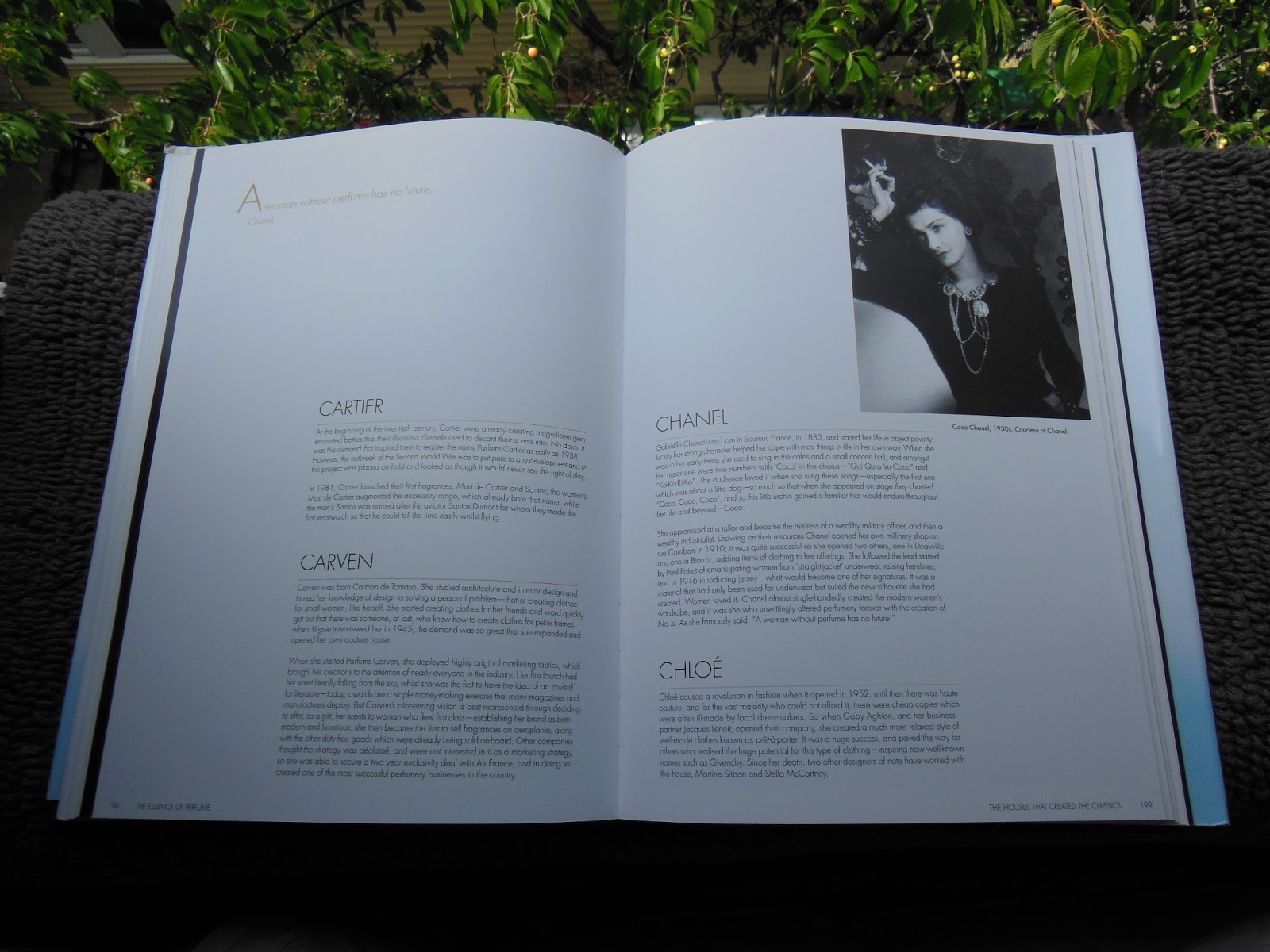
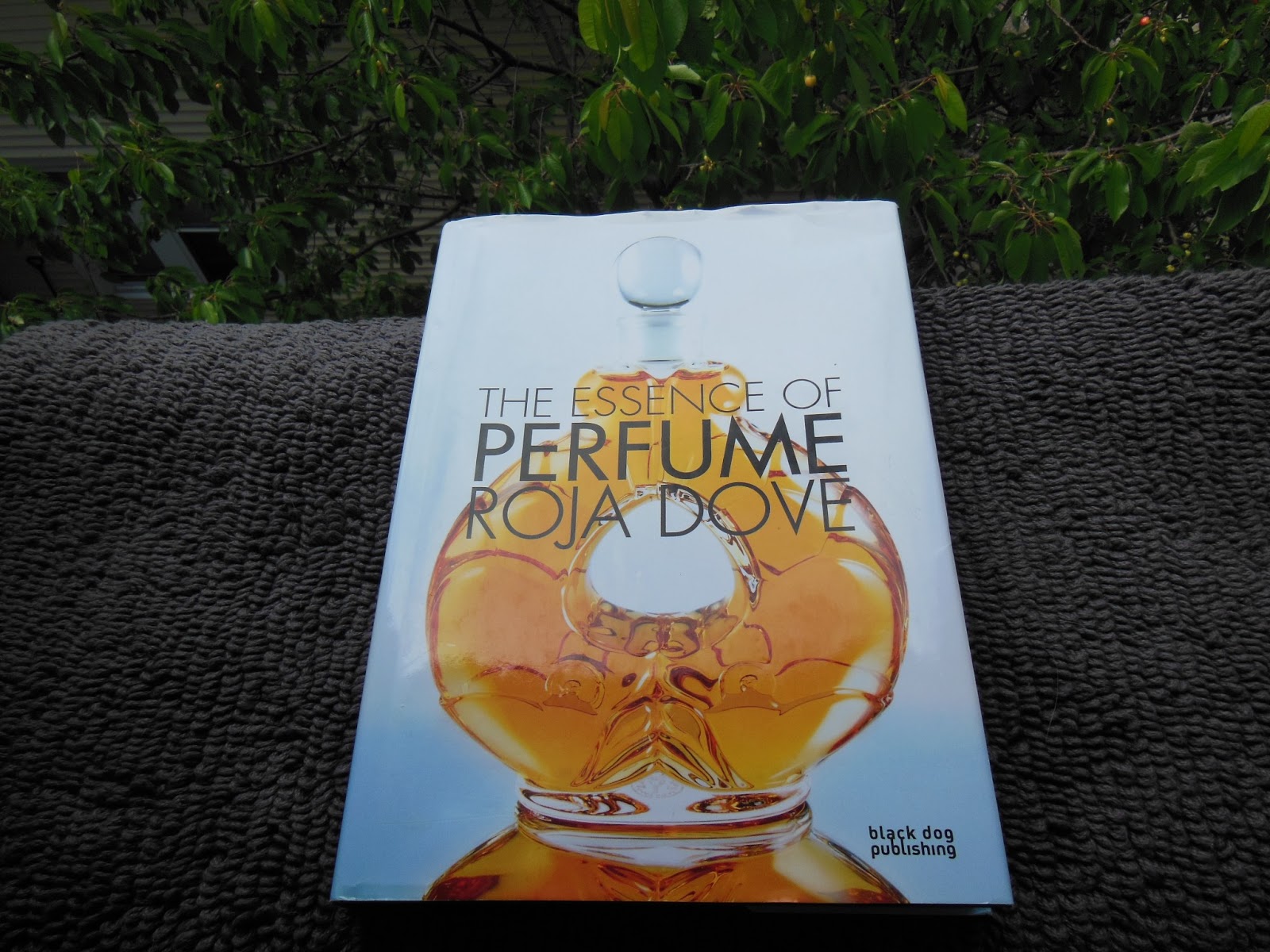
The Essence of Perfume (2008) by Roja Dove

Coffee table books are a funny genre. They may be the least read of all publications, because they serve functions quite distinct from those of other kinds of books. Coffee table books are primarily decorative in nature.


They sit in people's living rooms generally untouched along with a variety of other random objects. Often they are art related and may feature the name of their subject in bold type on the spine: Picasso, Van Gogh, Monet, Kandinsky, Warhol, Pollock, the list of immediately recognizable artists, even to people who never studied art history in school, goes on and on and on.


More sophisticated persons, who did study art history and perhaps have careers related in some way to art or design, may have stacks of coffee table books covering far more obscure subjects, featuring names unknown to the vast majority even of educated people. The books mark the owners as being a part of an elite cultural group rather far removed from the unwashed masses whose "coffee tables" serve as ottomans before televisions and are more likely to be littered with empty beer cans than covered with tastefully placed books.


With the advent of the internet, the boundaries between such groups have become far more fluid, since anyone can learn about even the most arcane of subjects simply by investing some time surfing the world wide web. 


Which brings us back to the subject of coffee table books. Why? Because they may be the only surviving physical books in the decades and centuries to come. As devices become the primary source of printed books, making it possible to carry an entire library in one's briefcase or purse--or better yet simply access someone else's collection as needed--coffee table books may still persist, sitting in pretty stacks in living rooms rarely if ever to be read, but occasionally browsed through, provided that the images which they contain are sufficiently engaging.


Roja Dove's The Essence of Perfume, published by Black Dog in 2008, is just such a book--provided that one is a perfumista. In fact, the book is ideal as a perfumista's coffee table book because it is filled with fascinating information of little interest to anyone but perfumistas. Ask yourself how many people outside the internet fragrance communities (people, say, in your neighborhood), would be interested in a history of perfume decade by decade?


What about a list of common ingredients in perfume, along with their sources and facts about their particular manner of isolation and use?


How many people do you know who would be interested in finding out the precise distinctions between the various concentrations of perfume: extrait, eau de parfum, eau de toilette, eau de fraîcheur and eau de cologne? Do you know very many non-perfumistas who care about the history of the major perfume-producing design houses, beginning with Chanel?


The Essence of Perfume offers all of this and more in a large format, beautiful coffee table book filled with information of interest to perfumistas--and only perfumistas! The black cloth binding embossed with gold lettering will make the day when the cover falls away in tatters after too much fondling a happy one indeed.


Sunday, June 2, 2013

Coco sans Parfum


Reflections on Coco avant Chanel  (2009), 
directed by Anne Fontaine

Historical fictions are tricky. Whether books or films, they play with and shape the facts in order to present a more pleasing work. The truth of what really happened may be sacrificed under the guise of poetic license. Because history is so complex, the decision to include or omit mention of certain parts of a story can completely change the overall portrait of controversial figures such as Gabrielle “Coco” Chanel. Before watching Coco avant Chanel, one of three films about the fashion designer released at about the same time (around 2009), I knew nearly nothing about her. This version of the story, in which Audrey Tatou plays the lead role, focuses on a simple idea: after her mother's death, little Coco was consigned by her father to an orphanage where she was raised by nuns. A single image of the young girl serves to determine the rest of the story:


Not much time is devoted to this segment of her life, but we learn that on visiting day, Coco would go wait outside for her father to come, which he never did. The image of this innocent child, devoid of any parental love and left to her own devices is referenced throughout the rest of the film.

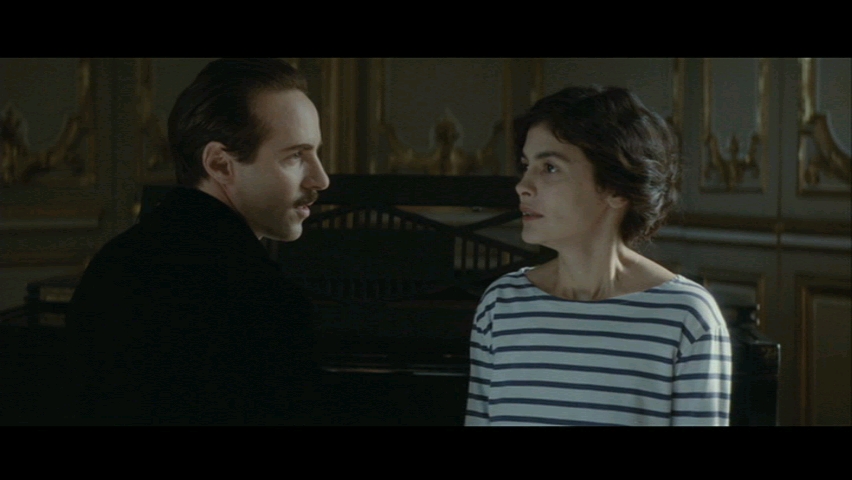
Flashing forward to her young adulthood, Coco is singing at night for tips at a cabaret while working by day as a seamstress. She makes the acquaintance of Etienne Balsan, a rather boorish but extremely wealthy “old money” Frenchman, with whom she has a brief fling. 


Balsan arranges an audition for the young woman to obtain a regular position as entertainer, but Coco does not impress the judge with her performance. 

Her hopes of succeeding as a singer and dancer are dashed, and she returns to her apparent fate: to work as a seamstress.


When her sister (this is a composite character in the film, whose story does not accurately depict what happened) takes leave to live with a man whom she hopes to marry—though this seems unlikely ever to happen and indeed never happens, as a result of her membership in the French equivalent of an undesirable social caste—Coco decides to pay Etienne a visit at his estate, under the pretext that she is on the way to visit her sister and has decided to stop by. 


Needless to say, he is surprised to see her in this context, where she does not belong, as they met in the demimonde.


Chanel ends up staying at the Balsan estate as a live-in concubine whose true status is revealed when she is required to remain hidden from sight during parties with the social elites whom Balsan entertains. The arrangement is degrading, to put it mildly. 


Even when Balsan takes Coco to the horse races, he abandons her while he goes to sit with his upper-crust friends in the stands.


Probably the most shocking part of this arrangement is that Balsan “loans” Coco for the weekend to one of his British friends, Arthur “Boy” Capel, who has become slightly smitten with the attractive and obviously intelligent woman who has taken up residence chez Balsan. 


Coco and Arthur become romantically involved despite Balsan's presence during a costume party, and when they take off to the seashore, Coco begins to dream of life as the wife of this wonderful British nobleman, who far from hiding her away, puts her on display, taking her to dance at a fancy ball and treating her like a genuine lady rather than a low-class live-in domestic servant, as she is accustomed to being treated by Balsan.


Alas, Coco's dream is shortlived, as she is curtly apprised by Balsan that Capel is soon to be married to a high-society English lady. Arthur attempts to persuade Coco to believe that two people can be in love without marrying, and that his marriage is nothing more than a matter of social convention—from which he is apparently too weak to demur—but Coco is crushed by the news.


Coco's True Calling


Throughout her years at the Balsan estate, Chanel has been developing her unique pared-down, minimalist style, transforming men's clothes into innovative pieces for herself. By wearing these new creations, she flouts the reigning trends, which emphasize opulence and “busy” designs and patterns, perhaps most graphically illustrated by the huge hats being donned by women, but also by the obligatory corset worn by all true ladies.


Coco avant Chanel focuses on a couple of distinctive trends begun by the fashion designer, including the use of black, formerly restricted to mourning contexts, and the stripping out of excessive embellishment such as feathers and flowers. Chanel is portrayed in the film as a women's liberator of sorts, insisting that they should be able to breathe and move freely in their dresses. In several scenes she is depicted unlacing women's oppressive corsets.

In reality, according to other sources, Chanel's sympathies with women's liberation began and ended with the abolition of corsets. She paid her own workers very poorly, and when they complained, she remarked, "let them take lovers." She vehemently opposed unionization to the point where she preferred to withdraw from the fashion industry for a number of years rather than accede to the demands being made by her workers. All of this is omitted from the story as depicted in Coco avant Chanel, which ends up seeming more like a statement on the conditions of lower-class women in the early twentieth-century than a faithful portrait of Gabrielle Chanel.

In this film, the image of innocence is nursed from start to finish, and well-conveyed by Audrey Tatou, as she portrays a woman whose at times objectively disgraceful behavior is rendered comprehensible, and even a cause for sympathy, given her humble origins.


The truth is that Gabrielle Chanel would never have become a fashion icon had she been born into a family with money. She would have married a gentleman and borne his children, and we would know nothing of her today. Instead, she became associated with wealthy gentlemen who provided her with the means she needed to begin her own boutique in Paris. Coco avant Chanel skillfully presents the impediments to success to women in what until only recently has been a man's world, making Chanel's eventual triumph seem all the more remarkable.

In this film, Arthur Capel is credited with being the primary supporter and benefactor during Chanel's early years as a fashion designer. (In reality, it may have been Etienne Balsan, who is depicted as something of a scoundrel here.)  Despite Arthur's marriage to someone else, he is painted as the love of Chanel's life, and their affair continues torridly on. 


When Capel is killed in an untimely automobile accident, Coco plunges into despair.


The rest of the film portrays Chanel working indefatigably, apparently as an outlet to replace the lost love of her life. At the end she is presented as a strong and independent woman who never married because, it is strongly implied, she loved only one man, Arthur “Boy” Capel.


This, too, is a matter purely of poetic license, for we know for a fact that Coco Chanel had affairs with many other men. Indeed, in another film released also in 2009, Coco Chanel and Igor Stravinsky (to be reviewed here imminently), the fashion designer is portrayed as one of the inspirations and benefactors of the great composer! More infamously and less controversially (no one seems to know for sure whether Chanel ever had an intimate affair with Stravinsky), it is a matter of historical record that during the Nazi occupation of France, she lived in the Ritz Carleton hotel among German officers, one of whom was her lover for many years.


The Perfume Angle

What does any of this have to do with perfume? you may by now be wondering, and not without good reason. In fact, the word 'perfume' is nowhere pronounced in Coco avant Chanel. Nor is there is a single image of any woman (or man) reaching for a bottle of perfume. There are not even any images of bottles of perfume anywhere in sight—not even in the fancy boudoirs at the estate of Etienne Balsan. 


There is, however, one plausible candidate for perfume wearer in the story, Emilienne d'Alençon, an actress who has had a longer-term and somewhat higher-level affair with Etienne Balsan. This woman did exist in history, and was notorious for attaching herself to men of means, sometimes to the point of their ruin.


Rather than Coco telling Emilienne that “women have no business smelling like flowers,” in the story as depicted in the film, Coco designs streamlined hats for the flamboyant woman, in effect telling her that “women have no business wearing birds' nests on their head.” 


No mention is made of Emilienne reeking of violets or honeysuckle or any of the other soliflores which Chanel is reputed to have denounced during her design with perfumer Ernest Beaux of Chanel no 5.

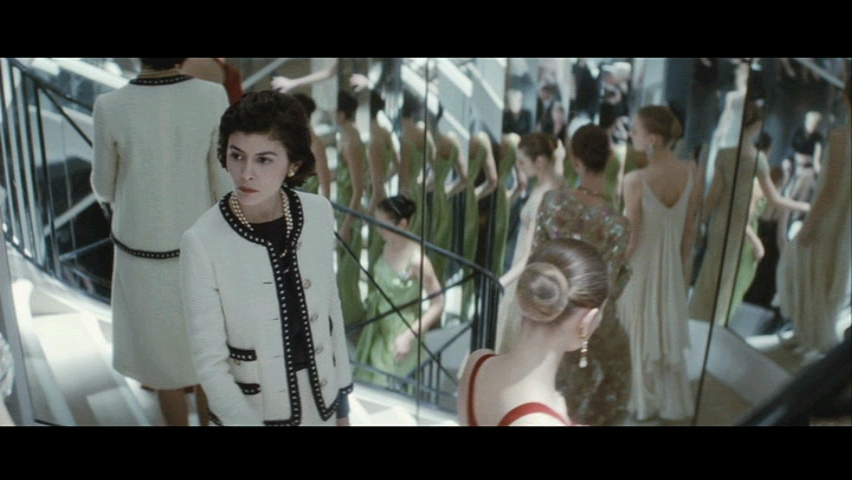
It is striking that there should be no mention of perfume whatsoever, though the film spans the duration of Gabrielle's life from her earliest days at the orphanage through the triumphant post-war comeback, where Chanel is shown inspecting her models from the vista of her famous mirrored staircase.


What are we to conclude? Someone ignorant about perfumery would come away from this film with no knowledge that Gabrielle Chanel brought into existence the most iconic perfume of the twentieth century. We perfumistas of course know this to be the case. Could a woman completely devoid of any interest in scent have done such a thing?


I should say that scent is not entirely absent from this film, as Coco is chain smoking in many of the scenes, from her days at the cabaret to her nights working alone in her atelier. While designing in her boutique, with customers present, she is repeatedly depicted with a cigarette dripping from her lip, to the point where one may not unreasonably wonder how an errant spark never caused the whole place to burn down in a blazing conflagration of black lace, silk, and wool.


Cigarette smoke has a strong and even overwhelming odor, which will modify, if not entirely mask, all subtle perfume. So one message which we could glean from this film, devoid though it is of any explicit mention of scent, is that when Chanel set about designing perfume, for her nose to be satisfied, it had to be a declarative, penetrating scent which would be detectable even in the presence of cigarette smoke. Perhaps therein lies the true reason why Chanel thought that women have no business smelling like flowers. A simple floral soliflore could never compete with the chimney stack of cigarette smoke which she was constantly pumping out!

Another message to take away from the omission of any mention whatsoever of Chanel no 5  is that Chanel was first and foremost a fashion designer, and perfume for her was a type of accessory. The fact that she farmed out her perfumery interest to the Wertheimer brothers would seem to corroborate that idea. Later, when Chanel no 5 became enormously successful, as a result of the marketing savvy of her partners, Coco attempted to reappropriate that part of her business, but her reasons appear to have been economic, not olfactory.

Perhaps the most obvious message to glean from the omission of any mention of perfume from Coco avant Chanel is that the director, Anne Fontaine, has no interest in perfume and so, to her, it seemed unnecessary to treat the topic at all in this version of the story. That a perfume-free film about Chanel could be made at all should serve as an important reminder to those of us ensconced within the subculture of perfume aficionados. There are countless people in the universe who do not care at all about perfume and find it even less interesting and valuable than fashion. Small wonder, then, that nearly no one takes it seriously as one of the beaux arts.


Friday, February 15, 2013

A Tendentious History of the World's Most Hyped Perfume


Reflections on the state of perfume writing occasioned by my reading of

The Secret of Chanel no. 5: 
The Intimate History of the World's Most Famous Perfume (2010)by Tilar J. Mazzeo


There is a serious dearth of books on perfume. Trust me, I've looked. A short stack of books are read and praised by perfume lovers because only that short stack exists. To be honest, most of the best of a bad bunch are not really up to snuff, if compared to works about other cultural phenomena written by serious critics with the appropriate theoretical background to support their claim to expertise regarding the topics about which they write.

Part of the problem in the area of perfume—aside from the gushing enthusiasm which seems to substitute in some cases for training and education—appears to be a general deficit of critical acumen among people who are really quite good at self-promotion but much less good at digging very deeply into the topic of perfume. They exalt themselves as experts and then, because there is no one around to dispute such claims, readers simply accept that the authors are what their publishers vociferously proclaim: the experts.

Perfumistas brush all of this aside. They don't care about credentials. “All you need is love” is what many apparently think. Guide groupies bristle at anyone's attempt to point out that personal attacks on perfumers and houses are not a form of valid criticism—and indeed exemplify fallacious reasoning. It all becomes ugly when critics attempt to criticize the pseudo-critics. That, it seems, is not permitted. We must love all perfume lovers who are attempting to elevate the object of our love—no matter how inept and self-defeating their efforts may be in the grand scheme of things, beyond the cloistered community of full-fledged fragrance fans.

Chandler Burr studied business and economics before studying, well, Luca Turin, after which Burr was curiously named the perfume critic for the New York Times. Was that appointment, too, like his current post as The Curator of the Department of Olfactory Art at MAD, his very own idea and a result of his own pitch to have himself appointed to the position? I ask because it has been years since Burr departed from The Times, and no person has yet been named to fill the “vacancy”. Is it that no one can fill his shoes? Or is it that no one else has dared to assert that their undying love of perfume qualifies them to bear the impressive title “The New York Times Perfume Critic”?

The nearly total absence of serious intellectuals directing their energies to the topic of perfume has given rise to what looks rather like a Lockean property first-dibs expertise schema, whereby the first people to have the bravura to label themselves “experts” become through that very act accepted by the ignorant masses as “the experts” about perfume.

There has been no need for intellectual rigor in writing about perfume to this point in history for the simple fact that there are so few perfume books in existence that virtually anything which anyone manages to get published will be praised as great by a small cluster of perfume enthusiasts—dare I say fanatics? In a culture which continues to regard perfume as a mere toiletry—or, at best, an accessory—anyone who cares (obsesses?) enough about perfume to be buying books about the subject is not going to be all that selective. They do not have that luxury, again, for the simple reason that perfume has yet to be taken seriously as an object of sustained intellectual critique.

There's a chicken-and-egg problem here: no one—aside from perfume junkies and geeks—seems to be taking perfume very seriously as a cultural phenomenon, one worthy of sustained critique, precisely because no one aside from juice-addicted perfumistas takes perfume seriously at all, with the notable exception, of course, of those who are in the business of perfumery for the bountiful profits which it reaps.

There are a few astute bloggers here and there, but in the published book category, not much has happened yet. Pseudo-intellectual drivel spewed out about perfume by slick public relations teams deployed in the service of a few aspirants to wealth and fame (and free perfume!) does not help in this regard. Outsiders, the non-perfumistas, cannot take diaphanous perfume marketing campaigns masquerading as high theory seriously. And why, after all, should they?

So there is Perfumes: The A-Z Guide, which portends to be a work of criticism and vaunts being the “only” book of its kind. I've said it before, and I'll say it again: the only book of its kind is both the best and the worst of its kind, and until better books come along, many people will continue to praise that work as great. In reality, Turin and Sanchez do no more in that book than to broadcast their own tastes and promote some perfumers and their creations, while demoting others in rude and sometimes vicious terms.

This point is obviously lost on many perfumistas, but in every other realm of inquiry there is a clear distinction between criticism, on the one hand, and slander and insults, on the other. Unfortunately Turin and Sanchez do not appear to recognize that distinction and brazenly and boorishly conflate the two, offering ad hominem attacks and personal insults in lieu of arguments or principles of aesthetic criticism. An abundance of passion and enthusiasm is not an effective substitute for reason, and being ready and willing to yell louder than anyone around does not imply that one is right.

Books for and by perfume lovers tend to show their bias—and pretension—on their covers. Turin and Sanchez allowed their musings to be published under the highly misleading title Perfume: The A-Z Guide, when it is nothing of the kind. The title is in fact triply mendacious. Fortunately, members of online fragrance communities are slowly becoming more savvy through their exposure to a wide range of reviews written by many different people. As a result, even some of the former Guide groupies appear to be coming to the recognition that, however passionate Turin and Sanchez (and Chandler Burr after them) may be about perfume, they are ultimately, at the end of the day, attempting to persuade readers that idiosyncratic and subjective values and tastes are objective truths.


Another Case in Point

Provocative titles sell books, as many consumers do judge a book by its cover. Tilar Mazzeo's The Secret of Chanel no. 5: The Intimate History of the World's Most Famous Perfume (2010) offers another example of the same. To sell books, one must have a claim to exclusivity and expertise—or pay deference to those who have made that their claim to fame. Chandler Burr's name is emblazoned prominently as the author of the first blurb on the back cover of The Secret of Chanel no. 5. Mazzeo thanks Turin and Sanchez on her acknowledgment page for having taken the time to speak with her. This is how the “expert” system works, too, in academia, where the back-cover blurb industry is frankly laughable, so perhaps I should not be surprised. The difference is that there are no checks and balances of any kind in the tiny universe of entirely self-appointed perfume critics.

What is odd about this book is not that Mazzeo is a true believer in the greatness of Chanel no 5—who but a true believer would bother to attempt to write the cultural history of a single perfume? No, what is a bit surprising is only that her preaching to the choir should be so very flagrant. Leaps of logic abound throughout the story of Chanel no 5 as told by Mazzeo, as she sets up what appear to be genuinely intriguing possibilities, and then in a short phrase resolves the question at issue with the bald statement, in effect, that Chanel no 5 is great, what is both the first premise and the conclusion of this work.

In this regard, Mazzeo provides a book-length example of the informal fallacy known as “begging the question”: to assume as a first premise what one is attempting to demonstrate. (As an aside, in the vernacular, “begging the question” has come recently to be used by people as a substitute for “raising the question”. So one often sees the observation that “this begs the question..., after which a question is posed.)

Unfortunately, all of the leaps in Mazzeo's “history” lean toward the protectionist side, minimizing any detraction from the hypothesis of the greatness of this perfume and its creator, all of which leads one to suspect that this is not at all “The Unauthorized Biography,” as the inside jacket of the book enticingly boasts, but the “thoroughly approved by the suits at Chanel” version of the story. Devotees will complain (as did Guide groupies before them): "So what? If you want a better book, why don't you write one?”

This sort of response, according to which it is somehow gauche or inappropriate to criticize already published books, that the only acceptable response is to publish another one to replace it, misunderstands the nature of criticism. You publish a book, and you put it out there in the world to be read. Some people will disagree with what you say and call you out on your false, and in some cases fraudulent, claims. That's the chance that you take.

Is the solution to stuff critics' mouths with socks and duct tape them shut? No, it is not. Is the only acceptable response to a mediocre book to publish a better book on the same topic but which avoids making the same mistakes? No, it is not. A critic may not have the interest or desire to devote the years of research needed to get to the bottom of the question. That does not mean that she is required to accept as gospel whatever the shucksters say.

There is a genuinely interesting question here: why is Chanel no. 5 so popular and famous? Well, to anyone familiar with even the broadest contours of the business of perfumery—or business more generally—it might seem that the obvious answer, superlative marketing and hype, should indeed be the best explanation of this perfume's phenomenal success. But, no, Mazzeo “informs” the reader: it is not just marketing; it is not just hype. It is that Chanel no 5 is something somehow transcendent. But is it, even according to Mazzeo's own marshaling of the facts?

Gabrielle Chanel granted control of the perfume branch of her eponymous company to the Wertheimer brothers in exchange for a percentage of profits paid back to her. Why? Because she wanted to focus on fashion, not the production and distribution of perfume. When the perfume became more popular and profitable than her haute couture, Chanel came to experience seller's remorse. This sort of thing is not at all uncommon in the history of business. The person who came up with the idea of Victoria's Secret, a company amazingly devoted solely and unashamedly to lingerie, so that ordinary women could walk into the store without feeling like a whore, sold the idea to someone else who developed it to resounding success. The woman who masterminded the root idea of The Body Shop, also sold her rights, and we all know how that story ended, with stores in cities all over the world. Even Facebook is said to have derived from the root idea of a couple of Mark Zuckerberg's cohorts at Harvard. (See The Social Network (2010), if you are unfamiliar with the story.) What matters in all of these cases is not the bright idea, but how it is nurtured and capitalized upon. Bright ideas are a dime a dozen. Entrepreneurs take such ideas—wherever they came from—and run with them hard and fast.

In the case of Chanel no 5 perfume, the Wertheimer brothers were incredibly savvy at business, more so even than Coco Chanel. The brothers, being Jewish, expatriated right before the German occupation of France to avoid—well, extermination—having sold the majority of the company to an Aryan partner, Félix Amiot, under whose management the company, too, could continue to survive. Under the law at the time, Jewish persons were not permitted to own businesses, and Coco Chanel was ready and willing to do what she needed to regain control of what had by then become a thriving perfumery business. But she was not quite as savvy as her partners, for they beat her to the punch, selling the company before she wrote her infamous letter to carry out her “civic duty” by reporting the Jewish ownership of the perfume branch to the appropriate authorities.

Working in the United States, the Wertheimers continued to devise ingenious marketing strategies. They got the needed Grasse jasmine smuggled out of France and delivered to humble Hoboken. Mazzeo describes how the brothers also decided to stop advertising in the 1940s in order to cut costs. As she tells the story, the natural materials needed to keep the perfume top quality required that corners be cut elsewhere. Of course, they did not reformulate—that would have been to ruin the perfume! Let's see, what would the Chanel company line on reformulation be, I wonder? I believe that it would be in their best interests to deny that the perfume was ever reformulated in any way. Until, of course, that becomes impossible. With the end of the use of natural musk in perfumery, reformulation became ineluctable, but Mazzeo assures the reader near the end of her tale:

Chanel No. 5 fans need not worry, though, because Chanel No. 5 still has those rich, warm scents of skin and that note of intense sensuality that Coco Chanel always wanted. As Christopher Sheldrake explains, while those nitromusks were wonderful, powerful, and inexpensive, they were not irreplaceable. There are ways to re-create their warmth and powdery textures in a perfume. It's just that they can't be replaced on the cheap, and most fragrance houses aren't prepared to spend the money. And, as perfumer Virginia Bonofiglio quips, "You can't make cheap that smells like Chanel No. 5."

In discussing the restrictions imposed by the IFRA regarding the use of jasmine in perfume, Matteo assures the reader, again:

New IFRA allergy restrictions won't threaten the perfume either, because for several years researchers at Chanel have been committed to finding a permanent solution. Among those hundreds of molecules in natural jasmine, it is only one or two that have the potential to cause even the most sensitive among us any problems. Creating a synthetic jasmine as nuanced and subtle as the natural jasmine of Grasse would be an impossible undertaking, but breeding just one or two molecules out of a plant or finding a technique to remove one or two molecules from an extract is entirely possible. Soon, Chanel hopes simply to have resolved the problem of jasmine sensitivity entirely. They hope that, eventually, the jasmine from Grasse will be something anyone can wear without hesitation—no matter how daringly high the doses.
For now, the legacy of the perfume is safe. Despite changes around it, the world's most famous fragrance remains essentially unchanged and timeless.

Goodbye scholarship. Hello, marketing text! And three cheers for GMOs!

To return to the World War II scenario, Matteo explains that rather than compromising the quality of the perfume through cheapening its formula, the Wertheimers instead undertook an initiative which made Chanel no 5 not just profitable, but universally loved: they distributed the perfume through the same channels—the military commissaries or PXs—which delivered food and cigarettes to the troops abroad, wherever they were stationed. Soldiers bought up the perfume for their mistresses or their loved ones back home, and by the end of the war, every woman, it seems, as Mazzeo tells the story, wanted nothing more ardently than a bottle of Chanel no 5—perhaps even more than world peace!

The question which Mazzeo does not answer is this: if it is true that the Wertheimers were so keen to sell as many bottles as possible, and if they knew that their new and vast client base had no perfume sophistication whatsoever, then why in the world would they not reformulate, so as to cut costs further and dramatically increase profits? No, Mazzeo insists. They would never have done such a thing.

Throughout the book, Mazzeo deflects any worries about any possible compromises to the formula of Chanel no 5 in exactly the same way: by flatly denying that they ever took place. Unfortunately, her grounds for this denial appear to be no and more less than her own fervent belief in the continuous integrity of the perfume, through thick and thin, and even at its low point, when the perfume had come to be broadly distributed through American drugstores.

As we all know, the other perfumes which went the drugstore route—consider the sad case of what once were the Coty classics—were horrifically reformulated and never restored. Reformulation in other cases has been a one-way street. Mazzeo simply denies that it ever took place at all in the case of Chanel no 5—despite the fact that it was being sold alongside other ghastly reformulations at the drugstore at the same time.

It is true, of course, that Chanel no 5 is in much better shape today than, say, Coty Muguet des Bois or Emeraude or Nina Ricci L'Air du Temps or... the list goes on and on. But that does not show that Chanel no 5 was never being sold in an inferior formulation while being mass-marketed at drugstores. Instead, it suggests that under subsequent management, the perfume was brought back to its luxury status—and, one surmises, was re-reformulated to the point of at least approximating the original perfume.

What can the grounds be for Mazzeo's insistence on the perfume's uninterrupted integrity beyond the fact that the company denies that reformulation ever took place? The Wertheimers were businessmen, not believers in the sacred immortality of the product which they were peddling. To them, it was a commodity like any other, so why would they cut into their own profits by producing Chanel no 5 at a quality level likely to go altogether unnoticed by the sorts of people—soldiers and their lovers—to whom it was being sold? No answer is given to this question by Mazzeo, because it should be obvious to any of her readers—most of whom are no doubt already true believers—that such an aesthetic crime would be tantamount to murder.

To return to the question of how Chanel no 5 ascended to universal icon status, what Mazzeo does not address is whether the distribution of the perfume to emotionally fraught and love-starved troops—allied and axis alike—would not have done the same for any other perfume distributed in that way. This was what catapulted Chanel no 5 to its status as the number-one selling perfume, where it has stayed since World War II, and what secured what Mazzeo seems to think will be its eternal fame. In truth, the wild popularity of this particular perfume could be explained by the ingenious distribution scheme alone—the creation of this perfume as a coveted object replete with profound significance as a symbol of survival and the scent of victory and relief.

After spending the entire book beating back any possible suggestion to the effect that Chanel no 5 might not be a sacred and transcendent object worthy of our eternal worship—akin to a religious totem—Mazzeo waffles in her final chapter, ascribing the greatness of this perfume to its legion of fans and attempting to anchor it in individual wearers' subjectivity. She writes:

Instead, the secret at the heart of Chanel No. 5 and its continued success is us and our relationship to it. It's the wonderful and curious fact of our collective fascination with this singular perfume for nearly a century and the story of how a scent has been—and remains—capable of producing in so many of us the wish to preserve it. Think of that number: a bottle sold every thirty seconds. It is an astounding economy of desire.

The root problem with this account is that the author simply ignores what would seem to be the real reason why throngs of fans wore and continue to wear this perfume. They were lured by marketing and hype to buy the perfume, or their lovers or husbands were seduced to purchase it for them. Once a bottle of the perfume had found its way to their vanity tray, these women wore Chanel no 5 and then, of course, it did become their own—for many it was and remains a signature scent.

The problem with Mazzeo's logic is that she supposes that the inherent properties of the perfume are the explanation for the perfume's fan base. If that were the case, why in the world would Chanel need to pay Brad Pitt $7 million to jump start sales? Clearly Chanel no 5 does not sell itself. It requires a huge marketing outlay and ingenious schemes for its continuing success. The first generations of wearers are now dead or moribund. What to do next?

Today, in the twenty-first century, as World War II fades from people's memories, the company is trying once again to drum up enthusiasm for a perfume whose time may have come. An overdose of aldehydes combined with precious essences of jasmine and rose was new and exciting in 1921, and the popularity of the perfume was renewed with each successive marketing scheme, but as the last World War II soldiers and survivors take leave of this world, so will the profound existential significance with which Chanel no 5 was infused throughout much of the twentieth century. We still associate this perfume with images of Marilyn Monroe, dead now for more than fifty years, and the models who represented it in subsequent decades: Catherine Deneuve, Carole Bouquet, Nicole Kidman, Audrey Tatou, and now Brad Pitt. Perhaps Pitt will be the nail in this coffin.

Needless to say, I am not a believer and was not converted by Tilar Mazzeo's book to the view that the resplendent success of Chanel no 5, a good perfume to be sure, has more to do with its allegedly divine beauty than with how it was promoted and distributed throughout the twentieth century. If you are a true believer, then you'll surely read this book as the welcome revelation of gospel. You may enjoy Mazzeo's attempt mystically to link the pristine white sheets at Coco's orphanage to the glacial plains of Siberia and the prominent aldehydes featured in Chanel no 5. No harm in that—don't we all like to read what we already believe? But for everyone else, the most plausible answer to the question What is the secret to Chanel no 5's success? remains unchanged by the publication of this book. The answer, in a phrase, is: marketing and hype.

Wednesday, January 23, 2013

Cliff's Notes to Coco Chanel


Skeptical Reflections on History occasioned by my reading of

Famous Fashion Designers: Coco Chanel (2011), by Dennis Abrams


Having recently viewed three feature-length films about Coco Chanel, all of which emerged around 2009-—Coco before Chanel, Coco Chanel & Igor Stravinsky, and Coco Chanel-—I decided that it might be nice to read a book about her, given that the sum total of my knowledge of the topic was exhausted by the information relayed in those films.

Little did I know that there are hundreds of books about Gabrielle “Coco” Chanel. Most of them are thick tomes with lengthy bibliographies many of the entries of which are earlier biographies of Chanel, and all of the hefty biographies which I took a look at (but did not read) repeatedly cited texts from previous biographies. The history of Coco Chanel has become a veritable industry with scholars writing new biographies presumably to supersede previous biographies, when in fact the primary source of most of the information revealed in any of the books is also previous books.

That is the nature of historical research, of course, which for that very reason has never appealed to me. I am happy that other people are willing to mine through mountains of earlier historians' books to try to figure out what is true and what is false about what has already been said, but I am far too much of a skeptic to be able dedicate my life to that sort of task. Attempting to discern the false from the true in the interpretations of previous historians about important persons and events strikes me as otiose at best. What are the criteria applied? Are not historians often seduced by interpretations which have been artfully designed?

How can a person write a book today about someone who died more than forty years ago? Well, by studying all of the already existent books and attempting to find a “new” angle. Or by locating previously unknown sources of information, in newly discovered letters or documents, or in archives not already mined. To be honest, I have never really understood how people get grants for historical research in archives. I realize that some of them are looking to answer a specific question, but the notion that there is something in an archive to be found, precisely the information needed to answer one's research question, seems tendentious, at best. It also supposes that previous treatments of the topic were inadequate, and the only grounds I've been able to come up with for believing such a thing, in a general way, as the basis of a profession, seem quite pragmatic to me. Burgeoning historians wish to secure positions, and once in academia, they wish to remain gainfully employed.

Since coming up with a “new” angle is what historians are required to do in order to survive professionally, it naturally behooves them to diminish the value of earlier works on their subject so as to elevate their own. It's a strange sort of paradox really, because students of history must simultaneously pay the proper deference to their mentors (also historians), while coming up with something new to say, which seems to imply that at least some of their mentors were wrong. The most interesting question in all of this to me is: why would one believe a priori that there was a new or better angle to come up with? Are new readings supposed to be better simply because they are new?

In the case of new translations of literary works, the thinking seems to be that as language evolves and cultures change, translations need to be updated. That is why translations of works as old as Plato's Republic continue to appear with each new generation of scholars. There are the so-called canonical translations, but young scholars of both ancient Greek and philosophy sometimes put forth newer translations, presumably regarded by them as necessary, which would seem to imply that the currently available translations are in some way inadequate.

In the case of history, the situation seems far more puzzling to me. Anyone who wishes to write a biography of Plato has commenced from a biography-derived understanding of Plato. To modern people, Plato may as well be a fictional character, since all that we have are dead people's accounts of his life. So what could a new biography of Plato possibly say which has not already been said without simply inventing something new?

Needless to say, the above skepticism clearly demonstrates that I would never have made it through a graduate program in history, had I been foolish enough to matriculate in one. How to adjudicate such a delicate and untenable duality? How to both criticize as wrong while paying deference to earlier historians at the very same time? No, thank you all the same.

To return to the case of Coco Chanel, I confess to having been a bit overwhelmed by all of the scholarship on this topic, and it seemed to me that there are basically two kinds of books on offer. First, there are the loyalists, the true believers in Coco Chanel as a great woman, and then there are the anti-loyalists, concerned to reveal her arrant depravity and to expose her for the scoundrel she really was. It makes sense that biographers should be polarized in this way, because anyone who goes to the effort to write an entire book about a topic tends to care quite a lot about it. Yes, passion seems to drive the so-called dispassionate quest for truth in history as elsewhere.

Having myself no interest in becoming a Chanel scholar, I finally decided to opt for the most recently published book which was also as short as possible, since I figured that I'd be sure to learn at least enough from such a book to determine whether I find Coco Chanel a topic sufficiently interesting to warrant reading a lengthier book about her. The book I ended up checking out, Coco Chanel by Dennis Abrams, was published in 2011 and spans a grand total of 124 pages, including an index and chronology. “Perfect” I thought to myself as I requested the book from the library online.

When the book arrived, I was quite surprised to find that it looked an awful lot like a school textbook. The print was large and there were many sidebars and other clues that this little volume was intended for educational purposes. For one thing, the blurb for the author, Dennis Abrams, indicates that he has also written biographies of Hillary Rodham Clinton, H.G. Wells, Rachael Ray, Xerxes, Albert Pujols, Georgia O'Keefe, and Nicolas Sarkozy!

Apparently Mr. Abrams, “a voracious reader since the age of three,” chews through scholarly biographies of famous people and then spits out short readable synopses of their lives. So this book, from the Famous Fashion Designers series published by Chelsea House, is in effect a Cliff's notes version of all of the big fat biographies which I was not sufficiently motivated to read based only on what I had learned about Chanel in three recent films.

I initially hypothesized that this might be a book for vocational tech students who are learning how to sew or perhaps for introductory students at a college of fashion design, primarily because some of Abrams' jibes at Coco seemed a bit too pointed for younger students. He makes a rather big deal out of the fact that she often lied about her life, particularly her lowly origins, and at one point he insists that she was not a designer because she never designed anything in the sense of drawing or sketching a design on paper.

Eventually, after having read the book, I searched for Chelsea House online and discovered that this book is intended for grades 6-12! As a true testimony to my severe deficit in the Coco Chanel scholarship department, I must confess that I managed to learn quite a lot from this little book. Well, I think that I learned from it—-if what Abrams has written is true. What he suggests is that the films which I viewed were loosely based on history, with all sorts of modifications made to increase the coherence of the films as works in and of themselves.

Facts about Chanel's beginnings in the world of fashion, how she supported herself, and why she never married seem to have been distorted in the films in order to make her seem more independent and admirable than she may have been. According to Abrams, Chanel did not marry Hugh Richard Arthur Grosvenor, but the reason seems to be that she was by then too old to bear him an heir. This is a very different version of the story than the one at least suggested in the films, which impart the distinct impression that Chanel was fiercely independent and refused to marry any man.

Another disparity involves the notion that Chanel was some sort of a feminist. Abrams explains that Chanel paid her workers poorly, and models especially, about whom she is cited as saying, “They're beautiful girls. Let them take lovers.” Again, when her workers went on strike to be paid better wages, as Abrams puts it, “Chanel felt that 'her girls' were getting paid quite enough as it was, and if they weren't, well, there were always men available who could help them.”

So much for the feminist myth. According to this account, Coco Chanel was definitely a liberated woman, but she was not a promoter of other women's liberation. The major contribution she appears to have made was to liberate women from their corsets, which was of course a good thing, but it's a far cry from feminism.

I learned a lot from this little book, as elementary as it is. The writing is not the best, but the text is readable. It certainly managed to pique my interest in this topic to the point where I now feel sufficiently motivated to take a stab at one of the larger tomes. I am especially interested in the story of the Wertheimer brothers who completely controlled the Chanel perfumery business. Coco Chanel apparently left everything to them when it came to perfume, initially because she wanted to focus on fashion. Later she regretted having signed off the rights to Chanel no 5, which was a resplendent success under the Wertheimers' management, but Chanel received only a small portion of the profits as a result of her contract with them. To find out more about that story, I'll need to read a bigger book. And I shall.

I do recommend this slim volume as a primer to people who are completely ignorant about the life of Coco Chanel. It would be a perfect lazy afternoon at the beach read as it offers enough of this woman's extraordinary life to keep even those who generally steer clear of biographies intrigued.