Showing posts with label subjectivity. Show all posts

Sunday, February 2, 2014

Report from the Tea Trenches: There are Thousands of Others Like You!


Of late, I've been spending a lot of my online time at Steepster, which is basically the tea lover's analogue to some intersection of Fragrantica, Parfumo, and/or Dnotes. I suppose that since there is no content beyond tea profiles and tea tasting notes (reviews--or comments relating to the same author's previous reviews), the closest comparison would be to Parfumo. 

People who love tea convene at Steepster to share their tea experiences. It's quite clear that some members spend the whole day drinking tea, and writing about drinking tea. So that's a bit different from the online perfume community experience, because few people write more than one review a day, and many people write nothing at all--aside from interacting in the forum boards.

Tea lovers, like perfume lovers, enjoy talking about their recent purchases, their struggle to "contain" their collection, and their desire to expand it at the same time. All of these dynamics are quite familiar to those who have fallen into the bottomless vortex of perfume acquisition, with many of us resolving each January to refrain from buying any more bottles until _____________ (fill in the blank). My favorite resolution is to not buy any new bottles until I have reviewed everything in my house--bottle, decant, and sample. I usually make it a month or more before breaking the resolution. I believe that my record may have been 2013, when I recall having lasted at least through the month of March! 

One relevant difference in this regard between these two obsessions is that tea costs a lot less than perfume and can be consumed several times a day--or all day long! Perfume, on the other hand, is generally worn for several hours, which means that even very prolific reviewers don't write about several different perfumes in a single day. With all of the aromachemicals swirling about in the air these days, that might not even be safe!

What are the other differences between "fumeheads" and "students of tea"? One may be that people who write about their tea experience do not appear to be advocating for the tea. I suppose that one could consider raves to be a form of exhortation and negative remarks a form of dissuasion. But more than anything, people who write about tea seem to be simply sharing their personal experience with a particular brand, style, and harvest of tea. Some people prefer blends; others prefer single-origin leaves. 

There are five major families of tea: black, oolong, green, white, and pu-erh, and different people tend to greatly prefer some of these over others. (In China, yellow tea is considered a sixth major category, but I have never tried it!) Some people prefer herbal infusions, which are not really "tea" at all, for they contain nothing derived from the tea plant, camellia sinensis. In navigating one's way through the vast and kaleidoscopic world of tea and tea-like brews, subjectivity is key: something not to be overcome but to be celebrated. 


No one seems to have any problem with a person who finds jasmine or oolong teas headache-inducing, for example. We are different people, and different people like different things, including different types of tea, in large part as a result of not only physiological factors, but also cultural habits acquired over time. Sencha is the number one tea in Japan. In Argentina, the "national infusion" (defined by law!) is maté. Is one of these beverages better than the other? In a referendum, the Japanese might insist that sencha is superior, but Argentinians would certainly demur!

There are groups of tea lovers who all seem to be patronizing certain very popular tea emporia, many of which would be absolutely unknown to the average person. There are also "controversial" tea providers--above all, Teavana--whose business practices elicit anger and denunciations reminiscent of some of the vitriol slung by perfumistas at houses such as Bond no 9, Creed, and Montale, among others which are beloved by many but scorned by others. In these and many other ways, the social world of tea and the social world of perfume seem to have many parallels.

There are many different levels, qualities, and kinds of tea within each family--indeed, more than there are of all perfumes taken together! People tend to like or dislike certain "genres", just as with perfume. In Japan, there are undoubtedly imbibers of maté (an herbal infusion packing a major punch of caffeine), and in Argentina, there are undoubtedly people who prefer sencha (a green tea with a clean, vegetal taste). 

Some tea drinkers add sugar or honey and cream or lemon to their brew; others regard such "adulteration" as akin to an act of desecration! In all of these matters of taste, the cultural milieu in which we are raised affects us without fully determining our preferences. How else could I, sherapop, who grew up in a perfume-free home, have become so obsessed with perfume? Why am I, sherapop, the only person in my family who even knows what bancha and pu-erh are?

In the school of hot cups, I have found less snobbery and less tendency to indulge in hype as a way of justifying one's tea preferences than I have sometimes witnessed in the spaces frequented by perfumistas. I believe that this may have something to do with the difference in price between fine tea and most niche perfume. If an ordinary (working) person drops $300 on a 50ml bottle of perfume, it had better be good. Very good

For the last couple of months, I have purchased little perfume and a ton of tea. Yet each order of tea, often containing up to a dozen--or more!--different varieties ends up costing less than a single bottle of perfume. It occurred to me that since tea is an intrinsically rich olfactory experience, in addition to being a healthy habit, given that the body and mind function best when well-hydrated, more perfumistas should perhaps look to the opportunity for olfactory enrichment readily available to them in what looks from afar to be a modest and mundane cup of tea. 

In truth, once one cuts through the packaging and perfume marketing hype, looking for the olfactory experience within the genie bottle--not the seduction of associating with the sorts of people who use, advocate, and advertise perfume--it becomes obvious that the sniffing in one case (the fumes emanating off the surface of a cup of tea or from a packet of dried leaves) is not really any different than it is in the other (the fumes wafting off one's neck or wrist--or ankles!). 

In fact, my fragrant friends, I have discovered that many of the most annoying aspects of the perfume industry in the twenty-first century--including the removal of natural substances from perfumes and the increasingly abstract and synthetic compositions being fobbed off in kitschy bottles as fine fragrances in their stead--are altogether absent from the world of tea. 

I exhort you, therefore, to consider expanding your olfactory horizons by opening the door to the multifaceted universe of tea, not only for the potable pleasure which it affords, not only for the health benefits which it brings, but also because of the olfactory adventures which await you in the exquisite range of teas carefully cultivated, harvested, roasted, steamed, dried, and blended in endless ways to produce a near infinity of flavors and scents all beckoning you to enjoy!


Sunday, September 1, 2013

The Beauty of Bell Curves, with applications to perfume


As of today, September 1, 2013, at 10:34 pm Berlin time, the Parfumo database lists 31,748 perfumes. For the past few months, I have been attempting to pull all of my perfume reviews together in a searchable archive. I'm not quite finished, but as of right now, there are 2,114 reviews. 

The goal of Parfumo appears to be to list all perfumes in existence, whether discontinued or readily available. My goal? Just to travel around the olfactory universe a bit. Do I have any intention of reviewing another 28K perfumes? No, of course not. Maybe I'll call it quits when I reach 3K, but one thing is clear: I have no desire to sniff the vast majority of perfumes in existence. Why? The answer, my fragrant friends, lies in the beautiful bell curve:


Bell curves depict a "normal" or Gaussian distribution of some quality or thing covering a fixed range. They are perfect for evaluations of things which come in all sorts of varieties and specifically when we choose to rate those things using simple numerical scales. I rate perfumes on a scale from 1 to 10, with 1 being rock bottom scrubber, and 10 being incredibly wonderful, even transcendent. In a normal distribution of things along the x axis, the number of items (shown on the y axis) at the lowest end will be matched by the number of items at the highest end. The ratings eventually drift off to nothingness at both ends when continuous and not discrete measures are used.

Bell curves are useful for handling lots of things in real life, believe it or not. Take people, for example, but let's also stick with perfume. Of the people you happen to encounter in your life, how many of them are completely anosmic? Probably not very many. If we were to graph that trait, I imagine that only a tiny number would be completely anosmic, and it might well match the number of people who are hyperosmic to the point of throwing a fit whenever anyone wears a scent in their presence. Most people fall somewhere in between. 

There are lots of statistical nuances between mean and median, and so forth, but for our purposes, to think about what we should expect when we set out to test perfumes, this simple bell curve is good enough.


The numbers didactically displayed on this particular version of the bell curve indicate that 68% of things fall right down the middle of the range, and 96% of things fill the broad underbelly of the curve. Most things, including perfumes, are average. Some are above average; some are below average. The extreme outliers are the top 2% and the bottom 2%. 

Let's think about those numbers for a moment. If you test 100 perfumes, how many, realistically speaking, should be masterpieces? Well, if perfume ratings are plotted along a normal distribution, then you should expect the number of scrubbers to pretty much equal the number of masterpieces. This is not to say that any two perfume wearers will agree on which ones those are. 

Every single trait, every sensitivity to every scent (and ingredient) included in a perfume, and every single taste can also be understood in terms of a bell curve distribution. Consequently, we should not expect to see all that much convergence in opinions about perfumes, it seems to me. What we should expect, however, in every case, is that to any given perfume wearer, most perfumes should be average. This might even be a tautology.

I have often wondered how I could explain my innate disdain for people who throw temper tantrums about perfumes which they happen not to like. Yes, they are childish, of course, but how and why exactly? The answer, my fragrant friends, lies here in the bell curve. We should rationally expect the worst 2% of all perfumes to be just that. It would be crazy to expect more than 2% of all perfumes to be masterworks, would it not?

Not so fast, sherapop. It's all going to turn on the reviewer. If someone actually expects every perfume to be a masterpiece, then he will be disappointed 98% of the time. On the other hand, if a person has no powers of discrimination, then everything will smell great. Will it not? But what, you may by now be wondering, does the actual perfume rating distribution look like for a real live perfumista?

Inspired by Undina, the reigning Queen of Perfume Stats, I set out this afternoon to plot my very own ratings and determine whether or not I evaluate perfumes numerically in accordance with a normal bell curve distribution. Here's what I found:


As you can clearly see, my ratings lean to the right, relative to a normal distribution. Although my numbers of absolute scrubbers and masterpieces are very similar, I am more generous in bestowing ratings on the wearable perfumes in the broad underbelly of the curve. I give an unexpectedly large number of 6's and 7's, which is probably because my approach is to award ratings based on an "all things considered" system. I take into account the cost of perfumes which strike me as an exceptionally good value, and as a result, I'll give a Molinard a 7 which I might have given only a 5 or a 6, had it not cost me nearly nothing.

All of this makes me wonder whether I should try to not do "all things considered" ratings. Until I remember that people may read my reviews, and they may be looking for some useful advice, especially if they already know that we have similar tastes. Keeping those people in mind, I feel that I should continue on with my "all things considered" ratings. So if a perfume costs $800 and smells like an average designer launch, then I may give it only a 4 instead of a 5, even though it is completely wearable. In this way I am basically expressing my opinion that it is not a perfume which I would recommend purchasing. Why? Because I don't see the point in spending $800 for a perfume very similar to a perfume which costs $80.

There is another possible explanation for the right-side heaviness of my curve: I do not seek out perfumes which I am fairly sure a priori will not smell good. I tried a couple of the Coty drugstore scents, and they were so horrible that I simply decided to avoid liquids in that general territory. This means that I am not really sampling a normal distribution of perfumes. I am not randomly spritzing in the dark. I decide to sample some perfumes and not others, and that selection process weeds out more of the perfumes that might have shown up in the 2, 3, and 4 rating region of the curve. 

I also test a lot of niche perfumes. Whether or not I happen to think that they are great, they are often very nice, and because I care very much about high quality ingredients, even a solid niche perfume which does not break any new ground may receive a 7 from me, just because it smells so nice. 

Now I'd like to open up the floor. What does your ratings distribution look like, and why? Can you think of other explanations for the leaning to the right of mine? Of course, I could just be indiscriminate, but that does not explain why the far left and the far right do appear to be normal. Or are they? I need to do a quick calculation. 

The total number of reviews is 2114, so 2% is about 42! This means that my extreme termini are unexpectedly low--at both ends of the graph. 

So it's really true, after all: Most perfumes are average! Or at least I believe that they are...


Saturday, August 3, 2013

Lessons Learned:The Serge Lutens Wax Sample Haiku Project


Concluding Unscientific Postscript to the Prolegomenon 
to Any Future Phenomenology of Perfume Perception


It all started so simply, as these things always do. One small step leads to another, and then another, and then another, until finally an inexorable sense of commitment is formed, and one must follow through in order to finish what one has already begun.

That is precisely what happened in this case, believe it or not. I did not scheme for five months—from January 31 to July 1—about beginning the very first phenomenology of perfume experiment precisely on July 1, 2013. No, I did not. It happened completely by accident, or perhaps divine intervention—or reasonable facsimile (I am agnostic, after all). Something, some unknown force, led me on July 1, 2013, to pick up the attractive black wax sample folio which was sent to me last year by the house of Serge Lutens. I had thought before about when to begin sniffing the samples, but there was no real planning involved. Instead, I just pulled out one of the cards and began. It happened just like that, and I did not even realize the date, until I came to the salon to post the first wax sample haiku. But then, of course, it all made so much sense: thirty-two wax samples; thirty-two haiku. The first foray on the first day of July. The rest is history.

Yes, OCD kicked in, and I could not resist the pull to continue on and on and on. Once five were finished, then I was already committed. There could be no turning back. To stop then would have been to admit defeat. Now that it's finally over, and all six of us can finally breathe a deep sigh of relief, it is time to take stock. What were the lessons learned from this extended haiku holiday of sorts in the land of le grand Serge?


  1. I learned that perfumes are nothing but a bunch of smells stuck together. They are no different from smells in nature except that groups of them have been clustered together, and that cluster has been christened some name (often arbitrary) and captured in a form where they can be found together again (usually in a bottle). Perfumers can be viewed as matchmakers of sorts, who bring together scents which are not married naturally in nature, but which work together harmonically. Sometimes...

  1. When I sniffed each wax sample, I discovered that the different scents brought together were sometimes confusing and muddled and corresponded to no single and precise scene in reality. Could such a fixed marriage between seemingly incompatible scents be sustained? Or would they not represent a divorce waiting to happen, and accomplished through a bath?

  1. No matter how cacophonous the mixtures sometimes seemed, they did, nonetheless, manage to remind me of groups of objects. Sometimes it took a couple of minutes, but eventually something more or less clear and distinct would pop into my mind.

  1. Haiku ended up being a reasonably good way to capture small parts of my experience of these clusters of scents. In some cases, I had difficulty coming up with an image, because the cluster really smelled like nothing recognizable to me at all. But I was always able eventually to come up with an image or two or three of what the smell(s) reminded me of. The challenge then was to devise a haiku meeting the 5-7-5 syllable requirement. Sometimes I ended up changing the image, tweaking it so as to be able to conform to the rules. Perhaps a more honest phenomenological study would need to be completely free form, with no restrictions or requirements whatsoever.

  1. It can be said without hyperbole, I think, that these wax samples served more as Rorschach tests than anything else, because the images evoked were deeply embedded in my mind, or created by combinations of other images deeply embedded in my mind. Once again, Christos of Memory of Scent has been vindicated: perfume, no matter the medium in which it is delivered, above all is this:

“a mixture of fragrant essential oils and aroma compounds, fixatives, 
and solvents used to create, modify and recall memories”

  1. I do not have static memories. My memories are dynamically connected so that I'll think of one object and then another object and then another. When I attempted to conjure up a single image, I generally failed. Even when I came up with a scene, it was usually more like a film than a snapshot.

  1. Throughout the thirty-two trials of this project, I felt a sense of liberation in knowing that I had never promised to be delivering reviews, so no one could really take issue with what I ended up conjuring in my mind and transforming into a concise text. In some cases, each line was a different image; in others, the lines were parts of a bigger image. Sometimes I felt that I was just making something up, but then I wondered to myself: how is making something up different from finding an image in my mind?

  1. I have to admit that the haiku structure requirement made me feel a bit less free, but it also made this more fun than simply penning a free-form review. Despite the structural constraint, I still found haiku somewhat less stifling than the tugging sense of obligation to “capture” the scent for readers looking to find out “the objective truth” about a perfume. By this I do not mean to suggest that I agonize over my perfume reviews, but it seems that I do feel some sense of obligation to say something useful, which in my more reflective moments I regret, as I do not believe that reviews are ever objective, so the most that anyone can do is honestly to report their idiosyncratic experience and ideas. The “requirement” is really just this: explain how it is possible for a person to experience this perfume in certain very precise circumstances and at a certain time and under particular weather conditions and while in a certain mood. In other words, perfume testing is not really open to “scientific confirmation” at all, since it is impossible to isolate the variables or to reproduce the same experimental setting twice!


  1. Lots of smells overlap, especially perfume smells. On several occasions I found myself erroneously guessing what the identity of the perfume was—usually either Fleurs d'Oranger or Arabie. Ironically enough, neither of those perfumes, which I had tested and reviewed earlier in liquid form, was included among the wax sample folios! Part of the reason why I kept thinking of those two perfumes was that so many of the Serge Lutens perfumes are either thick and powerfully floral (Fleurs d'Oranger) or spicy and heavy, with an emphasis on culinary scents (Arabie). Each time when I guessed that I must be smelling Arabie, in fact, it was something else entirely, albeit also something with heavy spices and dried fruits—at least to my nose at that time. It seems not unfair to say that a lot of curry and cumin is circulating about chez Serge, and it is clearly an acquired taste whether in cuisine or in perfume. On one occasion, I literally expressed gratitude outloud (and HRH Emperor Oliver can back me up on this) that I had been spared the curry and cumin that night through the benevolent intervention of the scent gods—or reasonable facsimile.

  1. My impression from several tests of the liquid perfumes of this house remains that many of these creations are event scents, good for experiencing but not necessarily all that pleasant to wear, and probably not something which I wish to smell like to others. Some of the wax samples conjured negative and even ugly images. I did not like the way they smelled and would not want to smell like them nor to  smell other people who smelled like those perfumes.

  1. Negative images were elicited by some of the wax samples during my initial wearing, as I devised my haiku, but a few of them ended up smelling much nicer later on down the line. Others, however, did not. As a result of my desire to finish all thirty-two wax samples during the month of July (with one running over to August 1), I was forced to modify my bathing schedule from summers past, when I often bathed in the morning. (Occasionally, on super-hot days, I have been known to take two baths, as my humble abode is air conditioning-free.) I found this year that I needed to take a bath at night, after my wax sample haiku session, for fear that the unpleasant or simply strong scent would induce nightmares in me. My concern on this front was caused by my knowledge that whenever I eat spicy food late at night, I have dreams about murder and mayhem. No, I am not joking, and I could not take that chance, as I had other things to do this month aside from the wax sample haiku.

  1. I learned that whatever I attend to in the moment seems essential, but it's really just a selection, and had my focus been on something else, then that thing would have been essential, at that moment, to my mind. This confirms, again, my long-standing belief that perfume review experiences probably should not be stable, at least not for any perfume with a fair amount of complexity. Because I can only focus on one thing at a time, my take on a perfume will be a function of how much time I spend thinking about it. If I apply a perfume and then go do something else, I'm bound to miss many of its facets.

  1. This selective attention problem helps to explain the sometimes radical divergence in opinion about a given perfume at fragrance community websites. Some people really focus in a dedicated way on a perfume over several hours; others take a whiff of the top notes and call it a day. These two approaches are bound to produce very different reviews, even by people who have had similar experiences in the past. Of course, none of this is new, but it seems to confirm some concerns expressed eloquently by Bigsly at Bigslyfragrance on a number of occasions. He is fond of reminding readers that he ignores top notes, but it seems clear from many reviews, that perfume wearers often have neither the time nor the patience to “wait it out”, so to speak.


All in all, this was a valuable learning experience, the most important lesson of which to my mind was that perfumes are really smells. As trivial as that may seem, I somehow find it profound. Perfumes evoke memories of groups of things because those or similar things have been smelled before in reality by the perceiver. In many cases, the smells are associated with other perfumes, but they are still things in reality which have been smelled before as distinct and isolable entities which can be found again and again, as someone somewhere decided to group a certain set of scents together and capture them in a small volume of space (again, usually inside a bottle).

These findings help to explain why laymen (by which I really mean nonperfumistas!) believe that perfumes are not works of art but scents, similar to the way in which the chirping of a bird is a sound, not a work of music. Phenomenologically speaking, that is precisely what they are, and although we may wish to lay an elaborate theoretical lattice upon our experience, in the end, comparisons to non-perfume scented things occurring either in nature or in man-made reality are no less valid, and probably more, in some ways. 

As I think about all of these matters, I continue to reflect upon the elizabethW magnolia candle which sits on a bookshelf close to the computer in my living room. I notice it only about once every several days—sometimes less often than that—but each time that I do, I find myself delighted by the scent and amazed that I had not the slightest perception of it for the several preceding days, during which it ceased to exist, for all intents and purposes, to my mind.


Tuesday, April 23, 2013

Entry #13: A Philosophical Lexicon for Perfumistas


Existentialism

Many people lead their lives for other people or in accordance with what they believe to be the dictates of their religion. Existentialism challenges us to face up to our own responsibility in making of ourselves what we become and in living in accordance with our own selected or created values. I was reminded of existentialism by a couple of comments on a recent post relating to why we write perfume reviews. 

The thinkers most associated with existentialism have been Søren Kierkegaard and Friedrich Nietzsche, in the nineteenth century; and Jean-Paul Sartre in the twentieth century. All three had very different takes on the idea, which makes sense, given their views about our subjective role in determining what to do and why.

Kierkegaard was a Christian, but he was not fond of religion in its politicized form. One of his famous mottos is "Truth is subjectivity," an idea which fits right in with our recent discussion of whether there are objective truths in perfume reviewing. In one of his insightful comments, Andrew Buck likened perfume reviewing to a "subjective science," and in that sense it is similar to Kierkegaard's own understanding of man's relationship with God. Perfume experience appears to be equally subjective and must, of necessity, vary from one person to the next.

Nietzsche famously announced "the death of God," by which he appears to have meant that God had ceased to provide man with a value structure anymore. Sure, plenty of people call themselves religious, but the reality of the lives which they lead need not necessarily reflect their alleged beliefs. Consider the case of Catholic mafia members who go to confession after whacking some poor soul. Nietzsche may have meant something like this, that there is a schism between what people say when they mouth words such as "I am a Christian," and then what they do. Another example might be self-proclaimed "Christians" in the twenty-first century who visit YouTube to watch what has regrettably come to be known as "war porn." Are you a Christian? Really? 

Nietzsche also famously denied that morality is absolute. He offered a complex genealogy of the origin of moral concepts, and he appears to have felt that people are driven ultimately by a "will to power". We can convince people to do what we want by imposing our values on them, by getting them to agree with us. Nietzsche wrote thousands upon thousands of fascinating pages of texts, all of which are multiply interpretable, so it's misleading to suggest that he had some sort of "theory". What tends to happen when scholars read Nietzsche is that they find their own ideas in his texts, and then of course they praise him as brilliant! 

People occasionally blame the abysmal behavior of some people at certain points in history on Nietzsche. This seems to me to be a mistake, according to the very basis of existentialism itself. No one forces anyone to interpret the words of Nietzsche in one way or another. We bring our values to bear on the text and decide or choose (whether consciously or not) to find certain meanings in his words.

Sartre added his own distinctive embellishments to the concern with subjectivity expressed by Kierkegaard and Nietzsche before him. One of his most famous ideas is that we are responsible for what we are, and what we do, and who we become. There are no excuses for Sartre. We are free to act or not to act, and to choose not to choose is already to choose. Freedom is the condition of humanity, and this freedom imposes burdens. We must decide what to do with our life. We make of ourselves what we become, for better or for worse. Only we can decide for ourselves. Even if we think that we are following a religion or the guidance of another person, we are choosing to do so, and therefore bear full responsibility for our actions. People who attempt to shirk responsibility suffer from mauvaise foi or bad faith, in Sartre's view.

Which brings us back to the question of why we do what we do, and why in particular some of us write perfume reviews. The existentialists would deny that we must write reviews to please other people or to promote certain perfumes and demote others. No, the answer to the question why we write reviews is just as subjective as is the content of the reviews. Perfume reviews serve the purposes of readers when they interpet them in certain ways. But those purposes are determined by the readers no less than the act of penning a review reflects the writer's values and beliefs.


Sunday, December 30, 2012

Can We Talk? About Perfume? Part 2


What does disagreement 
about the value of a perfume really mean?

Perfume reception is the consummate expression of subjectivity. This is how and why two different perfume enthusiasts can disagree vehemently about the value of the very same perfume. Chandler Burr hails as masterpieces Diptyque Eau de Lierre and Dolce & Gabbana Light Blue. Turin & Sanchez deride both of those perfumes as one-star failures. If the value of a perfume were a matter of objective fact, then one of two critics who held diametrically opposed views would have to be wrong.

So is Light Blue a triumph of modern perfumery? Or is it a hopeless wreck, less a perfume than it is swill or dreck? Perhaps it all comes down to idiosyncratic tastes. Burr likes clean scents, which Turin & Sanchez appear generally to abhor. Burr appreciates streamlined scents, while Turin & Sanchez are easily bored. Burr likes amber and hails Prada Amber as a masterpiece. Turin & Sanchez dislike amber in general and, logically enough, Prada Amber more specifically. A chacun son goût. One person's masterpiece is another person's disaster. End of story.

Or perhaps the critics who disagree in their most basic evaluations really disagree because they actually smell different things, owing to the natural range of variations in scent sensitivity within a human population for all of the components of the complex mixtures known as perfumes. Perhaps those who despise some perfumes fail to detect their beauty because they do not smell everything that is there. Another possibility is that they smell more than most other people do. They may smell substances the presence of which would ruin another person's experience of the perfume, if only he were capable of detecting them. A chacun son nez.

If this way of understanding aesthetic disagreement about perfumes is true, then in seeking out the opinions of critics, we would do well to hew to those who seem to share our basic sensitivities. Otherwise, we'll be led astray by the advice of people different enough from us to make it the case that we actually smell different objects when we smell perfume even drawn from the very same bottle.

Given the considerable evidence of heterogeneity in human scent perception, the effort to point outward, attempting to taxonomize perfumes as stable things in the world alongside other stable things—whether various types of paintings or the products of less-exalted crafts such as cooking or winemaking—would seem ultimately to be an otiose endeavor. To do such a thing is to walk down a path to a dead-end, because the primary value of perfume—beyond its simple inducement in us of pleasure—is not artistic but philosophical. The aforementioned critics want to uphold the objective reality of perfumic masterpieces. But they cannot even agree amongst themselves about what the pillars of perfumery are supposed to be.

The best—and most charitable—way of understanding profound disagreements about perfume among self-proclaimed experts is simply to accept the intrinsically subjective nature of perfume perception: A chacun son goût et son nez! This vindicates the critics—they are neither incompetent nor anosmic—while however simultaneously implying that no one is really a better expert than anyone else when it comes to perfume, a conclusion which will likely make the self-styled experts bristle. If their opinions are no more worthy than anyone else's, then why should anyone listen to what they have to say? For what, precisely, are professional perfume critics being paid? 

I think that the answer is clear: they are promoting some perfumes which will be bought because many ignorant people will simply accept the self-appointed experts' advice as authoritative. They end by serving as marketing shills when they hail certain perfumes, holding them up as objective masterpieces, and effectively advise their readers to avoid those which they either omit from mention or vociferously decry. The “experts” become marketing tools—whether wittingly or not—because perfume, being essentially and inextricably enmeshed in an economic context, is consumable and commodified. People pay to wear perfumes, and they choose to buy some but not others on the basis of the so-called experts' advice. Or am I giving the critics too much credit? How many of the millions of perfume consumers out there even know their names?

Probably not that many, I'd surmise. But another bottle sold is still another bottle sold, so marketers will support those who support the products which they are trying to sell. This explains how and why mutually beneficial arrangements such as The Art of Scent Exhibit at the Museum of Arts and Design can arise under the guise of objective art appreciation when in fact the works being exalted are already best-selling perfumes.


What do perfume marketers do?


Christian Dior does not use screen captures of Charlize Theron from the film Monster (2003) to advertise their best-selling perfume J'Adore

Instead, they seduce consumers into believing that they, too, will be bathed in a golden light of glamour, if only they buy and wear the perfume. 

J'Adore has been reformulated, but the advertisements remain more or less the same and are apparently just as effective as—if not more than—they were at the perfume's launch.

It probably does not matter much anymore what's inside the bottle. So long as it is at least wearable, women will continue to buy the perfume, seduced by the vain hope that they, too, can be as glamorous as Charlize Theron. But the properties of the perfume are completely distinct from the images used to market the perfume. This point is graphically illustrated when the same model advertises a variety of different perfumes.


Given the highly subjective basis for perfume appreciation, slapping new and foreign but apparently approbative labels on familiar perfumes, exalting them as masterworks of this or that movement in art, would seem to be just another variation on the marketer's game. 

In advertisements for perfumes, we are told, in effect, that we will be beautiful and glamorous or sexy and alluring, if only we don the product which the advertisement is attempting to persuade us to buy. There is no logical connection between the models who pose in perfume advertisements holding bottles and the liquid inside. All of this is no more and no less than a game of sleight of hand.

Similarly, the application to perfumes of labels borrowed from the visual arts such as Neo-romanticism and Surrealism is essentially equivalent to what marketers have always done. In other words, one way of understanding the current exhibit at the Museum of Arts and Design is as an innovative and ingenious marketing scheme. Perfumistas may wish to believe otherwise, but perfumery is a business, and anyone who has even the faintest grasp of the nature of the enterprise of enterprise should be well aware that the managers who agreed to invest money in the Art of Scent exhibit were concerned above all with one thing: selling more of their perfume.

Perfumistas see this:


and hail the dawning of a new age, in which perfume is finally given the recognition it deserves as one of the beaux arts.

In contrast, the people at the corporate headquarters of the perfume conglomerate giants making financial investment decisions—whether or not to fund The Art of Scent exhibit and donate free perfume to the Museum of Arts and Design—see, instead, this:


As they deliberate over whether to fund such an initiative, they may rub the palms of their hands together while dreaming gleefully about upcoming second-quarter returns. 

I do not mean to suggest that there is anything wrong with any of this. Savvy businessmen have always succeeded through such schemes. Indeed, the very point of marketing—its raison d'être—is to persuade people to believe that they need what they do not need, and to buy what they would not otherwise have bought. We have a wide range of choices in deciding how to dispense with our wallet share available for nonessential expenses, including luxuries such as perfume. Marketers' job is to see to it they we spend our money on their products, not those of the competition.

The marketing masterminds who agreed to promote the event are well aware that the fact that the perfumes on display in “The Art of Scent” are not being sold in the museum's gift shop certainly will not prevent enthusiastic exhibit goers from stopping at the nearest Sephora or other retail perfume purveyor on their way home. As for the countless people who have no way to travel to New York City to see the exhibit, they can console themselves by purchasing bottles of the “masterpieces” online.

The reason why all of this should matter, to supporters of independent perfume houses, is because consumers only allocate a portion of their budget to perfume, and once that money has been spent, it will not be spent again. Judging by some of the gushing I've seen around the blogs, some perfumistas have come to believe that exalting bestselling perfumes as artistic masterpieces will somehow help independent perfumers, when in fact nothing could be farther from the truth.

In reality, the more money people spend at the big houses funding the exhibit and whose works are being heralded as masterpieces, the less they will spend on the unnamed houses not being celebrated. The irony in all of this is that the perfumistas who rush to lavish praise upon Chandler Burr and his initiative seem to be entirely unaware of the likely economic outcome of this scheme: to buoy and promote the ongoing corporatization of perfumery. If Chandler Burr's funding, including his own salary, derives from the megacorporations controlling the houses whose works are currently on display at the Museum of Arts and Design, then he works for them. If his initiative succeeds in improving those companies' bottom line, then he will keep his job. If not, he will not.


The Good News


Can we talk about perfume? Yes, of course. Why? Because we do. Hundreds of new perfume reviews are written online every day, and people are reading them. The reviews combine personal anecdote and feelings with references to terms recognizable to other perfume lovers because they derive from what has emerged as a full-fledged perfume culture. The discourse among members of fragrance communities is informed by an idiom used by perfumers themselves. This makes perfect sense because perfumers know more than anyone else what their own intentions are in developing a new creation with particular aesthetic properties.


Certain conventions have already been widely embraced. Because perfumistas often commence from the text created by perfumers and marketers themselves, they have become fond of talking about the objects of their devotion in triangular hierarchies, as though there really were a distinct and distinguishable top, middle, and base to perfumes. 


In reality, the various stages in the evolution of a nonlinear perfume—from spritz to disappearance—are infinitely more nuanced and unfold continuously with no sharp breaks from one stage to the next. In some ways, perfume development bears similarities to music, which, too, flows through time in ways that static paintings, sculptures, and buildings do not.

The complex evolution of a perfume over time can also be compared to the aging process of a person. Each person is born an infant, grows and transforms continuously over the decades comprising his or her life, until old age and finally death, at which point there is little—if any—resemblance to the person's appearance at birth. At any moment in time we can describe how the person looks: her size, weight, and shape; the color of her hair and eyes; the texture of her skin; the presence or absence of skin pigmentation, etc. Just as in the case of perfume, we can decide to divide the life into three parts: childhood, adulthood, and old age, but those are in some ways arbitrary divisions, although they can be useful in certain circumstances.

Despite its somewhat fictional quality and the grayness of its boundaries, the tripartite hierarchy in perfume profiles may be nonetheless helpful because in fact the opening stages in a perfume's development are detectable but also transient, ceding quickly to the later stages, the longest and most memorable part of which we refer to as the drydown.

In discussing what they perceive during their experience of a perfume, reviewers sometimes lament not “getting” this or that note, but in reality the notes are nearly never ingredients, as some of them are explicitly claimed to be by the perfumers themselves in self-consciously minimalist perfumes such as Escentric Molecules Molecule 01 and Molecule 02 and Juliette Has A Gun Not A Perfume.

Iso-E-super is usually not mentioned as a note even though it is quite frequently used as a cedar surrogate, just as ambroxan is used to mimic natural ambergris, which is often listed as a note though it is in such cases a fiction. All of this should suffice once and for all to demonstrate that the ingredients are not the notes, and the alleged notes said to be salient in a given creation by marketers are metaphors and manifest evocations: an attempt to tell consumers what they are supposed to find in the perfume.

Those who know the difference between the scent of cedar and the scent of the aromachemicals used to confer a cedar-like quality to a perfume, may say that they do not detect cedar in a perfume which lists cedar as a note. And they are right. Others may have arrived at a concept of cedar which is more open and includes the scent of the aromachemicals used to mimic the scent of cedar in nature, just as the perfumer intended them to. 

Once we know what iso-E-super and ambroxan smell like, having compared them directly to perfumes containing real cedar and ambergris extracts, then we may become difficult to fool, jaded and even annoyed by the near ubiquity of the use of such blatant aromachemical surrogates under the guise of more natural substances. But iso-E-super and ambroxan are only the beginning of the story, or the first drops in a sea of metaphor. 

No perfume literally contains a cedar tree. Even those which contain substances derived directly from cedar wood are abstractions. Why are certain substances included in perfumes while others are not? Why do perfumers choose to produce a cedar scent, or one which smells like ambergris? For their effects on our sensory apparatus.

Ionones are used to produce a violet-like scent; and eugenol smacks of clove to many. But because different people have variable sensibilities and sensitivities to all scents, the first-person experience of a perfume may bear little—if any—resemblance to what the press materials decree is the nature of the creation which they have launched and are attempting to sell. Sometimes this is because they use unfamiliar metaphors: oud and papyrus may have scents, but how many times have most of us encountered them beyond the realm of perfume?

When we identify notes, we are sharing with others our own subjective experience of a perfume. Likewise, when we laud a perfume as beautiful or great, we may be saying something about its aesthetic properties, but we are also saying something—indeed, much more—about ourselves. The reason why we perfumistas have been flocking together to discuss perfume is that we have established a language through which to share our experiences with others who also appreciate these same sorts of insights made possible by perfume.

By penning reviews and commenting on them, explaining how our own experience coheres or does not with that of another perceiver of the same perfume, we broaden our understanding of not only perfume, but also ourselves. We come to see what it means to perceive different facets of a perfume and how two equally valid experiences may arrive at divergent judgments about the value of the very same thing, as a result of each individual's distinct history, memories, personality, and tastes.

Perfume language should be exactly what develops among perfume lovers informed by perfumers and marketers because the only reason why we have any understanding of perfume at all is because it is sustained through the perception by some people of perfume as profitable. If no one believed that they could make money from selling perfume, then they would sell something else, and we would not be meeting to discuss perfumesthe good, the bad, the beautiful, and the uglybecause they would not exist at all.


At the end of the day, what matters is our personal experience of perfume. This implies, among other things, that if one loves celebrity fragrances despised by niche snobs, one should nonetheless wear them with one's head held high. How could anyone be a better judge of what one likes than one's self? 

It does not matter whether other people disagree with our taste in perfume, although it would be decent of us, whenever possible, to make an effort not to offend others or induce in them undue strife, as a courtesy to our fellow community members, by which we express our respect for and tolerance of difference. Within the privacy of our home, anything goes: we are the kings and queens of our scented castle!


What are perfume reviews?

Perfume is a cultural artifact, but it has no meaning unless it is experienced, and for many people, the perfume story ends at pleasure. It is no coincidence that perfumes lauded as “great” are also thought by many to be delightful to smell. But perfume perception can also serve as a phenomenological tool, providing insight into our place in the universe and how we in fact construct it, conceptually speaking. Because of the intimate connections in our nervous system between the processes of olfaction, cognition and emotion, perfume immediately elicits memories of our past and may trigger in our mind a cascade of emotions, images, and ideas. 


There is no question that marketers attempt to shape those images through advertising, but any positive label or image attached or implied points the consumer in the very same direction: to reach for his or her credit card. 

Looking beyond the perceiver, to the established art world in trying to make sense of perfume, is to turn away from the profound philosophical insights to which perfume may give rise. It is also to diminish or deny the value of the uniquely intimate engagement which forms the very basis of our love of perfume. We do not love a perfume because someone else has labeled it in one way or another or hailed it as a masterpiece. No, we love a perfume, when we do, for the pleasure it provides and the richness it adds to our mental life, thanks to its ability instantly to evoke ideas and images in our mind. 

The language in which we discuss perfume must connect directly with the objects of our own experience as recorded in our memory bank because that is both how and why perfume succeeds in affecting us. We compare perfumes to other, noncomposed scents, because we have memories of them, too. As perfumistas grow more and more familiar with the vast terrain of the universe of perfume, they may begin to compare perfumes to one another. However we choose to convey our experience, it must commence from ideas in our own minds, whether rudimentary or complex, and whatever their provenance. We are, in the end, products of our culture.

Some perfume reviewers take themselves to be offering advice to their readers about which perfumes are good and which are not. Others, however, regard their task as a more modest one: to record the subjective experience of their own encounter with a perfume. Such an experience can never, strictly speaking, be replicated, even within the very same perceiver who spritzes on the very same perfume. Why? Because the perceiver will have changed, and the conditions in which the perfume is being used will be different, too.

In fact, the two different kinds of reviewers may inhere in the very same person, someone who chronicles his or her subjective experience in order to inform other people that there is someone somewhere who has experienced the perfume thus. In other words, the review expresses one possible reaction to the perfume, which may or may not cohere with other people's experience. It is interesting, all the same, because it reveals how other people may perceive what we perceive in an entirely different way. Therein lies the profound philosophical importance of perfume.


Saturday, November 3, 2012

The Scent of "The Scent of Green Papaya"


Synaesthetic Suggestion and Subjectivity 
in the 1993 film by Tran Anh Hyung


Set in Saigon, Vietnam, in the 1950s, The Scent of Green Papaya relays, on its most obvious level, the tale of a young peasant girl, Mui, who has been sent away from her home to work as a domestic servant as a result of hardships endured by her family after her father's premature death. In some respects, certainly for Western viewers, the story follows a familiar plot, that of the fairytale Cinderella.


There are important deviations from that morality play, however, including the fact that in this film virtually all of the women appear to be victims of circumstances beyond their control. 


Harridans and shrews are nowhere to be seen, and in the one scene in which a woman scolds another, a man is the ultimate cause of her lashing out. The mother-in-law upbraids her daughter-in-law for having failed to please her husband, what the mother takes to be the explanation for her son's flight from the home. 
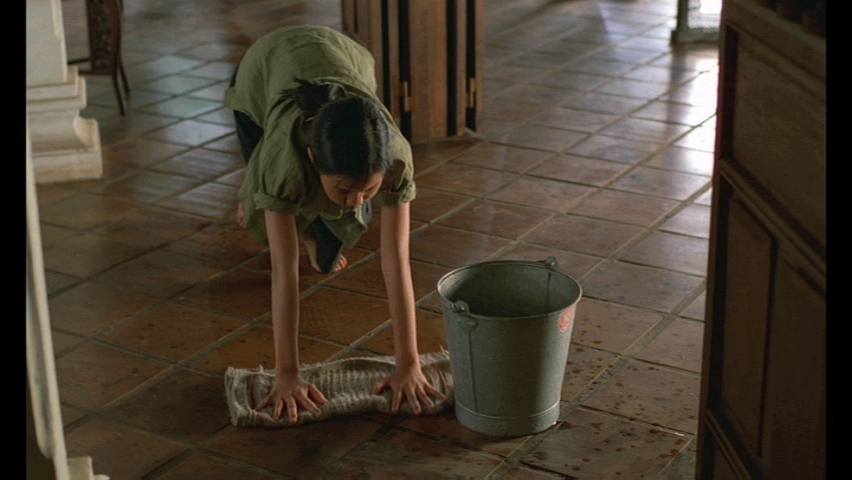
For the most part, aside from that single scene, the women of the film are quiet, gentle creatures, hard-working, well-meaning, and resigned to their fate. Even the mother-in-law spends the duration of the film in her room lightly beating a drum as she mourns the dead.

The men in the story can be interpreted, in some sense, as the women's oppressors, but this, too, appears to be a result more of the social and economic context than of their own maliciousness. 


The superficially Cinderella-esque plot develops rather differently in the final section of the film, although it is true that upon reaching womanhood, Mui is ultimately “rescued” by a man, a composer whom she met and admired from afar while working as a domestic helper when she was still a child.


Basically, as cynical as this may sound, she trades one domestic role for another. The indentured servant becomes an indebted wife. After toiling away for more than ten years for other people, Mui, upon reaching womanhood, is “rewarded” by becoming the wife of the man for whom she was working, and also the mother of his child.

Some Western viewers have no doubt voiced complaints that the story is objectionable in one way or another, and I do believe that in order to be able truly to appreciate this work it may be necessary to “evacuate your critical mind,” as I recall a yoga instructor once exhorted those participating in her class to do (including me, who of course rolled her eyes). 

For some such a feat is easier said than done, but it does seem to me that the plot of this film is arguably beside the point, and the wide-ranging and penetrating feminist and neo-Marxist critiques to which it could easily give rise need to be set to one side if one is to discover what it was that the director here intended to convey.

The film garnered much praise from critics but much less from nonprofessional reviewers, many of whom seem to have found it affected (“artsy-fartsy”) and over-contrived. Other viewers complained about the slow pace and relative dearth of action. The Scent of Green Papaya received awards for its cinematographic excellence, and therein lies the true value of this creation, not in its banal plot.

To focus on the narrative of this film is to miss the beauty which unfolds in infinite complexity from the opening and all the way to the final scene, as the deliverances of the senses are presented so as to create a quasi-synaesthetic sensory odyssey of sorts while capturing and conveying the perspective of the central protagonist at the same time.


The Buddhist philosophy undercurrent of The Scent of Green Papaya, which is unmistakeably symbolized throughout the film, is finally made graphic (flagrant?), for those who somehow failed to grasp it earlier, with the concluding shot being none other than a statue of the Eastern sage.


But if this film is Buddhist in orientation, what does that mean? And can the manifest sensuality of so much of the film be reconciled with Buddhist philosophy? 


Scenes of ablution are interwoven throughout the film, but especially near the end, once Mui has achieved womanhood, bathing takes on a decidedly sensualist cast.


On one level, the message, if you will, of much of this film may seem to overlap with the ethical vision of the ancient Greek Stoics, according to which one must steel one's self against adversities over which one has no control. In this regard, the film might seem to share what the nineteenth-century German philosopher Friedrich Nietzsche regarded as the life-negating aspect of resignation common to most religions, which was a bit later pithily summarized by Karl Marx in the phrase “Religion is the opium of the masses.”


Buddhism is a religion, albeit a godless one, but it enjoins the same attitude toward life on earth as the theistic religions: that our attachment to earthly things, all possessions, including our very life, is vain and otiose. 


Desire is to be squelched, since only then, without the constant yearnings to succumb to temptation, can one be at peace with oneself, living harmoniously and in equanimity with nature. In keeping with this Buddhist-cum-Stoic outlook, one way of understanding the docile acceptance by Mui of her station in life is as an expression of her acceptance of this fate and refusal to struggle against it.


It does seem as though all people are constrained by chains of one variety or another, though most of them are invisible. The men and boys of the film, no less than the women, are born into a context rife with expectations of what they must be and do, and those expectations undeniably play a role in shaping the persons whom they eventually become—to a greater or lesser degree, depending upon the individual's relative propensity toward freespiritedness, on the one hand, and malleability or tendency to conform, on the other. Their ostensibly privileged status certainly does not render the males immune from suffering.


There is another way, however, of viewing Mui's way of looking at and attitude toward the world, and even for those who reject the teachings of the “preachers of death,” there are truths here to be pondered for those with eyes to see, ears to hear, and a nose to smell. This film illustrates that far more important for the quality of one's own life than external factors beyond one's control are internal factors and the perspective which one adopts toward the people and things in one's experience, a Stoic point, to be sure, but an aesthetic one as well.


Obviously there are extreme cases, where people are physically imprisoned in nightmarish scenarios created by others, and which make it impossible for those shackled to enjoy their own subjective experience of the world. In The Scent of Green Papaya, the focal protagonist retains sufficient liberty to be able think about and to perceive the world as colored by her own values. Her interactions with people and things evince a quiet nobility, despite her low social standing.

Mui lives in a bubble of sorts, entirely unaware of what life might be, were she not situated where she has found herself, as the servant of a well-to-do family. Having received no education, she is illiterate and powerless—not only economically, but also conceptually—to extricate herself from her indentured role. In reality, her station is not so different from the billions of women throughout history whose only hope for economic and social security has been marriage to a man capable of providing those things.


The institution of marriage was initially established to formalize the relation between a man and some of his property, his wife, who took his name and essentially gave her life over to him in agreeing to propagate his name through the production and nurturing of his progeny. 


Today marriage has taken on new meanings, but it will always be tainted by its purely pragmatic and sordid origins, which prevented most women for most of human history from realizing their creative potential beyond the narrow ambits of the home. Many women have flourished, no doubt, in such a role, and many do still today, but for thousands of years they had no viable alternative and so cannot be said to have freely chosen what became their primary vocation. 


In theory, of course, such a lifestyle may well be every bit as valid and worthwhile as any other choice which a woman might make—a point underscored by recent gay marriage activists—provided that it really is her own choice and not imposed upon her from outside.

What is unique about The Scent of Green Papaya is that, rather than negating the servant girl's value, this film reveals the preciousness of her subjective engagement with reality, what is typically ignored in social critiques of gender- and class-based inequities. The focus of social critics has typically been on improving the circumstances of such persons, not on revealing their unique perspective on the situation in which they find themselves. The ironic result is that the victims are often doubly negated. They already have no power over the system in which they exist and which rules their lives, but they also have no voice.


This film presents an anthropological tableau, not a social or moral critique, in displaying the economic stratification as well as the patriarchy of the society in which Mui finds herself. Early on it may appear that a critique is forthcoming, as the males of the family are painted in somber shades as capricious and despotic. The father and head of the household, a troubled musician who appears to be dissatisfied with his bourgeois family life, disappears at periodic intervals with the family's savings to indulge in debauchery with prostitutes until the money has all been exhausted, at which time he returns home.

Even the smallest boy of the family manifests ignoble behaviors toward Mui which suggest that in the future he will follow in the footsteps of his father, and will perhaps even grow up to mistreat women. No good will come of any it, suggests the plight of the father, who having apparently contracted venereal disease during the last of his fugues of fornication, succumbs shortly thereafter, leaving the family forever and permanently behind.


Truth is Subjectivity

A social critique can of course be made of this entire situation, with the women at the beck and call and mercy of the men in 1950s Vietnam—as most everywhere else—but what director Tran Anh Hung does instead is to focus upon the subjective perspective of Mui and the lush beauty which surrounds her like a halo. The girl has an artist's sensibility and finds value in every single thing she encounters. She views the world in a state of awe at the infinite richness contained within it, and she perfectly encapsulates the maxim that beauty lies in the eyes of the beholder.


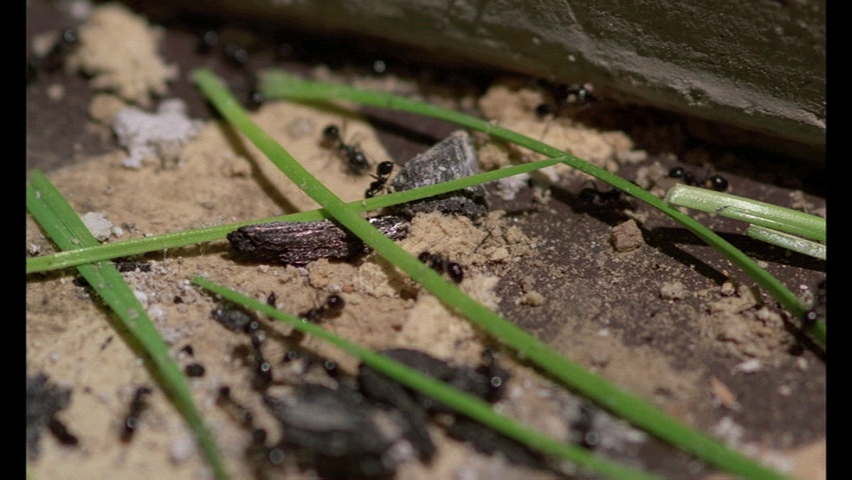
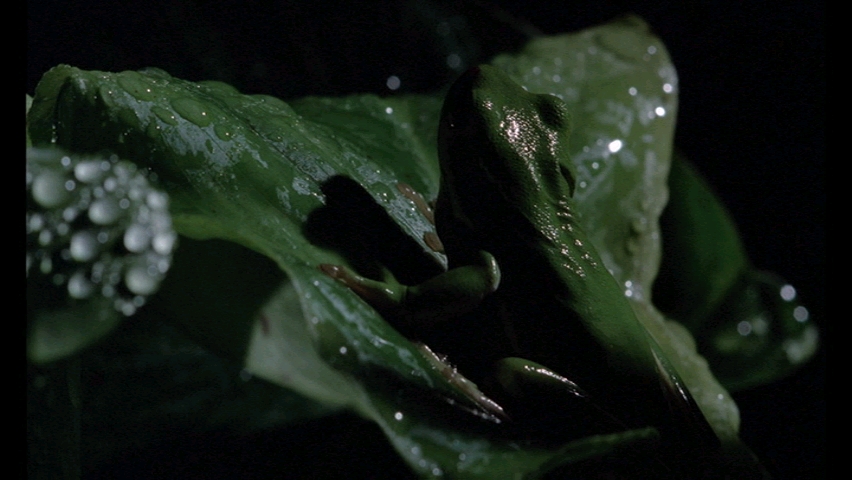
Mui takes note of the minutest of details in her experience, watching an ant attempt to hoist a piece of rice or a toad as it croaks. The house is structured openly, making it possible for various creatures, insects, lizards, frogs, to lead their separate existence while harmonizing with the people also present.


Mui's attitude toward these creatures is very different from most people's, and none of what are often regarded as pests appear to be so from her own perspective. Rather than setting out to destroy the ants, as the son of her master does—lighting a candle and dripping wax upon them as he watches them slowly die—Mui observes in a state of awe the beauty of their struggle to survive.


A ten-year lacuna of Mui's life is not covered by the film. The story is taken up again when she is twenty years old, at which point she seems physically different but still a child at heart and in her interactions with the world. In the opening shot of this final section of the film, Mui seems almost retarded, although the intention appears to be to depict her as saintlike—in something like a state of transport achieved through natural mysticism. 

There have been many varieties of mystic throughout history, with some holding a pantheistic view, finding divine elements or “gods” in all that they encounter. Others have understood their extraordinary experiences as direct communications with a canonized God in a particular religion such as Christianity.

Mui's ecstatic encounters with nature are reminiscent of those of many religious mystics throughout history, including Saint Teresa of Avila (1515-1582AD). The difference between Mui and the mystics of established religious traditions is that she does not possess any of the cognitive or conceptual apparatus to be able to articulate her interactions with God—or the divine—as manifested through nature. It is noteworthy, however, that many orthodox mystics, too, have insisted that the content of their experiences was ultimately ineffable. Incapable of being transmitted to others through human language, the phenomena giving rise to the mystic's experience could only be gestured toward.

As a young woman, Mui seems even less inclined to talk—close to mute—by now, and one suspects that this was how she managed to survive pure and innocent in a system where many analogous people throughout history have suffered corruption at the hands of those more powerful. Having been adopted as a surrogate daughter by the woman of the house (who had lost her own daughter), one senses that Mui benefited from the protection afforded her by this relationship.


Once Mui is sent to work for the composer in his house, preparing his meals and tending to his domestic needs, he ends up falling in love with her, and ultimately forsakes his fiancée, a well-to-do young woman of society who appears to have no use for or real interest in the composer's true calling, music.


The unmistakeable message is that the musician, like Mui, is nobler in spirit than his would-have been wife of high society, who comes off as shallow and superficial. 


The woman becomes outraged upon recognizing that her lover and would-have-been husband has fallen for his live-in servant. She throws a tirade before storming out of the house, leaving her engagement ring behind.


The musician's infatuation with Mui during what is a nearly speechless section of the film is revealed through the sketches he has made of her face. It appears that he finds himself drawn to Mui as to a kindred spirit of sorts. The possibility of course exists that the father of Mui's child, too, like the troubled musician at the head of the household where she worked as a child, may grow restless and forsake bourgeois family life. But one senses that Mui is unlikely to be devastated by such a development, because every single thing around her is miraculous to her. She has no identity to lose, because she blends in with the environment no less than do the toads and the lizards and the ants.


Music as a Metaphor for Scent

How can the subjective experience of such a person be captured on film? A virtual infinity of colorful images carefully composed and juxtaposed make up the visuals of The Scent of Green Papaya, but the musical score—comprising both original material and well-known classical music pieces—is just as important, and together the two help to create the synaesthetic illusion of scent throughout the film.

In some ways, the music serves a metaphor for scent, with rapid transitions and modulations signaling abrupt emotional changes, just as occurs when a scent, invisible to the eye, eventually penetrates a person's consciousness as the molecules make contact with olfactory receptors and a message is transmitted to the brain.

I have often felt that scents are colored. I do not suffer from—or is it enjoy?—the literal synaesthetic conflation of sight and scent. I do, however, strongly associate certain scents with certain colors. The Scent of Green Papaya synaesthetically suggests for me the sense of scent through the use of breathtakingly beautiful visual images and sounds, both natural and manmade. As Mui shreds fresh papaya, the music and the image together produce a scent-like experience because it seems to be right there before me.

At first the unpeeled papaya smells vegetal and green, somewhere between Pierre Balmain Vent Vert and Frédéric Malle Carnal Flower, but then it becomes fresh and fragrant and tart like a bright eau de cologne such as Parfums de Nicolaï drat or perhaps one of the Hermès Jardins. The film is literally filled with clean, limpid, aqueous, and vegetal scents, and the musical sound of water—whether dripping or splashing—suffuses the entire work.


The smell of rice in the kitchen is evoked as dinner is prepared, but the rice is scented, as beautiful as Gianfranco Ferre's Ferré eau de parfum, which includes a succulent rice note.


When, as a young woman, Mui applies red lipstick for the very first time, my memory of that scent becomes activated. I think of the smell of Guerlain Météorites or Frédéric Malle Lipstick Rose.


When the composer's fiancée flirts with him at the piano, I sense the presence of Chanel no 5. When she becomes angry, throwing a temper tantrum and destroying beautiful pieces of ceramics before storming out of the house, all of her charm evaporates away, leaving something harsh and ugly, an aura of caustic chemical soup (selection of an apt example is best left to the reader...).


When the composer enters Mui's private quarters for the very first time, I smell something with musk, but a clean, light, sweet and innocent heliotrope-laced musk such as Kenzo Vintage Peace


The green incense burning in the home brings to my mind Comme des Garçons Kyoto.


As the couple shares playfully in the process of educating Mui, I sense the juxtaposition of L'Artisan Parfumeur Voleur de Roses and Drôle de Roses. The couple lives harmoniously together, respecting one another as fellow creatures in the Buddhist rock garden which is their home, far from the fray of urban contention and strife.


All of these image-scent associations emerge from my own subjective experience and are likely unique to me of all viewers, but therein lies precisely what I find so fascinating about the sense of scent: our associations arise out of our own memories, shared with no one else in all of space and time. Our interactions with our environment and our reactions to what we see and smell and hear have as much to do with us as they do with the things which serve as catalysts of sorts in causing a flood of memories to rush as from nowhere to the forefront of our mind. Whether we like or we dislike what we see has a great deal to do with our prior experiences and beliefs.

I must admit that I myself disliked the heavy-handed sexual imagery near the end of The Scent of Green Papaya, and feel that the effect would have been much stronger more subtly applied, but overall this film is a richly scented evocative gem and well-worth any perfumista's time.


Should Class and Gender Inequity be Aestheticized?

Social criticism is important. Without it, no progress would ever have been made toward the betterment of the circumstances of marginalized and diminished persons, including all persons who are non-White or lack a Y chromosome—or both. Strides have been made toward equalizing the opportunities of the people of all races and both genders and, more recently, sexual orientations, although there is much more to be done.

Even in ostensibly free and enlightened Western nations, the diminished status of females, in particular, is evidenced by economic statistics revealing that they continue to be paid significantly less than their equally qualified male counterparts for performing the very same work. In other words, women continue to be regarded as less than full-fledged persons equivalent in moral value to males, as has been the case throughout human history. This is a valid concern, and some viewers may find that The Scent of Green Papaya conveys a conservative perspective too ready to condone inequalities and injustice. Such criticisms have a great deal of merit in their own right, but morality and justice are not really what this film is about, when all is said and sniffed.