Synaesthetic
Suggestion and Subjectivity
in the 1993 film by Tran Anh Hyung
Set
in Saigon, Vietnam, in the 1950s,
The Scent of Green Papaya
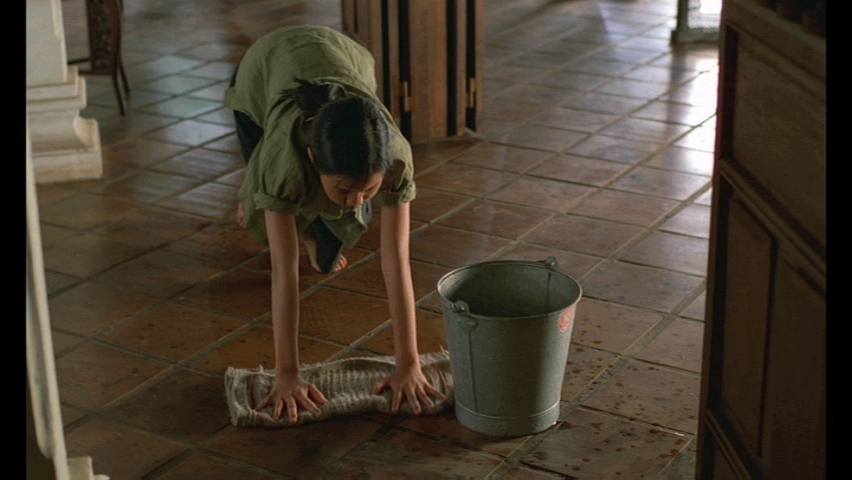
relays, on its most obvious level, the tale of a young peasant girl,
Mui, who has been sent away from her home to work as a domestic servant as a result of
hardships endured by her family after her father's premature death.
In some respects, certainly for Western viewers, the story follows a
familiar plot, that of the fairytale Cinderella.


There
are important deviations from that morality play, however, including
the fact that in this film virtually all of the women appear to be
victims of circumstances beyond their control.
Harridans and shrews are nowhere to be seen, and in the one scene in which a woman scolds another, a man is the ultimate cause of her lashing out. The mother-in-law upbraids her daughter-in-law for having failed to please her husband, what the mother takes to be the explanation for her son's flight from the home.
For the most part, aside from that single scene, the
women of the film are quiet, gentle creatures, hard-working,
well-meaning, and resigned to their fate. Even the mother-in-law spends the duration of the film in her room lightly beating a drum as she mourns the dead.
The
men in the story can be interpreted, in some sense, as the women's
oppressors, but this, too, appears to be a result more of the social
and economic context than of their own maliciousness.
The superficially Cinderella-esque plot develops rather differently in the final section of the film, although it is true that upon reaching womanhood, Mui is ultimately “rescued” by a man, a composer whom she met and admired from afar while working as a domestic helper when she was still a child.
Basically,
as cynical as this may sound, she trades one domestic role for
another. The indentured servant becomes an indebted wife. After
toiling away for more than ten years for other people, Mui, upon
reaching womanhood, is “rewarded” by becoming the wife of the
man for whom she was working, and also the mother of his child.
Some Western viewers have no doubt voiced complaints that the story is objectionable in one way or another, and I do believe that in order to be able truly to appreciate this work it may be necessary to “evacuate your critical mind,” as I recall a yoga instructor once exhorted those participating in her class to do (including me, who of course rolled her eyes).
For some such a feat is easier said than done, but it does seem to me that the plot of this film is arguably beside the point, and the wide-ranging and penetrating feminist and neo-Marxist critiques to which it could easily give rise need to be set to one side if one is to discover what it was that the director here intended to convey.
The film garnered much praise from critics but much less from nonprofessional reviewers, many of whom seem to have found it affected (“artsy-fartsy”) and over-contrived. Other viewers complained about the slow pace and relative dearth of action. The Scent of Green Papaya received awards for its cinematographic excellence, and therein lies the true value of this creation, not in its banal plot.
To focus on the narrative of this film is to miss the beauty which unfolds in
infinite complexity from the opening and all the way to the final scene, as the deliverances of the senses are presented so as to create
a quasi-synaesthetic sensory odyssey of sorts while capturing and
conveying the perspective of the central protagonist at the same
time.
The
Buddhist philosophy undercurrent of The
Scent of Green Papaya,
which is unmistakeably symbolized throughout the film, is finally
made graphic (flagrant?), for those who somehow failed to grasp it
earlier, with the concluding shot being none other than a statue of
the Eastern sage.
But
if this film is Buddhist in orientation, what does that mean? And can
the manifest sensuality of so much of the film be reconciled with
Buddhist philosophy?
Scenes of ablution are interwoven throughout the film, but especially near the end, once Mui has achieved womanhood, bathing takes on a decidedly sensualist cast.
On
one level, the message, if you will, of much of this film may seem to
overlap with the ethical vision of the ancient Greek Stoics,
according to which one must steel one's self against adversities over
which one has no control. In this regard, the film might seem to
share what the nineteenth-century German philosopher Friedrich
Nietzsche regarded as the life-negating aspect of resignation common
to most religions, which was a bit later pithily summarized by Karl
Marx in the phrase “Religion is the opium of the masses.”
Buddhism is a religion, albeit a godless one, but it enjoins the same attitude toward life on earth as the theistic religions: that our attachment to earthly things, all possessions, including our very life, is vain and otiose.
Desire is to be squelched, since only then, without the constant yearnings to succumb to temptation, can one be at peace with oneself, living harmoniously and in equanimity with nature. In keeping with this Buddhist-cum-Stoic outlook, one way of understanding the docile acceptance by Mui of her station in life is as an expression of her acceptance of this fate and refusal to struggle against it.
It
does seem as though all people are constrained by chains of one
variety or another, though most of them are invisible. The men and
boys of the film, no less than the women, are born into a context
rife with expectations of what they must be and do, and those
expectations undeniably play a role in shaping the persons whom they
eventually become—to a greater or lesser degree, depending upon the
individual's relative propensity toward freespiritedness, on the one
hand, and malleability or tendency to conform, on the other. Their
ostensibly privileged status certainly does not render the males
immune from suffering.
There
is another way, however, of viewing Mui's way of looking at and
attitude toward the world, and even for those who reject the
teachings of the “preachers of death,” there are truths here to
be pondered for those with eyes to see, ears to hear, and a nose to
smell. This film illustrates that far more important for the quality
of one's own life than external factors beyond one's control are
internal factors and the perspective which one adopts toward the
people and things in one's experience, a Stoic point, to be sure, but
an aesthetic one as well.
Obviously there are extreme cases, where people are physically imprisoned in nightmarish scenarios created by others, and which make it impossible for those shackled to enjoy their own subjective experience of the world. In The Scent of Green Papaya, the focal protagonist retains sufficient liberty to be able think about and to perceive the world as colored by her own values. Her interactions with people and things evince a quiet nobility, despite her low social standing.
Mui
lives in a bubble of sorts, entirely unaware of what life might be,
were she not situated where she has found herself, as the servant of
a well-to-do family. Having received no education, she is illiterate
and powerless—not only economically, but also conceptually—to
extricate herself from her indentured role. In reality, her station
is not so different from the billions of women throughout history
whose only hope for economic and social security has been marriage to
a man capable of providing those things.
The
institution of marriage was initially established to formalize the
relation between a man and some of his property, his wife, who took
his name and essentially gave her life over to him in agreeing to
propagate his name through the production and nurturing of his
progeny.
Today marriage has taken on new meanings, but it will always
be tainted by its purely pragmatic and sordid origins, which
prevented most women for most of human history from realizing their
creative potential beyond the narrow ambits of the home. Many women have flourished, no doubt, in such a role, and many do still today, but for thousands of years they had no viable alternative and so cannot be said to have freely chosen what became their primary vocation.
In theory, of course, such a lifestyle may well be every bit as valid and worthwhile as any other choice which a woman might make—a point underscored by recent gay marriage activists—provided that it really is her own choice and not imposed upon her from outside.
What is unique about The Scent of Green Papaya is that, rather than negating the servant girl's value, this film reveals the preciousness of her subjective engagement with reality, what is typically ignored in social critiques of gender- and class-based inequities. The focus of social critics has typically been on improving the circumstances of such persons, not on revealing their unique perspective on the situation in which they find themselves. The ironic result is that the victims are often doubly negated. They already have no power over the system in which they exist and which rules their lives, but they also have no voice.
This film presents an anthropological tableau, not a social or moral critique, in displaying the economic stratification as well as the patriarchy of the society in which Mui finds herself. Early on it may appear that a critique is forthcoming, as the males of the family are painted in somber shades as capricious and despotic. The father and head of the household, a troubled musician who appears to be dissatisfied with his bourgeois family life, disappears at periodic intervals with the family's savings to indulge in debauchery with prostitutes until the money has all been exhausted, at which time he returns home.
Even
the smallest boy of the family manifests ignoble behaviors toward Mui
which suggest that in the future he will follow in the footsteps of
his father, and will perhaps even grow up to mistreat women. No good
will come of any it, suggests the plight of the father, who having
apparently contracted venereal disease during the last of his fugues
of fornication, succumbs shortly thereafter, leaving the family
forever and permanently behind.
Truth
is Subjectivity
A
social critique can of course be made of this entire situation, with
the women at the beck and call and mercy of the men in 1950s
Vietnam—as most everywhere else—but what director Tran Anh Hung
does instead is to focus upon the subjective perspective of Mui and
the lush beauty which surrounds her like a halo. The girl has an
artist's sensibility and finds value in every single thing she
encounters. She views the world in a state of awe at the infinite
richness contained within it, and she perfectly encapsulates the
maxim that beauty
lies in the eyes of the beholder.
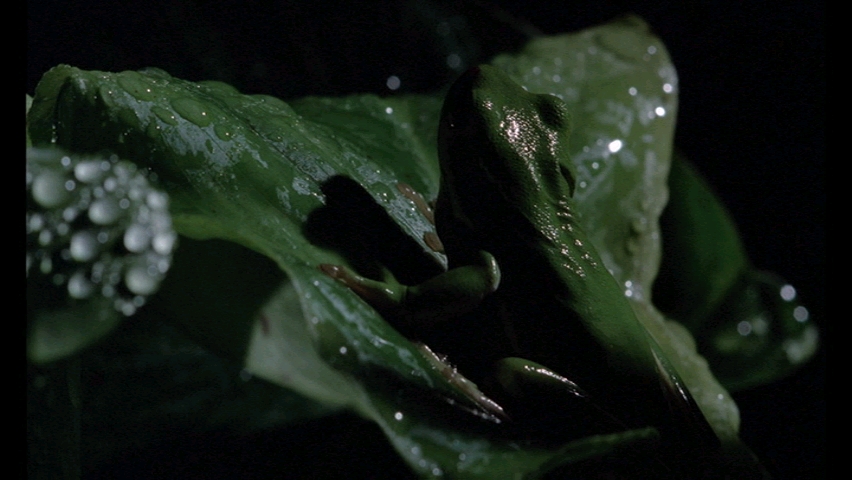
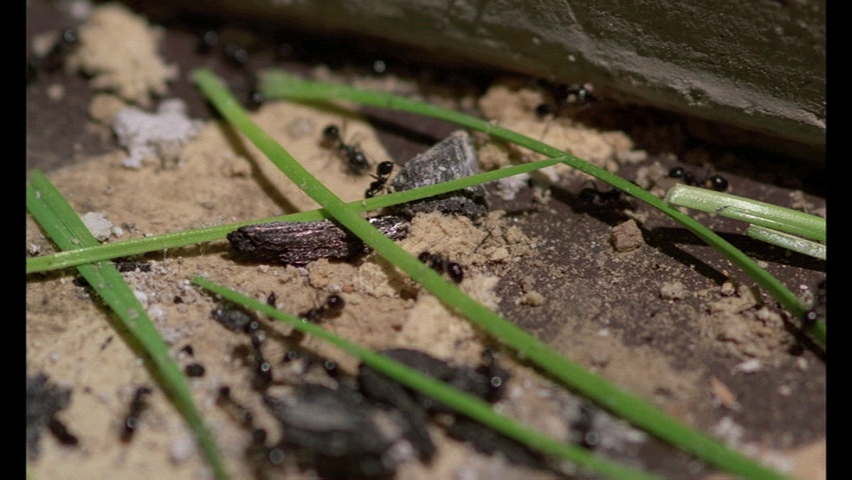
Mui takes note of the minutest of details in her experience, watching an ant attempt to hoist a piece of rice or a toad as it croaks. The house is structured openly, making it possible for various creatures, insects, lizards, frogs, to lead their separate existence while harmonizing with the people also present.
Mui's attitude toward
these creatures is very different from most people's, and none of
what are often regarded as pests appear to be so from her own
perspective. Rather than setting out to destroy the ants, as the son
of her master does—lighting a candle and dripping wax upon them as
he watches them slowly die—Mui observes in a state of awe the
beauty of their struggle to survive.
A
ten-year lacuna of Mui's life is not covered by the film. The story
is taken up again when she is twenty years old, at which point she
seems physically different but still a child at heart and in her
interactions with the world. In the opening shot of this final
section of the film, Mui seems almost retarded, although the
intention appears to be to depict her as saintlike—in something
like a state of transport achieved through natural mysticism.
There
have been many varieties of mystic throughout history, with some
holding a pantheistic view, finding divine elements or “gods” in
all that they encounter. Others have understood their extraordinary experiences as direct
communications with a canonized God in a particular religion such as
Christianity.
Mui's ecstatic encounters with nature are reminiscent of those of many religious mystics throughout history, including Saint Teresa of Avila (1515-1582AD). The difference between Mui and the mystics of established religious traditions is that she does not possess any of the cognitive or conceptual apparatus to be able to articulate her interactions with God—or the divine—as manifested through nature. It is noteworthy, however, that many orthodox mystics, too, have insisted that the content of their experiences was ultimately ineffable. Incapable of being transmitted to others through human language, the phenomena giving rise to the mystic's experience could only be gestured toward.
As a young woman, Mui seems even less inclined to talk—close to mute—by now, and one suspects that this was how she managed to survive pure and innocent in a system where many analogous people throughout history have suffered corruption at the hands of those more powerful. Having been adopted as a surrogate daughter by the woman of the house (who had lost her own daughter), one senses that Mui benefited from the protection afforded her by this relationship.
Once Mui is sent to work for the composer in his house, preparing his meals and tending to his domestic needs, he ends up falling in love with her, and ultimately forsakes his fiancée, a well-to-do young woman of society who appears to have no use for or real interest in the composer's true calling, music.
The unmistakeable message is that the musician, like Mui, is nobler in spirit than his would-have been wife of high society, who comes off as shallow and superficial.
The woman becomes outraged upon recognizing that her lover and would-have-been husband has fallen for his live-in servant. She throws a tirade before storming out of the house, leaving her engagement ring behind.
The
musician's infatuation with Mui during what is a nearly speechless section
of the film is revealed through the sketches he has made of her face.
It appears that he finds himself drawn to Mui as to a kindred spirit
of sorts. The
possibility of course exists that the father of Mui's child, too,
like the troubled musician at the head of the household where she
worked as a child, may grow restless and forsake bourgeois family
life. But one senses that Mui is unlikely to be devastated by such a
development, because every single thing around her is miraculous to
her. She has no identity to lose, because she blends in with the
environment no less than do the toads and the lizards and the ants.
Music
as a Metaphor for Scent
How
can the subjective experience of such a person be captured on film? A
virtual infinity of colorful images carefully composed and juxtaposed
make up the visuals of The Scent of Green Papaya, but the musical score—comprising
both original material and well-known classical music pieces—is
just as important, and together the two help to create the
synaesthetic illusion of scent throughout the film.
In
some ways, the music serves a metaphor for scent, with rapid
transitions and modulations signaling abrupt emotional changes, just
as occurs when a scent, invisible to the eye, eventually penetrates a
person's consciousness as the molecules make contact with olfactory
receptors and a message is transmitted to the brain.
I
have often felt that scents are colored. I do not suffer from—or is
it enjoy?—the literal synaesthetic conflation of sight and scent. I
do, however, strongly associate certain scents with certain colors.
The Scent of Green
Papaya
synaesthetically suggests for me the sense of scent through the use of breathtakingly beautiful visual
images and sounds, both natural and manmade. As Mui shreds fresh papaya, the music and the
image together produce a scent-like experience because it seems to be
right there before me.
At
first the unpeeled papaya smells vegetal and green, somewhere between
Pierre Balmain Vent
Vert and Frédéric
Malle Carnal
Flower,
but then it
becomes fresh and fragrant and tart like a bright eau de cologne
such as Parfums de Nicolaï Cédrat
or perhaps one of the Hermès
Jardins.
The film is literally filled with clean, limpid, aqueous, and vegetal
scents, and the musical sound of water—whether dripping or splashing—suffuses the entire work.
The
smell of rice in the kitchen is evoked as dinner is prepared, but the
rice is scented, as beautiful as Gianfranco Ferre's Ferré
eau de parfum, which includes a succulent rice note.
When,
as a young woman, Mui applies red lipstick for the very first time,
my memory of that scent becomes activated. I think of the smell of
Guerlain Météorites
or Frédéric
Malle Lipstick
Rose.
When
the composer's fiancée
flirts
with him at the piano, I sense the presence of Chanel
no 5.
When she becomes angry, throwing a temper tantrum and destroying
beautiful pieces of ceramics before storming out of the house, all of
her charm evaporates away, leaving something harsh and ugly, an aura
of caustic chemical soup (selection of an apt example is best left to the reader...).
When
the composer enters Mui's private quarters for the very first time, I
smell something with musk, but a clean, light, sweet and innocent
heliotrope-laced musk such as Kenzo Vintage
Peace.
The
green incense burning in the home brings to my mind Comme des Garçons
Kyoto.
As
the couple shares playfully in the process of educating Mui, I sense
the juxtaposition of L'Artisan Parfumeur Voleur
de Roses and Drôle
de Roses.
The couple lives harmoniously together, respecting one another as
fellow creatures in the Buddhist rock garden which is their home, far
from the fray of urban contention and strife.
All
of these image-scent associations emerge from my own subjective experience and
are likely unique to me of all viewers, but therein lies precisely
what I find so fascinating about the sense of scent: our associations
arise out of our own memories, shared with no one else in all of
space and time. Our interactions with our environment and our
reactions to what we see and smell and hear have as much to do with
us as they do with the things which serve as catalysts of sorts in
causing a flood of memories to rush as from nowhere to the forefront
of our mind. Whether we like or we dislike what we see has a great
deal to do with our prior experiences and beliefs.
I
must admit that I myself disliked the heavy-handed sexual imagery
near the end of The
Scent of Green Papaya,
and feel that the effect would have been much stronger more subtly
applied, but overall this film is a richly scented evocative gem and
well-worth any perfumista's time.
Should
Class and Gender Inequity be Aestheticized?
Social
criticism is important. Without it, no progress would ever have been
made toward the betterment of the circumstances of marginalized and
diminished persons, including all persons who are non-White or lack a
Y chromosome—or both. Strides have been made toward equalizing the
opportunities of the people of all races and both genders and, more
recently, sexual orientations, although there is much more to be
done.
Even
in ostensibly free and enlightened Western nations, the diminished
status of females, in particular, is evidenced by economic statistics
revealing that they continue to be paid significantly less than their
equally qualified male counterparts for performing the very same
work. In other words, women continue to be regarded as less than
full-fledged persons equivalent in moral value to males, as has been
the case throughout human history. This is a valid concern, and some
viewers may find that The
Scent of Green Papaya
conveys a conservative perspective too ready to condone inequalities
and injustice. Such criticisms have a great deal of merit in their
own right, but morality and justice are not really what this film is
about, when all is said and sniffed.