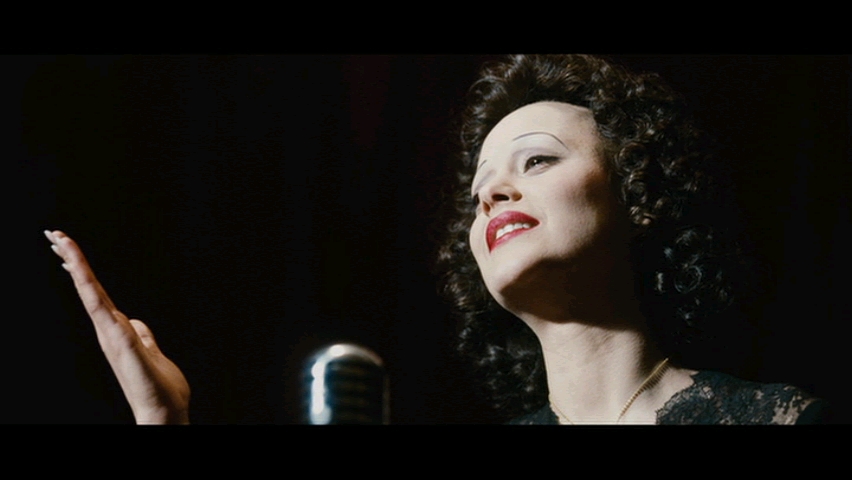
La
vie en rose (2007), a film directed by
Olivier Dahan, recounts the life story of French popular music legend
Edith Piaf, née Edith Giovanna Gassion. I hereby confess that I knew nothing about this woman's life before
viewing this film. I had no doubt heard her voice in some of her more
famous recordings—without knowing that I did—but I could never
have identified her in a line-up. A multiple choice test question
involving her name would have ended in random conjecture, pure and
simple.
This
is not because I am horribly ignorant of French culture—I am not.
But I am much more conversant with the likes of Charles Baudelaire, Guy de Maupassant, Alain, Jean-Dominique de la
Rochefoucauld, and Maurice Blanchot than I am with the performing
artists of France. Sure I know who Gérard
Depardieu is—I've watched plenty of French films (and, yes, he
plays a role in this one, too)—but popular singers are not a part
of my cultural ken. To those who scoff, I can only defy: name me one
popular singer from Bombay in the mid-twentieth century. That should suffice.

I
am assuming most charitably, as I can only do, that the people who
put together La vie en rose
were competent and did their historical homework before floating what
would become known as the true story of Edith Piaf's life by
countless moviegoers not so different in their abject ignorance from me. Should the producers have failed in
some way, we may rest assured that some graduate student somewhere
will be writing a doctoral dissertation on the topic, to be turned
eventually into a book which nearly no one will ever read.
I
glanced over a few of the negative reviews (always the best...) at
imdb.com, and sure enough it appears that key chapters of this
woman's story were glossed over or left out, above all, the untimely
death of her only child, to which a brief and inscrutable allusion is
made, but no one who has not read either a biography of Edith Piaf
or her autobiography is going to understand what it meant.
Somewhat
ironically, I selected this film to review at the salon de parfum
because of its name, La vie en rose.
It turns out that there are not very many films in existence with the
words perfume
or scent
in them, so I decided to cast my net a bit wider and check out all
films featuring the names of flowers as well. Who
would deny that women have every business in the world smelling like
flowers? I ask most sincerely.
By
strange coincidence (not...), this film was originally titled La Môme,
“little sparrow”, which happens to be the name of a perfume from
the house of Balmain which I happen to own. I did not know any of
this, however, when I checked the film out. I chose it for the rose
idiom, no more and no less. I soon discovered that this film
has next to nothing to do with perfume—at least not on its surface.
Yet the naming of the film was not at all coincidental, albeit not at all for the obvious reason.
La
vie en rose and La Môme
serve, remarkably enough, as an apt introduction to a topic
dear to me: the profound philosophical significance of perfume. Let
me here baldly state (comme d'habitude)
that I truly believe that the art hounds, so to speak, are barking up
the wrong tree. But before I can explain this, my latest act of
flagrant sacrilege, let us consider the film in its own right and on
its own merits. Eventually where this is all leading will become
clear.
The Story
Born into poverty to street-performer parents—the mother, a singer; the father, a contortionist—Edith Piaf spent her childhood and adolescence scrounging about, simply attempting to scrape together enough money to be able to eat and have a roof under which to sleep.
La Vie en Rose presents a few key episodes of this period which succeed in conveying the trials and tribulations of a person who for the most part missed out on childhood, being bounced as she was from one place to another and never able to develop meaningful long-term relationships with either of her parents or most other people, for a variety of different circumstantial reasons.
The young girl is initially depicted living with her alcoholic mother in the most
wretched of circumstances, and is wrenched away by her father, now
working as a circus player, who transfers Edith to the care of her
grandmother. Out of the frying pan, into the fire, it seems
initially, at least upon Edith's arrival. Far from reflecting the
classic stereotype, Edith's grandmother is the madame of a brothel.
The worst that one might have expected does not, however, transpire—at least not in the film. Instead, the child is adored by a couple of the house prostitutes, who essentially adopt her as their daughter. She is shown during this portion of her life enjoying such things as singing songs and taking baths, and the happiness which she brings to the otherwise wretched existence of the prostitutes is patent.
During this same period, while still quite
young, Edith suffers a serious eye infection which the doctor fears
might leave her permanently blind. Eventually, however, she recovers.
Throughout the film she is shown praying to God for help, and this
seems to have begun with one of the prostitutes, who prayed with the girl to Saint
Teresa, imploring that Edith's eye sight be restored.
A bit later, Edith's father retrieves her again and takes her along with him on the circus tour, but after he has a falling out with some of the other members of the troupe, he decides to go it alone as a solo artist performing in the streets and depending on the kindness of strangers to remunerate him for accomplishing such feats as wrapping his legs around his head.
One
night the crowd clamors for an act by Edith, whose role up until then
has been to pass the hat for collections. In order to ensure that the spectators will chip in, Edith's father pushes her to perform. At a loss as to
what to do, she sings an impressive rendition of La
Marseillaise, beloved to all good
republican French people. (Not, however, to old-school monarchists.)
The people like what they see and hear, and this constitutes the
beginning of Edith's storied singing career.
Let us pause here
briefly to review the text of La Marseillaise and attempt to recall why until only rather recently, all good republican (small 'r') people abhorred the tyrannical practice of summary execution without trial of persons suspected of crimes:
- Allons
enfants de la Patrie
- Le jour de gloire est arrivé !
- Contre nous de la tyrannie
- L'étendard sanglant est
levé (bis)
- Entendez-vous dans nos
campagnes
- Mugir ces féroces soldats ?
- Ils viennent jusque dans vos
bras.
- Égorger vos fils, vos
compagnes !
refrain:
- Aux
armes citoyens
- Formez vos bataillons
- Marchons, marchons
- Qu'un sang impur
- Abreuve nos sillons
II
- Que
veut cette horde d'esclaves
- De traîtres, de rois
conjurés ?
- Pour qui ces ignobles entraves
- Ces fers dès longtemps
préparés ? (bis)
- Français, pour nous, ah !
quel outrage
- Quels transports il doit
exciter ?
- C'est nous qu'on ose méditer
- De rendre à l'antique
esclavage !
refrain
III
- Quoi
ces cohortes étrangères !
- Feraient la loi dans nos
foyers !
- Quoi ! ces phalanges
mercenaires
- Terrasseraient nos fils
guerriers ! (bis)
- Grand Dieu ! par des
mains enchaînées
- Nos fronts sous le joug se
ploieraient
- De vils despotes deviendraient
- Les maîtres des destinées.
refrain
IV
- Tremblez,
tyrans et vous perfides
- L'opprobre de tous les partis
- Tremblez ! vos projets
parricides
- Vont enfin recevoir leurs
prix ! (bis)
- Tout est soldat pour vous
combattre
- S'ils tombent, nos jeunes
héros
- La France en produit de
nouveaux,
- Contre vous tout prêts à se
battre.
refrain
V
- Français,
en guerriers magnanimes
- Portez ou retenez vos coups !
- Épargnez ces tristes victimes
- À regret s'armant contre
nous (bis)
- Mais ces despotes sanguinaires
- Mais ces complices de Bouillé
- Tous ces tigres qui, sans
pitié
- Déchirent le sein de leur
mère !
refrain
VI
- Amour
sacré de la Patrie
- Conduis, soutiens nos bras
vengeurs
- Liberté, Liberté chérie
- Combats avec tes
défenseurs ! (bis)
- Sous nos drapeaux, que la
victoire
- Accoure à tes mâles accents
- Que tes ennemis expirants
- Voient ton triomphe et notre
gloire !
refrain
VII
- Nous
entrerons dans la carrière
- Quand nos aînés n'y seront
plus
- Nous y trouverons leur
poussière
- Et la trace de leurs
vertus (bis)
- Bien moins jaloux de leur
survivre
- Que de partager leur cercueil
- Nous aurons le sublime orgueil
- De les venger ou de les
suivre !
refrain
VIII
(Couplet
supprimé par Servan, Ministre de la Guerre en 1792)
- Dieu de clémence et de
justice
- Vois nos tyrans, juge nos
coeurs
- Que ta bonté nous soit
propice
- Défends-nous de ces
oppresseurs
- Tu règnes au ciel et sur
terre
- Et devant Toi, tout doit
fléchir
- De ton bras, viens nous
soutenir
- Toi, grand Dieu, maître du
tonnerre.
refrain
IX
- Peuple
français, connais ta gloire ;
- Couronné par l'Égalité,
- Quel triomphe, quelle
victoire,
- D'avoir conquis la
Liberté ! (bis)
- Le Dieu qui lance le tonnerre
- Et qui commande aux éléments,
- Pour exterminer les tyrans,
- Se sert de ton bras sur la
terre.
refrain
X
- Nous
avons de la tyrannie
- Repoussé les derniers
efforts ;
- De nos climats, elle est
bannie ;
- Chez les Français les rois
sont morts. (bis)
- Vive à jamais la République !
- Anathème à la royauté !
- Que ce refrain, partout porté,
- Brave des rois la politique.
refrain
XI
- La
France que l'Europe admire
- À reconquis la Liberté
- Et chaque citoyen respire
- Sous les lois de
l'Égalité ; (bis)
- Un jour son image chérie
- S'étendra sur tout l'univers.
- Peuples, vous briserez vos
fers
- Et vous aurez une Patrie !
refrain
XII
- Foulant
aux pieds les droits de l'Homme,
- Les soldatesques légions
- Des premiers habitants de Rome
- Asservirent les nations. (bis)
- Un projet plus grand et plus
sage
- Nous engage dans les combats
- Et le Français n'arme son
bras
- Que pour détruire
l'esclavage.
refrain
XIII
- Oui !
déjà d'insolents despotes
- Et la bande des émigrés
- Faisant la guerre aux
Sans-Culottes
- Par nos armes sont
altérés ; (bis)
- Vainement leur espoir se fonde
- Sur le fanatisme irrité,
- Le signe de la Liberté
- Fera bientôt le tour du
monde.
refrain
XIV
- O
vous ! que la gloire environne,
- Citoyens, illustres guerriers,
- Craignez, dans les champs de
Bellone,
- Craignez de flétrir vos
lauriers ! (bis)
- Aux noirs soupçons
inaccessibles
- Envers vos chefs, vos
généraux,
- Ne quittez jamais vos
drapeaux,
- Et vous resterez invincibles.
refrain
XV
- Enfants,
que l'Honneur, la Patrie
- Fassent l'objet de tous nos
vœux !
- Ayons toujours l'âme nourrie
- Des feux qu'ils inspirent tous
deux. (bis)
- Soyons unis ! Tout est
possible ;
- Nos vils ennemis tomberont,
- Alors les Français cesseront
- De chanter ce refrain
terrible :
refrain
By
the time she is twenty years old, Edith has taken up with a variety
of sordid sorts and seems to be something of a lush. Her best
friend—who I have since learned was her half-sister, what is never
made clear in the film—seems even worse and could be used to define
the term riff-raff
by ostension. One day Edith is singing outside in what looks to be
the 16eme arrondissement, while her side-kick solicits donations from
passers-by.
Purely
by chance, the singer is discovered by Louis Leplée (played by the inimitable Gérard
Depardieu), an impresario who takes the singer under his wing and
begins having her perform at his cabaret, to great acclaim.
He introduces Edith to his colleagues and audiences as un diamant brut, a diamond in the rough, which seems equally true of him. Depardieu is the perfect actor for this role, given his own past. But that's another story.
No
good deed goes unpunished, and Edith's new manager is murdered by some
of her former associates, who appear to have been a part of an
extortionist ring taking a portion of everyone in the neighborhood's
money on pain of misfortune or worse for refusing to comply with the
law of the jungle which they have laid down. Incensed by
the fact that Edith has achieved a modicum of independence from them,
they appear to have killed her manager, to everyone's horror. (The crime was never
formally solved.) Because she knows the prime suspects, the singer becomes
an object of scrutiny as possibly complicit in the homicide.
For
some time thereafter, Edith suffers ignominy, having been blamed by
the people and the press alike for the murder, though in reality she
had nothing to do with the death and would have been the last person
to want to see her guardian angel's demise.
Eventually
Edith hooks up with a singing instructor, Raymond Asso, who had approached her early
on in her nightclub adventure. He had given her his card, indicating
that she should call him when she was “ready”. Given the way in
which they interact with one another in the film, Edith appears to
have been romantically involved with this man. As her voice
teacher, he seems rather psychologically abusive, but he does have good
intentions and in fact succeeds in transforming this diamant
brut into a world class performer.
With
this polishing of her natural talent, Edith's fame and fortune
skyrocket, leading her to be a French national heroine of sorts, and
she travels to America to reach ever more people and critics.
Initially the American press does not appear to appreciate Edith's
gifts, but after a front-page New York
Times review gushing with praise from
one of the nation's most well-regarded critics, she becomes famous
also in the United States.
It
is at the height of her glory that Edith meets and falls in love with Marcel Cerdan, a professional boxer from Morocco who, too, has become famous in
America for his feats—another performer of sorts. He is married but
this does not keep the madly passionate couple apart, although he
travels back and forth from his farm and family in Morocco to New
York City, where he spars in the ring with other great boxers,
meeting with Edith to celebrate his victories in between.
There
seems to be a somewhat moralistic point to this next part of the story, at least as it is relayed in this film, but
that is to read significance into what on its face was a simple
historical fortuity.
While flying back to New York City to be with
Edith, who had summoned him, the boxer's plane crashes, thus abruptly
terminating the ill-fated affair and leaving the devastated Edith in
a state of total despair. She appears in the film always to have been
a heavy drinker, but now she turns to drugs to assuage her ailing
soul.
This is, at any rate, how it looks in the film. When asked by a doctor why she has been plying herself with drugs, she speaks of "the accident", which can be interpreted as a reference to her lover's plane crash. From a fact-finding mission, I learned that two
very severe car accidents were the real reason why Edith became
addicted to morphine, which was provided to her while she was
convalescing under a physician's care in the hospital.
Once
physically healed, she continued to use the drug, eventually becoming hopelessly addicted. She
appears also to have been a chain smoker, although this fact is
omitted from the film. Eventually her drug addiction takes its toll on her
health, and five years down the line, she and the man who is now her
husband seek professional help.
For a few years Edith appears to have
struggled to free herself from morphine. At the end of this battle,
she is about forty years old but looks more like sixty.
Marion Cotillard, who won an academy
award for her performance, did a decent job of capturing the extreme
personality and rather rough-hewn, often loud and bawdy comportment
of Edith Piaf, although I must say that I found some of the scenes
of hysteria in this film rather over the top. (Think Milla Jovovich
in The Messenger: The Story of Joan of
Arc.)
Inspired
by a soldier leaving to the battle front who has written a song for
her, Je ne regrette rien,
Edith manages to pull herself together for another grand performance
after what has been a long and grueling hiatus. The bulk of this film ends up being a fairly harsh condemnation of drug use, although it manages
to paint Edith in a sympathetic light, as a mere victim of tragic loss compounded by a
difficult life, who has turned to drugs in order to
be able to continue to survive. But nothing costs nothing, and her
years of drug and alcohol abuse eventually lead to Edith's premature
death at the age of 48, succumbing finally to liver cancer.
The
story of this woman's tragic demise is not depicted chronologically.
Instead, scenes from the various stages of her life are woven
together in a sort of tapestry. I found this film to be well made,
but without a strong, convincing performance from the lead actress,
it would have been a catastrophe. (Think Milla Jovovich in The Messenger: The Story of Joan of Arc.)
I do
have a few gripes with minor aspects, such as the performance by one
of the early time slices of Edith. The girl who first sang in the street at her
father's insistence seemed much more intelligent and
pensive than all of the other Ediths throughout the film, so I
question casting in that case, but all in all, this film is worth
watching, albeit rather disturbing at times. What it is not at all is a view of life through rose-colored lenses, as the title implies.
Instead, La vie en rose
is an inexorable reiteration of how fragile people are, and how
important fortuna is to our lives.
Meta-discussion
A
few scenes of this film show Edith Piaf applying make-up or sitting in front of a mirror, and some unidentifiable (by me, at least) perfume bottles can be seen on her
vanity tray. But never is she seen applying perfume, nor does she or
anyone else make any mention of the stuff. I freely admit, therefore,
that it is not immediately obvious why this film should be relevant
to perfume. Key words: immediately
obvious.
In fact, the story of Edith Piaf's life is eminently relevant to
perfume, on two distinct levels.
First,
on the literal level mentioned above, it turns out that the house of
Pierre Balmain launched a perfume in honor of Edith Piaf: La
Môme,
which was the moniker conferred upon the singer by the man (Louis Leplée)
who first discovered her while she was still singing in the streets
for people's small change. I owned this perfume long before having
learned
for whom it was composed. I added it to my collection because I am an
admirer of nearly every perfume launched by Balmain. I have been
consistently amazed by the quality, especially relative to the cost. A clear indication that designers
continue to regard their fragrances as accessories of sorts—perhaps even lowly toiletries!—is that Pierre Balmain perfumes cost about as much
as a button on one of the design house's shirts. I kid you not.
Interestingly
enough, unlike Jolie
Madame,
Balmain,
Miss
Balmain, Monsieur Balmain, Ivoire,
and Ambre
Gris,
La
Môme
never seems to have garnered a very big following. I believe that the
launch was limited edition and timed to coincide with the film (also in 2007), so that may be part of the explanation.
Still, there is something strangely elusive and inaccessible about
the composition, reminiscent of Edith's voice teacher's stern yet
sincere admonishments—one translated example: how can someone so talented be so dense? Despite such borderline
cruelty, there is something likeable about the man, and the same can
perhaps be said of the perfume, La
Môme.
What
is the perfume La
Môme
like? Well, it's mercurial. Sometimes it seems sophisticated and
majestic; at others it seems confusing and imbalanced. In this way,
the perfume amazingly captures the essence of Edith Piaf, whose
diminutive size (only 4'8” at full adult height—which leads one
to suspect that her mother's alcoholism may have stunted her child's
growth) is completely contradicted by the volume of her voice. Her
passion in singing is fueled of course by the emotional tragedies
which she has suffered but managed to endure. In the end, however,
Edith Piaf falls prey to forces greater than herself.
This
leads to the second, more philosophical, significance of La
Môme:
perfumes are every bit as fragile—and mortal—as persons. They
change over time due to extrinsic factors over which they—and their
loved ones and admirers—have absolutely no control. They may enjoy
a relative degree of fame, which may look, in the moment, like
immortality, but in the end, it is not. Persons and perfumes do not
endure the test of time. They are, indeed, intrinsically ephemeral.
Death is the great equalizer of persons and perfumes alike.
Moreover, no matter how much we
may wish to believe that contemporaneous success bodes well for
long-term renown, the reality is quite different. The magnitude of
the contemporary success of a particular person—his or her
celebrity—would seem indeed to be inversely proportional to the
prospects for long-term appreciation of who he or she once was. Why
is this? Let us reflect upon this idea for a moment.
In order for some person or thing
to be widely acclaimed within their own lifetime, they must, by
definition, be accessible to the masses. Everyone loves their
society's currently reigning celebrities, but what have they really
done? They have entertained their contemporaries.
As irreverent as this may seem, I
believe precisely the same to be true of best-selling books and
best-selling perfumes as is true of the “it” girl or guy of the
day. These people, and those words, and those scents, will fade away.
Why? Because the basis of their popularity impugns their claim to
true greatness. Yes, relative to society today, as it happens now to
be, we can identify certain persons as celebrities, but if, as often
seems to be the case, they spend more time on self-promotion than on
the creation of lasting works, then this will be revealed upon their
deaths. No one is going to be around to promote dead people whose ambition vastly
exceeded their talent. Far more importantly, this concern with
contemporaneous fame tends to impede whatever ability a celebrity may—or
may not—have to produce works which might be able to live on once they are long gone.
The problem for perfumes is that
they are even worse off in this regard than are persons. Perfumes
have a finite lifespan dependent not upon their quality or their
worthiness to survive, but on the kindness of strangers, so to speak.
Nothing can save a perfume which was launched by a house taken over
by a corporation whose guiding telos is profit. But since
corporations are essentially profit-seeking entities, the best
corporations, by definition, are the ones which pursue profit most
assiduously, rejecting any other measure of value.
I do not mean to suggest by saying
all of this that Edith Piaf was not a remarkable woman. She was. It
is nothing short of miraculous that she managed to make anything of
her life, given the conditions into which she was born. She also managed to conquer her own fairly serious stage fright. Still, no one
can reasonably deny that much of her eventual success was due to
sheer luck. How many great musicians are there inhabiting the
tenements of sprawling urban centers in the third world? We will
never know because they will never break out of the conditions which
bind them as if by chains.
This
is not to say that now and then someone will not beat all of the
odds, but fate comes back in the end to take back all which it seems
to have given to a soul such as Edith Piaf, may she rest in peace.
La
vie en rose
is the portrait of a woman who refuses to give up and who exudes an
enthusiasm and joie
de vivre
which made her and continue to make her an inspiration for all those
fortunate enough to become aware of her story. Most people in the
world, however, are unaware of the identity of even wildly popular persons who lived
in the past. Why? Because they are now dead, and as time passes,
celebrity, too, will eventually evaporate away, just like perfume.
Like persons, the vast majority of
perfumes which ever existed have slipped away into anonymity. They
were beautiful while they lasted, and they had their fans no doubt,
but to most modern people, it's as though they never existed. That is
precisely how it should be, it seems to me, because perfumes are
inherently, intrinsically, ephemeral creations, just like human
beings. We may attempt to erect effigies in their honor, but they will be but false idols, incapable of capturing what once was a complex, subjective, and equally ephemeral reception by persons who happened to exist at the time and be situated so as to be able to appreciate what became their beloved perfumes.