part 1
It's been over a week since I last applied perfume. How has she survived? is no
doubt a question surfacing in some of your minds. And now, at last, for a small confession of sorts, which will come as no surprise to some of you, I am sure: many of my body products are selected specifically for their appealing scent, in addition to their functional benefits. A case in point: Clarins Huile Orchidée Bleue, which, to be perfectly frank, smells a lot better any new perfume I've tried in recent sniffing history. I have mixed this product with argan oil in a dropper bottle, and I put it on my neck and décolleté area every night before retiring.
Did I lie, when I promised not to wear perfume while caring for my mother's beloved pup? No, of course not. I have not opened the perfume sample vials I brought along. They sit inert, untouched, in my suitcase. Still, there's no unscrambling the egg, as Pentagon officials are wont to lament having funded the heinous crimes of warlords all over the planet, under the assumption that "the enemy of my enemy is my friend." Well, not exactly. The principle is more like "forced to collaborate with bad or worse, I'll take bad." The fallacy in the argument, of course, is that anyone is ever forced to collaborate with anyone. But that's another completely different story, redolent of nothing but vice. Let's return to something nice.
My skincare regimen happens to afford me the felicitous opportunity to doze off in a beautiful cloud of scent but without having touched a bottle of perfume. I never agreed to forego my skincare regimen, so I did not lie. It's true that I have been noticing that little Jula seems to suffer allergy attacks especially at bedtime, and she does sleep in a bed on the floor close to mine. Causal connection or pure coincidence? I'm not sure, to be honest, because I always take her out for a bathroom session right before going to bed. She invariably breaks out sneezing the moment we step out the door, and her eyes water, too, clear evidence that this was not all just a pretext on the part of my perfume-phobic mom to prevent me from leaving traces of scent behind. Of course her reason, too, is allergies, but my impression is that she is allergic to added chemicals more than the natural stuff.
My dad, too, like Jula, suffers from severe allergies, especially during the spring, when pollen begins to float about the air. I don't recall my mom ever having suffered in the way that my dad always does from hayfever, but I'll take her word for it! There are a few nagging pieces of evidence in the house, however, which make me wonder how much of her aversion to perfume is a matter of taste and how much a matter of physical discomfort. Perhaps it does not matter, since it is her house, so she's allowed to forbid anything she wants within this space, up to and including smoking.
Which brings me to my stepdad's inveterate pipe-smoking habit. A while back, when I reviewed Tom Ford Tobacco Vanille, my stepdad was brought to the forefront of the perfume blog reading public (perhaps even immortalized!) as I insisted that he smells exactly the same as the drydown of that perfume. Not his tobacco, but him, as he is literally saturated with the scent. Probably the only time he does not smell like pipe tobacco is right after a shower at the gym--before he makes his way outside to light up a pipe once again.
It's a very pleasant smell to me, and I learned before their departure--to my amusement and satisfaction--that in fact he smokes a vanilla-scented tobacco! I actually love the way it smells and told my mom as much. She exhorted me not to share the news with my stepdad, because it would only reinforce and validate his habit! (Of course, I could not resist.)
Well, at this point in history, as "he" approaches "his" eightieth birthday--I suppose that I could name names, but shouldn't I leave something for the biographers to do?????--I don't think that there's going to be any turning back. And, why, after all? This is a guy who for decades has carried three freshly stoked pipes with him wherever he goes--in addition to a sleeve of loose tobacco. So, yes, I'd say that the word incorrigible applies, unless of course one happens to enjoy the scent, as anyone who appreciates Tom Ford's Tobacco Vanille surely would.
Smoking is strictly verboten (auf Deutsch, bitte!) inside the house. However, this humble abode is far from scent free. The hand soap in the upstairs bathroom appears to be one of those triclosan-infused foam generating Soft Soap dispensers. The label has been removed--which is fine with me as the only thing I hate more than plastic containers are plastic containers with their store labels still affixed. I mean, why? Why do I need to know that the Rubbermaid tote in which a serial killer stows the body parts of his victims was made by Rubbermaid? I see this on garbage barrels all over the place. A smooth, monochromatic surface spoiled by an unsightly peel-off label, which no one ever bothered to peel off. When possible, I take the liberty of doing so myself, but touching everyone's trash can is even less appealing than being subject to these omnipresent eyesores. But I digress...
So the Soft Soap--or reasonable facsimile. It is apricot-orange colored and smells very aquatic and calonic. A big "yuck" for me. Not to mention my suspicions about triclosan, which seems to be found in everything these days: hand soap, dish detergent, toothpaste... what????? I was using the orange Soft Soap stuff for the first few days here, as there is no other hand soap in the sink area. Fortunately, at one point I was sufficiently caffeinated to think out of the bottle, so to speak, when I opened the cabinet below, where I espied with relief a bottle of Johnson's Baby Shampoo.
Thankfully, it smells a lot better than triclosan-soaked, artificially orange-colored foam goo, so now I am using that instead. Something about the scent of Johnson's Baby Shampoo is so soothing, perhaps it is tapping into some of my earliest infant memories. Who really knows? What matters now, is that the scent is pleasant enough that I no longer cringe at the prospect of washing my hands. Chez moi, back in Boston, the ready-at-hand bathroom sink soaps are Puig Agua Lavanda and L'Occitane Verveine-scented shea.
Surprise, surprise...
(to be continued)
Philosophical reflections on perfume and perfumery: An exploration of aesthetic, epistemological, metaphysical, moral, ontological, and phenomenological issues. Relevant comments are most welcome—whether you agree or disagree!
Showing posts with label smoking. Show all posts
Monday, September 22, 2014
The Ubiquity of Scent, part 2
Labels:
allergies,
aromachemicals,
natural perfumery,
smoking,
soap,
taste,
Tom Ford,
triclosan
Saturday, July 12, 2014
Plus ça change: Perfume and Morality in Le Corbeau (1943), directed by Henri-Georges Clouzot
It is rare to happen upon a great movie among recent releases. Long before the decline of the movie theater, I adopted a strategy to protect myself from the flood of mediocrity pouring out of the Hollywood faucet. I simply stopped watching first-run movies. I still enjoyed going to the cinema, but I'd stick to revival houses or places like the Museum of Fine Arts in Boston, where I've been known to watch the entire French Film Festival. (It is held every summer over a two- or three-week period.) For most of my film viewing, I have depended on rentals: DVDs, and before that video tapes. This strategy is much less safe today, as many DVDs are now released within weeks of live screenings, so lots of "stuff" not worth watching is always mixed in with the greats when I peruse the shelves at the Cambridge Public Library, which has supplanted Netflix as my primary source of films.
I've noticed of late that there seems to be a trend going on in movie-making similar to the one I've witnessed in publishing. Movie makers and authors appear to be landing contracts before producing works, and then when deadline time rolls around, they sometimes have to hustle to get the thing done. In movies, there seems to be a further factor involved. A number of productions starring big names start out pretty decently, but then seem to end prematurely, as in twenty or thirty minutes before the standard Hollywood mark of two hours. It's not that the works are finished--they are not. Instead, they are hurriedly wrapped up, it seems, with a makeshift dénouement thrown together to get the job done sufficiently to satisfy the terms of the contract.
My hunch is that in the case of inadequately incubated films the moviemaking team (and these days they are huge, by the way) has exceeded their budget, and the big names in question probably have better things to do, other commitments, even if the producers were able to pull together the extra cash needed to keep them around. I've read many books in the twenty-first century with similarly weak endings, relative to the quality of the opening pages and chapters. It's as though the author has simply run out of steam but is obligated to sign off on the thing by a certain date and so rushes to finish it up. Many books published today also appear not to have been edited.
Needless to say, I find these trends regrettable, though fully comprehensible in this highly capitalized world. Nearly everyone seems to be more interested in the outer packaging and hype than in the content and form. Similar dynamics appear to be affecting the perfume industry as well. The sheer number of new launches each year virtually guarantees that many of these fragrances have been rush jobs. What else could they be, with flankers running rampant? Anyone who does not believe that most flankers are trivial probably has not given enough of them a sniff. Not that I think that it's olfactorily worthwhile for anyone to do so.
I imagine that serious perfumers working for the conglomerates may be a bit jaded by now, given the tough budgets, low-grade materials, and IFRA restrictions all conspiring to impose severe constraints on their creative output and ultimately reining in their heartfelt desire to produce something great. Some among them may think of themselves more as hacks than as persons in a position to realize their olfactory dreams through the launch of a masterpiece. Not going to happen, if the creator has to come up with a "new" scent by cobbling together a bunch of inferior "stuff" determined by marketers to be in demand among Jill Q. and Joe. Q Consumer.
I've been thinking about old films and old perfumes and old books recently--and also old tea (pu-erh), but I'll save those thoughts for another day. Unlike vintage lovers, who worship most any perfume launched pre-Y2K, I do not believe that something old is automatically better than anything new. It's just not true. There were plenty of mediocre books published in centuries past about which we know nothing because they have been essentially forgotten. Some of them were bestsellers back in the day, but they have not stood the test of time. The problem for perfume, of course, is that it degrades and fades away, so we can never really know what it was like when it was launched. All we have are surviving bottles, and all we can do is hope that they reflect in some way the intended scent of their creator.
I do believe, however, that the percentage of excellent perfumes in the twentieth century was much greater than today. That is not because I prostrate myself before all things said to be vintage. No, not at all. It's a recognition of the fact that many more perfumes are being produced much more quickly and using much less natural material than ever before in the history of perfumery. A big part of this trend has to do with who runs the show. The head honcho at Procter & Gamble gets the last word on the scent of shampoo and deodorant and also perfume.
Aren't they all really just variations on a theme? A toiletry is a toiletry by any other name.
A toiletry by any other name would smell as clean.
That's the sort of wisdom I imagine bubbling up in the mind of the CEO of a megaconglomerate such as P&G. Everything they produce, at the end of the day, is a source of profit, no more and no less. The key to maximizing profit in the perfume arena appears to involve, the savviest of marketing strategists have figured out, persuading people to believe that they really prefer to smell clean and abstract, not complicated like real flowers and other natural substances, but streamlined and simple. The perfume equivalent to SSRI happiness. Don't worry, be happy. And if you begin to entertain ever so faintly the idea that there might be something awry somewhere in the universe, something which you might set out to do something about, our culture tutors you to Shut it out, which is remarkably easy to do these days. Take a chill pill. Literally.
What about old movies? Are old movies automatically better than new movies? Well, not automatically, but they have stood the test of time. If people are still watching them seventy years after they were produced, then there is probably a good reason for that.
With that rather circumlocutory introduction, I would like without further ado to commend to your attention a film which I only just discovered, though it was produced way back in 1943:
Le Corbeau [The Raven]
directed by Henri-Georges Clouzot
The first clue that this film is worth watching--aside from sherapop's enthusiastic recommendation--is the fact that Le Corbeau was reviled by the Nazis, the Partisans, and the Catholic Church! This film is so modern, and so intelligent, and so well-paced, and so complete and fully incubated that it would bear your sustained attention even if it were not also beautiful. This work is not, as you may surmise, a movie version of the classic narrative poem by Edgar Allan Poe, many of whose texts, for your information (in case you didn't know) were translated into French by the equally great Charles Baudelaire.
Instead, Le Corbeau offers a rather La Rochefoucauldian (or is it Maupassantian???) morality tale using a long concatenation of multivalent metaphors. The setting is St. Robin, "any village", and the residents present the complete range of human qualities: the good, the bad, and above all, the ugly.
The main character is the dashing Dr. Germain, after whom every single woman--and some married as well!--lusts. You know the drill: a handsome doctor who happens also to be an eligible bachelor! Sound familiar? Plus ça change.
Salon de Parfum readers may by now be growing restless. Has sherapop lost her marbles? Isn't this supposed to be a perfume blog?
Calmez-vous, mes chers amis. Indeed, I have brought this film to your attention not only because it is a masterful representative of several genres of cinema simultaneously, but because it further features the following scene in which perfume is touched upon in an incredibly modern way--remarkably relevant to what we are seeing in contemporary society today.
Dr. Germain has been summoned to examine Denise, a young woman with a decidedly femme fatale demeanor and a snarl that could give Sid Vicious a run for his money. Denise is bedridden, where she is painting her toenails and smoking, for want of anything better to do:
Upon hearing the doctor knock at her door, Denise immediately buries herself under the bed covers, though it is clear that her wet polish must be smearing the sheets.
She extinguishes her cigarette in an ashtray located conveniently next to an open bottle of champagne. She then begins to cough and deploys her most feeble-sounding voice to instruct the doctor to enter her chambers.
Before commencing the examination, Dr. Germain rushes to shut the windows, as the sound of the children yelling in the courtyard is grating on his nerves. He then pauses for a moment, sniffs the air, and asks Denise whether she is wearing perfume.
Denise replies, "You don't like it?" To which the doctor curtly retorts that he should have left the windows open.
Why is this exchange so interesting? First of all, because the scent which displeases Dr. Germain is in all likelihood a commingling of smoke from Denise's recently extinguished cigarette and the fumes of her wet nail polish. Perhaps she is also wearing Chanel no 5 (apparently all the rage at that time), but surely those two strong non-perfume odors would still be hanging in the air and dominate the space.
Dr. Germain, in other words, is a member of the perfume police, who bristles at the slightest detection of any scent which he can denounce as foreign and unnatural. He simply assumes that the odor in question is perfume, for he is opposed to the very idea of perfume, whether beautiful or ugly.
For Dr. Germain, perfume is a part of Denise's slutty lifestyle. Her reputation precedes her, and the good doctor soon discovers that she has no illness whatsoever. This house call was only a pretext for a physical examination! While putting his stethoscope away in preparation to depart, Dr. Germain brusquely informs the young woman that she has no need of a doctor--at least not one like him, the snide insinuation of course being that she needs to see a shrink.
Rather than spoil this fabulous work for you, let me simply assuage any concerns you may be having about what is going to transpire between these two comely characters. A bit later, Denise has a second chance with Dr. Germain, and this time, she takes a slightly different tack.
In the end, the much larger mystery, of who is sending the townspeople letters filled with the juicy details of all their viciousness, is solved. But to find out the rest of the story, you'll have to watch the film!
![]() |
| "Parce que c'est aussi bête que ça: Je t'aime." |
Labels:
Art vs. Function,
Baudelaire,
capitalism,
film,
flankers,
IFRA,
morality,
nail polish,
religion,
smoking,
SSRI,
vintage perfumes
Sunday, June 2, 2013
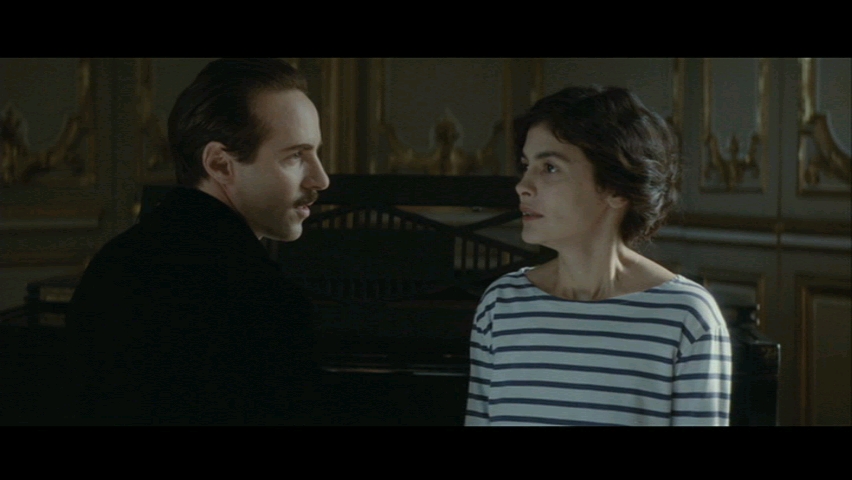
Coco sans Parfum
Reflections
on Coco avant Chanel (2009),
directed by Anne Fontaine
Historical
fictions are tricky. Whether books or films, they play with and shape
the facts in order to present a more pleasing work. The truth of what
really happened may be sacrificed under the guise of poetic license.
Because history is so complex, the decision to include or omit
mention of certain parts of a story can completely change the overall
portrait of controversial figures such as Gabrielle “Coco”
Chanel. Before watching Coco avant Chanel, one of three films
about the fashion designer released at about the same time (around
2009), I knew nearly nothing about her. This version of the story, in
which Audrey Tatou plays the lead role, focuses on a simple idea:
after her mother's death, little Coco was consigned by her father to
an orphanage where she was raised by nuns. A single image of the
young girl serves to determine the rest of the story:
Not
much time is devoted to this segment of her life, but we learn that
on visiting day, Coco would go wait outside for her father to come,
which he never did. The image of this innocent child, devoid of any
parental love and left to her own devices is referenced throughout
the rest of the film.
Flashing forward to her young adulthood, Coco is singing at night for tips at a cabaret while working by day as a seamstress. She makes the acquaintance of Etienne Balsan, a rather boorish but extremely wealthy “old money” Frenchman, with whom she has a brief fling.
Balsan arranges an audition for the young woman to obtain a regular position as entertainer, but Coco does not impress the judge with her performance.
Her hopes of succeeding as a singer and dancer are dashed, and she returns to her apparent fate: to work as a seamstress.
When
her sister (this is a composite character in the film, whose story
does not accurately depict what happened) takes leave to live with a
man whom she hopes to marry—though this seems unlikely ever to
happen and indeed never happens, as a result of her membership in the
French equivalent of an undesirable social caste—Coco decides to
pay Etienne a visit at his estate, under the pretext that she is on
the way to visit her sister and has decided to stop by.
Needless to say, he is surprised to see her in this context, where she does not belong, as they met in the demimonde.
Chanel
ends up staying at the Balsan estate as a live-in concubine whose
true status is revealed when she is required to remain hidden from
sight during parties with the social elites whom Balsan entertains.
The arrangement is degrading, to put it mildly.
Even when Balsan takes Coco to the horse races, he abandons her while he goes to sit with his upper-crust friends in the stands.
Probably
the most shocking part of this arrangement is that Balsan “loans”
Coco for the weekend to one of his British friends, Arthur “Boy”
Capel, who has become slightly smitten with the attractive and
obviously intelligent woman who has taken up residence chez Balsan.
Coco and Arthur become romantically involved despite Balsan's
presence during a costume party, and when they take off to the
seashore, Coco begins to dream of life as the wife of this wonderful
British nobleman, who far from hiding her away, puts her on display,
taking her to dance at a fancy ball and treating her like a genuine
lady rather than a low-class live-in domestic servant, as she is
accustomed to being treated by Balsan.
Coco's True Calling
Coco avant Chanel focuses on a couple of distinctive trends begun by the fashion designer, including the use of black, formerly restricted to mourning contexts, and the stripping out of excessive embellishment such as feathers and flowers. Chanel is portrayed in the film as a women's liberator of sorts, insisting that they should be able to breathe and move freely in their dresses. In several scenes she is depicted unlacing women's oppressive corsets.
In
reality, according to other sources, Chanel's sympathies with women's
liberation began and ended with the abolition of corsets. She paid her own
workers very poorly, and when they complained, she remarked, "let them take lovers." She vehemently opposed unionization to the point
where she preferred to withdraw from the fashion industry for a
number of years rather than accede to the demands being made by her
workers. All of this is omitted from the story as depicted in Coco
avant Chanel, which ends up seeming more like a statement on the conditions of lower-class women in the early twentieth-century than a faithful portrait of Gabrielle Chanel.
In
this film, the image of innocence is nursed from start to finish, and
well-conveyed by Audrey Tatou, as she portrays a woman whose at times
objectively disgraceful behavior is rendered comprehensible, and even
a cause for sympathy, given her humble origins.
The truth is that Gabrielle Chanel would never have become a fashion icon had she been born into a family with money. She would have married a gentleman and borne his children, and we would know nothing of her today. Instead, she became associated with wealthy gentlemen who provided her with the means she needed to begin her own boutique in Paris. Coco avant Chanel skillfully presents the impediments to success to women in what until only recently has been a man's world, making Chanel's eventual triumph seem all the more remarkable.
In this film, Arthur Capel is credited with being the primary supporter and benefactor during Chanel's early years as a fashion designer. (In reality, it may have been Etienne Balsan, who is depicted as something of a scoundrel here.) Despite Arthur's marriage to someone else, he is painted as the love of Chanel's life, and their affair continues torridly on.
The
rest of the film portrays Chanel working indefatigably, apparently as
an outlet to replace the lost love of her life. At the end she is
presented as a strong and independent woman who never married because, it is strongly implied, she loved only one man, Arthur “Boy” Capel.
This,
too, is a matter purely of poetic license, for we know for a fact
that Coco Chanel had affairs with many other men. Indeed, in
another film released also in 2009, Coco Chanel and Igor
Stravinsky (to be reviewed here
imminently), the fashion designer is portrayed as one of the
inspirations and benefactors of the great composer! More infamously
and less controversially (no one seems to know for sure whether
Chanel ever had an intimate affair with Stravinsky), it is a matter
of historical record that during the Nazi occupation of France, she
lived in the Ritz Carleton hotel among German officers, one of whom
was her lover for many years.
The
Perfume Angle
What does any of this have to do with perfume? you may by now be wondering, and not without good reason. In fact, the word 'perfume' is nowhere pronounced in Coco avant Chanel. Nor is there is a single image of any woman (or man) reaching for a bottle of perfume. There are not even any images of bottles of perfume anywhere in sight—not even in the fancy boudoirs at the estate of Etienne Balsan.
There is, however, one plausible candidate for perfume wearer in the story, Emilienne d'Alençon, an actress who has had a longer-term and somewhat higher-level affair with Etienne Balsan. This woman did exist in history, and was notorious for attaching herself to men of means, sometimes to the point of their ruin.
Rather
than Coco telling Emilienne that “women have no business smelling
like flowers,” in the story as depicted in the film, Coco designs
streamlined hats for the flamboyant woman, in effect telling her that
“women have no business wearing birds' nests on their head.”
No mention is made of Emilienne reeking of violets or honeysuckle or any of the other soliflores which Chanel is reputed to have denounced during her design with perfumer Ernest Beaux of Chanel no 5.
It
is striking that there should be no mention of perfume whatsoever,
though the film spans the duration of Gabrielle's life from her
earliest days at the orphanage through the triumphant post-war
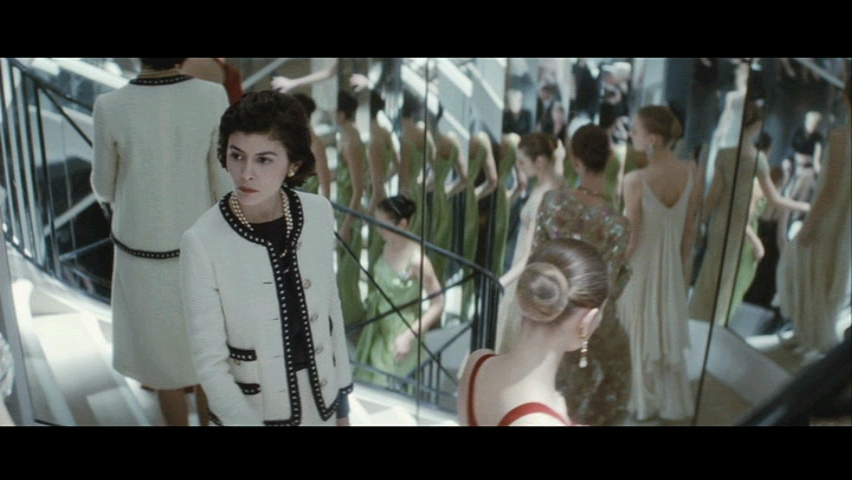
comeback, where Chanel is shown inspecting her models from the vista
of her famous mirrored staircase.
What
are we to conclude? Someone ignorant about perfumery would come
away from this film with no knowledge that Gabrielle Chanel brought
into existence the most iconic perfume of the twentieth century. We
perfumistas of course know this to be the case. Could a woman
completely devoid of any interest in scent have done such a thing?
I
should say that scent is not entirely absent from this film, as Coco
is chain smoking in many of the scenes, from her days at the cabaret
to her nights working alone in her atelier. While designing in her
boutique, with customers present, she is repeatedly depicted with a
cigarette dripping from her lip, to the point where one may not
unreasonably wonder how an errant spark never caused the whole place
to burn down in a blazing conflagration of black lace, silk, and wool.
Cigarette
smoke has a strong and even overwhelming odor, which will modify, if
not entirely mask, all subtle perfume. So one message which we could
glean from this film, devoid though it is of any explicit mention of
scent, is that when Chanel set about designing perfume, for her nose
to be satisfied, it had to be a declarative, penetrating scent which
would be detectable even in the presence of cigarette smoke. Perhaps
therein lies the true reason why Chanel thought that women have no
business smelling like flowers. A simple floral soliflore could never
compete with the chimney stack of cigarette smoke which she was
constantly pumping out!
Another
message to take away from the omission of any mention whatsoever of Chanel no 5 is that Chanel was first and
foremost a fashion designer, and perfume for her was a type of
accessory. The fact that she farmed out her perfumery interest to the
Wertheimer brothers would seem to corroborate that idea. Later, when
Chanel no 5 became enormously successful, as a result of the
marketing savvy of her partners, Coco attempted to reappropriate that
part of her business, but her reasons appear to have been economic,
not olfactory.
Perhaps
the most obvious message to glean from the omission of any mention of
perfume from Coco avant
Chanel is that
the director, Anne Fontaine, has no interest in perfume and so, to
her, it seemed unnecessary to treat the topic at all in this version
of the story. That a perfume-free film about Chanel could be made at all should serve as an important reminder to those
of us ensconced within the subculture of perfume aficionados. There
are countless people in the universe who do not care at all about
perfume and find it even less interesting and valuable than fashion.
Small wonder, then, that nearly no one takes it seriously as one of
the beaux arts.
Subscribe to:
Posts (Atom)