
Of
Vats and Vaults, Toilets, Truffles and Top notes
As a
part of my admittedly quixotic quest for olfactory
omniscience, I have made it my mission to watch every single film
with any perfume or scent reference. (Please leave comments with any
suggestions you may have!) Using perfume as a search term in
my library's database, I recently happened upon an obscure PBS Nova
miniseries episode produced back in 1995. The Mystery of the
Senses: Smell is not a feature-length film but a 56-minute
educational video intended for people like me who are interested in
learning about scent.
Even
knowing all of this, I must confess that I found my thumb hovering
threateningly over the eject button of my DVD player's remote control
as I watched and listened to the cringe-worthy opening of this
production. The text is narrated by Diane Ackerman, author of The
Natural History of the Senses, in a truly annoying tone befitting
of a junior high school biology teacher. For your pleasure, I provide
the text and a few images from the opening scene:

We're
about to embark on a journey through the world of smell. And we're
going to start at the Statue of Liberty, of all
places, where a real smell-celebration is in
full swing.

The
fireworks are for Champagne, a new Yves Saint
Laurent perfume.
This
is Champagne's gala coming out party—the perfume, not the drink.

It's amazing how much sensing happens at a snazzy shindig in the dark. There's lots of conversations to hear, and sights to see, and there's plenty of tasting ... to work off. There's touch.

This is a fabulous
party,
and all for the sake of a smell!
That
should suffice. You always know that what you're watching is really lame when your eyes shunt back and forth between the minute counter clock on the DVD
player and the screen. Nonetheless, I decided to stick it out. How
bad could it really be? I asked myself as I calculated the
remaining 53 minutes left to endure. In the end, I was very happy to
have invested just under an hour of my life to learn what I learned
from this film.
It
wasn't watching male cockroaches attempt to copulate with a rod just
dipped in female cockroach hormones which redeemed The Mystery of
the Senses: Smell. (Sorry: no screen shots, as I have a deep fear
and loathing of insects and also prefer not to draw entomologist
traffic to this site. Porn enthusiasts already flock here in search of “group orgy”, “prostitutes”, and
the like. Believe it or not, such search terms bring more new
visitors to the salon de parfum than even “Luca Turin divorce”!)


Nor
was I especially smitten with the smart scene where Ms. Ackerman, in her bright red dress and facial foundation two shades too light, sashays into a steam room and does a quick twirl toward the camera amidst
several hairy-chested, virile-looking, towel-clad men to proclaim,
after drawing a deep breath through her nostrils:
It really does
smell good in here!

I felt that the segment on drug-sniffing dogs working for the Feds at an airport and a shipping dock could have been edited out without loss since on the day of the filming the dogs found nothing, making it all seem rather anti-climactic, especially given the suspenseful musical score playing in the background.


An
olfactory scientist's ability to literally wave his nose back and
forth over the opening of a Chanel
no 5 perfume bottle was, I own, mildly amusing. He
apparently has extra muscles in his nose or has somehow trained it to move as though it had joints!


I
confess, too, to having enjoyed the repeated and graphic
demonstrations that skin chemistry is very important to scent
perception.


A brief segment on olfaction instructs viewers as to the process by which we recognize scents: it's a matter of molecular shapes inserting
themselves like keys into receptor “locks”.
I enjoyed traveling with a Bedouin-like man by camel over desert terrain to find gnarled trees in which frankincense is hidden.


He harvests some of the blobs of this resin and then returns home to negotiate a price with a big frankincense dealer.

This segment was truly educational to me, as I did not formerly know that frankincense was a resin tapped from trees like sap.


A short excursion to Oman, the true
source of the current oud fad (pace Pierre/William/Ammar) is equally rewarding.
But the undeniable highlights of this film are three. First, the segment featuring a perky little sow on the hunt for truffles, which—I had no idea before this viewing—are sought because they happen to bear the scent of boar musk within them!


Yes, believe it or not, female pigs burrow into the ground to dig out truffles because they believe themselves to be finding a mate! What a revelation. I honestly had no idea.
A friendly French farmer preparing a truffle omelette slyly confides with slanted eyes that truffles have aphrodisiac effects upon human beings as well! Ooh, là, là!

All of this excitement and talk of pheromones naturally got me thinking about the possibly biological basis of the age-old “Cats or Dogs” dichotomy. Perhaps it really does come down, in the end, to pheromone receptors! The people who dislike cats often love dogs, and vice versa. Some people, of course, go both ways.
The second big eyeopener of this little film involved a visit to a factory where fragrances are produced. I have often referred to “vat-produced chemical soup” in my negative reviews of what I find to be unwearable fragrances (not worthy of the name perfume...), and in The Mystery of the Senses: Smell, all of my suspicions were confirmed about the various kinds of errors which may arise when factory workers mix together perfumes in large vats.
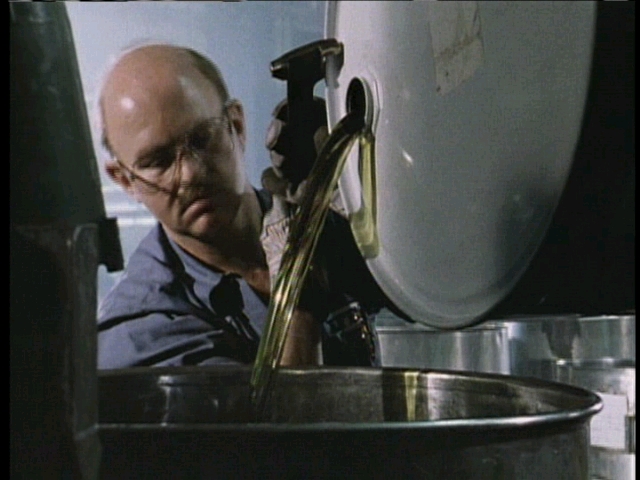
Ever
wonder about batch variations? The nearly infinite possibilities for
mistakes are revealed in a few snapshots of the inside of one of the
places where fragrances are produced in bulk volumes. All it would
take would be one tiny error: a mix-up on the tank, the spigot
number, the measurement line for the proper amount to add, a distracting cellphone call, a
foreman's illegible scrawl...


Small wonder that big perfume houses feel that they can reformulate with impunity. Mistakes are and can only be made! Oh well.


After this incredibly insightful look at the inside of one of these
fragrance factories, I realized that it's very nearly a miracle
that any two different batches ever smell anything alike!
Small wonder that big perfume houses feel that they can reformulate with impunity. Mistakes are and can only be made! Oh well.

The
third, and by far most important part of this educational film, for
perfumistas, is the rare glimpse which it offers into the
behind-the-scenes workings at International Flavors and Fragrances (IFF).


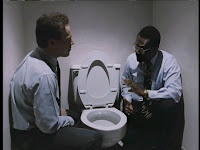


Viewers are treated to such exquisite sights as a perfumer and his
manager arguing animatedly over a toilet about whether a new cleaning
scent contains too much pine—and (because the manager thinks that
it does) what to do about it.


Again,
a perfumer and his supervisor hover over a freshly shampooed head,
which, they come to agree, smells too sophisticated, too floral, and
needs more fruit to be able to appeal to younger consumers!
So there you have it, my fragrant friends: the ultimate source of the fruity-floral tsunami of fragrances being put out today. These supervisors and managers working behind the scenes at IFF—and elsewhere, I presume—are requiring perfumers to modify their creations to fit prior shared conceptions of what toilets and young women should smell like!

Grojsman expresses manifest frustration at having been asked by her employer to produce a men's fragrance, given that she specializes in women's floral accords. She also complains at one point that the powers that be at IFF have decided that she works better under pressure, so now they all “step on my neck”!
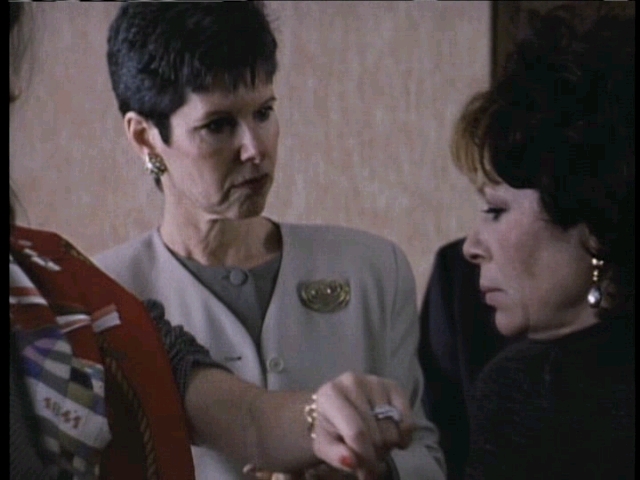
That what Grojsman says is indeed true becomes clear in the scene in which she and Gottlieb face off over Grojsman's fragrance submission. Gottlieb has the power in this relationship, representing as she does the company who will have the final say on whether Grojsman's new composition will be launched as a perfume.


Gottlieb complains that
Grojsman's fragrance needs a fresher top note, and she provides a
liquid example of what, as she puts it, “we'd like to see built
into your submission.”

All
of this takes place on Friday afternoon. The group comprises
representatives from both sides: the client, led by Gottlieb; and
IFF, with Sophia Grojsman as the target of criticism for having
produced a perfume (gasp!) unacceptable to Gottlieb! The group
decides to reconvene to evaluate Grojsman's modified submission on
Monday afternoon at 2pm. The Friday meeting is thus adjourned and,
from there, presumably all of the bureaucrats and Tzar Gottlieb go
home to enjoy the weekend.


Meanwhile, Grojsman toils away nonstop in her laboratory, assistants by her side, attempting to produce Gottlieb's desired fragrance by the looming deadline.

Grojsman's weekend struggle is ultimately for naught, as the fragrance is rejected and the formula relegated to the vault of perfumes composed but never launched, an official failure. Why?


In
The Mystery of the Senses: Smell, Gottlieb comes off looking like
something of a villain, towering over Grojsman and browbeating her
into producing what Gottlieb wishes to smell. Given this derogatory
depiction, I feel obliged to observe here that I
myself am in fact a fan of perfumer Ann Gottlieb, who was the nose
behind two quite original creations: Sarah Jessica Parker Covet,
a bizarre lavender-chocolate fougère,
and Calvin Klein Contradiction,
an oddly indescribable and equally appealing
eucalyptus-fruity-oriental perfume.
Both of these compositions are admired and even loved by me and, perhaps precisely for their sheer eccentricity, both have been discontinued. Gottlieb created these innovative and challenging perfumes and obviously had the gumption to stand up to her clients. Covet and Contradiction, albeit now discontinued, were in fact launched. Alas, these perfumes fell prey to the tyranny of the market, to whom the companies which produced them are beholden. Businesses, lest anyone forget, are intrinsically profit-seeking entities.


Because the client rejected what Grojsman produced for having failed to be what the client wanted it to be.
Discussion
Both of these compositions are admired and even loved by me and, perhaps precisely for their sheer eccentricity, both have been discontinued. Gottlieb created these innovative and challenging perfumes and obviously had the gumption to stand up to her clients. Covet and Contradiction, albeit now discontinued, were in fact launched. Alas, these perfumes fell prey to the tyranny of the market, to whom the companies which produced them are beholden. Businesses, lest anyone forget, are intrinsically profit-seeking entities.
In
the scene in which Gottlieb appears in The Mystery
of the Senses: Smell, she is the boss,
exerting near tyrannical power over Grojsman, whom many, however,
regard as a better perfumer. Certainly, Grojsman's résumé boasts
far more success stories: Estée Lauder White
Linen and Beautiful,
Calvin Klein Eternity,
Yves Saint Laurent Paris and
Yvresse
(originally launched as Champagne,
the perfume being celebrated at the opening of this production),
Lancôme Trésor,
Bvlgari Bvlgari pour Femme.
The list of Sophia Grojsman-designed bestselling perfumes literally
goes on and on and on...
I must reiterate that the face-off between Gottlieb and Grojsman presented
in this video was very surprising to me, as I have always regarded Sophia
Grojsman as the perfume artist par
excellence, if any perfumer is an
artist at all. That is, in effect, the question pointedly raised by
The Mystery of the Senses: Smell,
and it makes the short film well worth any perfumista's time to see
the reality of what perfumers are doing when they agree to work for
clients who have the final say on whether a new creation makes the
grade, deserves to be launched and therefore exist.
The
fact that Ann Gottlieb, a considerably less well-known and less
well-regarded perfumer than Sophia Grojsman should be able to issue a fate-sealing judgment on one of Grojsman's creations constitutes a serious reality check
for those who persist in insisting that perfumery is an art. Watch
this film, please, if you can find a copy somewhere—anywhere—and
then ask yourself whether the kind of pressure under which Grojsman
is placed, forced to modify her creative output to reflect the values
of other people—and ultimately to please their, not her tastes—can
properly be considered artistic creation. To me, this little film
provides an iron-clad, definitive proof of what Bryan Ross over at From Pyrgos has been saying all along:
Client-commissioned
perfumery is design.
What
all of the perfumers at IFF are doing—whether they work in the
toilet bowl cleaner area or around the shampoo sinks or in an
elaborate workshop such as Sophia Grojsman's, where iconic perfumes
are born—is the same. Yes, scents for toilet bowl cleaners and shampoos are created in the same way, with negotiations and
concessions being made by clients and contracted perfumers. Should we say, then, that all
of the perfumers working at IFF are artists?
One
thing is clear: if the word artist is to mean anything, then it
must delineate a contrast class. The question becomes: who are the
non-artists among all perfumers? If, as Chandler Burr ("The Curator") suggested in an interview for a piece at the Daily Beast regarding his new "olfactory art" exhibit (at the Museum of Arts and Design), even the person who created the scent for Coppertone suntan lotion is
an artist, then it starts to sound as though anyone who produces new
scents is automatically an artist. In the case of this naïve—or
ignorant, if you like—use of artist as an emotive form of
approbation, the term simply refers to anyone who produces something
which we appreciate. What many in the "perfumery is art" camp fail to grasp is that the question of whether perfumery is art is not a question about whether perfume is a good or worthy thing. It is, rather, a conceptual question.
If
every perfumer is an artist, then why not every chef and gardener and
wine producer? Are candle and soap makers and bakers also artists in
this sense? Well, then why not everyone else who does anything else
we value, too? Why not farmers, civil engineers, school teachers, and
heads of state? All of these people apply their intellect to generate
creative solutions and reach certain goals: crop rotation, irrigation systems,
interdisciplinary classroom curricula, five-year plans. Are these all
supposed to be artworks, too?
We
should not blind ourselves to the implications of this sort of
promiscuous application of the term artist to everyone and his
mother, brother, sister, father, cousin, niece and nephew.... In the
end, if everyone is an artist, then no one is an artist. The label
has been evacuated of all meaning. Why not, then, simply honor the perfumers who
excel at their trade by identifying them as “great”?


