Saturday, October 6, 2012

Perfumes of Geography: What's in a Place Name?


Perfumes with literal geographical references in their names have become quite fashionable of late. First came Bond no 9, whose founding mission and guiding idea was to “make scents of New York.” They've launched perfumes with the names of streets (Lexington Avenue, Fashion Avenue, Wall Street...) and parks (Central Park, Madison Square Park, Bryant Park...) and boroughs (Brooklyn and Manhattan, with Staten Island, the Bronx, and Queens no doubt to come!) and beaches (Fire Island, Coney Island...) and squares (Cooper, Union, Astor Place...)—and you name it (Harrods, Saks, Queen Elizabeth II, The Scent of Peace!). They even got a bit carried away—in what might however be regarded endearingly as the typical New Yorker way—with launches of perfumes whose names correspond to locations rather far from the Big Apple: Indianapolis, Boca Raton, Texas, and Las Vegas, among other places.


To New Yorkers, of course, all the world is a part of the big, melodramatic and metaphorical Broadway stage. To the rest of the country, New Yorkers may as well be for'ners—and many of them are, including Bond no 9 guru Laurice Rahmé, who in true Napoleonic style set out in 2003 to conquer the olfactory universe, one fine eau de parfum launch at a time. I mean that as a compliment, I really do. In this world of Pac-man like corporations gobbling up small houses left and right, it takes some real guts to embark on the construction of an independent perfume empire!

The geography idea soon caught on—though I must say that I haven't seen any credit given where credit would seem to be due... Of course, there have been subtle nuances in the various concepts now smattering the grand olfactory map of all perfumes present and past. 


Guerlain launched its Les Voyages Olfactifs series in 2009, the first three destinations (all originating, naturally, from Paris) being Tokyo, Moscow, and New York, the latter of which came close to encroaching on Bond territory, but hey: imitation is the highest form of flattery! In 2011, Paris-London was added to this series and, in 2012, Paris-Shanghai, so I gather that Les Voyages Olfactifs have enjoyed some market success, in spite of the fact that the original launches were offered only in 250 ml bottles.


Somehow this geography concept acquired a kind of momentum, and today several different niche houses have launched place-inspired perfumes. The Different Company recently launched Tokyo Bloom, and Keiko Mecheri has a few geographically inspired perfumes, including not only Tangeri, in the new Bespoke collection, but the set of four perfumes specifically marketed as evocative of distinct places: Tarifa, Taormine, Les Nuits d'Izu, and Mulholland Drive, the latter of which, too, seems to take its cue from Bond no 9—both in concept and compositional style. But in these cases, the isolated launches of place-named perfumes represent only a tiny fraction of the total creative output of the house—rather like the launch by Parfums de Nicolaï of New York in 1989, or by Yves Saint Laurent of Paris, way back in 1983. I should perhaps say that the name Paris appears in more than 100 perfumes, but that city is obviously a special case. And of course some of them refer to Paris Hilton!


In contrast to the sporadic appearance of city names in the collections of several niche houses, a couple of new ventures have made cities the very basis of their entire oeuvre. Dueto, founded in 2010, boasts a grand total of four perfumes, the bottles of all of which are covered with a sort of city name wallpaper with dozens of different cities listed. Dueto's concept is that of the global city: we are all connected in our urban sprawls, wherever they happen fortuitously to be. It's not just that we're connected as citizens of the world, as the Stoics of ancient Greece maintained in espousing cosmopolitanism. No, we're connected in coolness, as is indicated by the names of the perfumes: City Oud, City Love, Lady Cool, and Golden Boy.
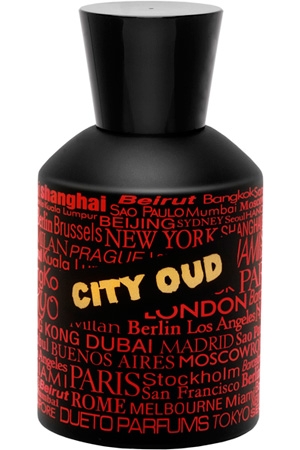

If the individual perfumes are not distinguished by specific cities, then why are cities' names on the bottles? one may with reason ask. The answer, to reiterate: globalization is this house's concept. I'm not entirely sure that pasting the names of some finite number of cities on all of the bottles of perfumes of a house is likely to be an effective marketing tack, but then again, what do I really know about marketing? I do know that Dueto currently has a promotion running through which a free smartphone case will be yours with the purchase of one of their perfumes. This is starting to look like a gimmick run amok. But who knows? Perhaps their perfumes are masterpieces. On ne sait jamais...

The crown for the most place-name launches in the shortest period of time has been usurped from Bond no 9 and now belongs to The Scent of Departure, the house recently founded by Histoires de Parfums' own Gérard Ghislain, who apparently ran out of literary inspirations a while back, having switched to the most literal of all possible names for his tuberose trio: Tubéreuse 1, Tubéreuse 2, and Tubéreuse 3—although it's true that descriptive subtitles were also given to the perfumes, presumably to prevent confusion. In my testing, I did not find those descriptions (respectively, Capricieuse, Virginale, L'Animale) to be accurate to my phenomenological experience of these perfumes, so the subtitles ended up being more confusing than helpful. The only way that I can remember which one is which is to go back and read my reviews...

In any case, Scents of Departure already boasts 19 perfumes, each said to be a destination for olfactory departure to be accessed through spritzing a bit of the named perfume on. This is gimmickry beyond belief. Does anyone think that cities smell like perfumes? Bond no 9 stretched credulity with its concept of mapping scents on places in and around New York City—to my nose one of the stinkiest cities in the First World, certainly in the United States—but at least there were some breathers in there, perfumes representing beaches and parks and gardens, all of which do have various kinds of scents. What, pray tell, does Dubai smell like? In reality, all big cities are teeming with all manner of smells. And yes, they are mainly smells, not sources of olfactory delight.

I recall that some perfumistas used to chide Bond no 9 as a tourist house, but that distinction, too, has been stolen away by The Scent of Departure, although Bond no 9 made a valiant effort to hold their own on that front with its series of I Love NY launches featuring no less than the t-shirt logo itself and offered at a slightly reduced price so as to be more accessible to, well, tourists. At one point they were even running a promotion offering a free t-shirt with the purchase of one of the bottles of I LOVE NY perfume.  


The Scent of Departure perfumes are modestly priced—well, okay, they're actually cheap relative to niche standards—which is bound to raise skeptical brows among niche snobs: $45 for 50ml? That would be a no-go for most people who frequent L'Artisan Parfumeur, Montale, Frédéric Malle, and the like. In fact, that price is so low that one suspects that the juice inside may be even less worthy than middling mainstream designer launches.

I have not tested any of the recent flurry of city perfumes (from either The Scent of Departure or Dueto), and I cannot decide whether I should. In some ways I'd rather protest with my wallet to gimmickry gone grossly awry by buying one really good perfume rather than a bunch of mediocre samples which will end up depressing me about the Fall of Western Civilization all over again. Maybe I'll test all of those fragrances after I've finished the Montales, the Kriglers, the Illuminum, and the Boadicea the Victorious perfumes waiting patiently in my queue. See you in 2014, The Scent of Departure, by which time either you'll have 60 city perfumes in your collection, or you'll have shuttered your store.


Are Perfumes of Place a Rejoinder to Flanker Madness?

The big houses have not generally (Guerlain being a noted exception) felt the need to get in on this particular gimmick game. After all, they have infinitely proliferating flankers to peel off of their massively marketed bestsellers, which provides a built-in name and new-launch generator. One takes the name of the original perfume, say, Dior Poison, and simply tacks on an adjective: Hypnotic Poison, Midnight Poison, Pure Poison. Of course, those perfumes were only nominally flankers, as each was entirely distinct and became an independently iconic perfume.


The real Poison flankers—flankers in name and spirit—were the second-order creations, whose names were made from the original names by attaching words such as “Elixir” to produce: Pure Poison Elixir, Midnight Poison Elixir, and Hypnotic Poison Elixir.

The most flankerized Dior perfume appears to be Addict, which has spawned Addict to Life, Addict Dior Twist, Addict 2, Addict 2 Eau Fraîche, Addict 2 Logomania, Addict 2 Sparkle in Pink, Addict 2 Summer Breeze, Addict 2 Summer Litchi, Addict Eau Fraîche, Addict Eau Sensuelle, Addict Shine, Addict Summer Peonies, Addict Limited Edition Collect It, and of course the eau de parfum. There also appears to have been a second, separate launch of a perfume by the name of Addict Eau Fraîche—just to keep Addict addicts on their toes (forget their nose...).

It seems clear that such flankers are intended to be one-bottle wonders, purchased once and then forgotten as new flanker launches capture the Addict-devotee's attention. It is their loyalty to the original Addict which must keep consumers coming back again and again to buy these new short-marketlife perfumes, because they are never around long enough to create a following of their own.

Other houses have engaged in massive flankerization of their most popular perfumes as well, including Calvin Klein, which since becoming a page in the Coty Prestige portfolio appears to be vying for the flanker folie award. All of the original, classic Calvin Klein fragrances have been flankerized, with CK One and Eternity having spawned, respectively (as of today...) 18 and 13 offspring, although if one counts the Eternity Man spores, then Eternity would win with 22 flankers covering both genders. (This comparison makes some sense because CK One is a unisex fragrance.)

Who needs place names with a virtual infinity of potential flankers, all of which sail on the tail of the wave of marketing success of their namesake? Given the proven economic efficacy of the flankers based on their famous perfumes, for a house such as Dior or Calvin Klein to begin by naming brand new perfumes after places doesn't make all that much sense. It is the name of the already famous perfume which the names of flankers are intended to evoke, filling the consumer with a warm feeling likely to generate a fumbling about one's purse or wallet in search of a credit card.


The geography idea has somehow, nonetheless, managed to infect even a few designer houses. Donna Karan, a mainstream house now under helm of the Estée Lauder Group, has gotten in on the place name game with four recent launches of Be Delicious LOVE THE WORLD apple perfumes said to be city-inspired: Rio, London, Paris, and New York. Isn't Rio de Janeiro the site of a documentary film about people who live in the garbage dumps situated around the perimeters of the city? So is that the scent of Rio, and if not, why not?

The Be Delicious apples had already been massively flankerized—by my count 19 times before the Cities series, which, inching ahead of Calvin Klein Eternity, brought its flanker total to 23 as of 10pm EST on October 5, 2012. If one gimmick is good, then are not three gimmicks three-times better? appears to have been the brilliant deduction of one of the marketing masterminds at DKNY—or perhaps all of the big ideas now erupt out of the Estée Lauder nerve center.

So why should an apple be associated with London, Paris, or Rio? Your guess is as good as mine. The concept is further confused by the visible name New York as a part of the name of the house: Donna Karan New York on all four of the flanker boxes. I suppose that in three of the cases the first could be the departure and the second the destination city, à la Guerlain's Voyages Olfactifs: Paris and New York, Rio and New York, London and New York. The fourth one just seems redundant. Or maybe it's a cleverly coded message that New York is where everyone really wants to be? Which brings us back again to Bond no 9. Oh well.

At this point, I think that it is fair to say that the Be Delicious flankers have essentially become disposable perfumes: one bottle will outlast the production cycle and is all you're ever going to get of these launches, so if you fall for one, you'd better stock-up early. I don't want to make sweeping generalizations about the quality of the Be Delicious perfumes, as I have yet to muster up the courage to test any one of them, but I suspect that they are not the sorts of compositions which inspire profound reverence among wearers. Perhaps I am wrong.


Multilauncher Madness?

For the multilaunchers, there are plenty of alternatives to the place-naming game. Montale perhaps offers the example of the least creative effort invested in naming. Produce a name by simply pushing together two nouns or adjectives which can be said to apply to the perfume inside—even in some vague or tenuous sense, but often in a most literal way. I confess that I have lately fallen prey to the Montale sample game, which involves acquiring as many Montale samples as possible to be able one day to say that one really knows this house. As a consequence, I happen to have lots of their unimaginative names ready at hand.


Montale Santal Wood

Montale White Musk
The good thing about Montale, of course, is that they actually produce quite likeable perfumes. They embody a predictable quality which keeps customers once hooked coming back for more and more, and the range is so vast that one cannot become easily bored. True, there is a lot of repetition, but I'm not convinced that this is a matter of concern in the case of Montale. Whichever “Aoud” perfume you choose will be closer to another Montale Aoud perfume than it will be to anything else, but no one ever said that each creation of a house had to be entirely unique, and the proliferating launches convey a different marketing philosophy altogether: profligacy over parsimony! If I may be so brazen as to paraphrase Montale/Shakespeare himself:  If some is good, is not more better? 

In reality, more is sometimes less, when it is created through the sacrifice of standards and the type of gestation period apparently common to most of the great perfumes of the past—back in “the good old days,” as vintage perfume lovers are wont to lament, reminiscing upon the time when a perfume launch was a bona fide event, rather than the metaphorical equivalent of a tweet.


The guiding idea behind all of the multilaunchers' efforts seems to be to produce a large set of fine niche perfumes into which consumers can dip with some confidence that they will be happy even with a blind buy, having once ascertained the quadrant—or octant—in which their preferences generally lie. It wouldn't really help consumers if Montale's perfumes were all completely unique, since no individual can possibly wear 60 or 80 or 100 different perfumes, so there's no real need to have them all. No, a couple or a few Montales will fill that Montale need quite well until those bottles have been drained. In the meantime, Pierre or Ammar will have produced a dozen or so more creations to satisfy the consumer's simultaneous yearnings for consistency and newness in one fell swoop.

Illuminum, a new British house, has pretty much followed Montale's lead, christening its perfumes using the same simple pairing system to produce such names as Black Musk, White Musk, Black Oud, Rose Oud, Vetiver Oud, White Lotus, White Saffron, Saffron Amber, White Gardenia Petals, etc. Established in 2011, this house already has a collection spanning 33 perfumes!

When you're out to compete with Montale and Bond no 9 in frequency of launches, other types of naming require too much work, it seems. Or perhaps one might surmise, more charitably, that more creative energy is being channeled into perfume composition than the advertising. Hope springs eternal. In reality, that's not such a good argument, because the people designing the bottles are not the same people designing the perfumes, so there's no reason for thinking that the two are somehow in competition with one another. The beautiful bottles used for mainstream fragrance launches do not cut into the perfume composition budget, which stays measly whether the bottle looks good or not.

Similarly, it does not seem to me that creative perfume naming in any way precludes creative perfume composition—nor on the other hand does it ensure it. The tendency appears to be to spend a lot of time on the concept and to wheel in a nose for hire to produce a scent—in time for the intricately orchestrated launch—which can be said in some sense to reflect the name. After that, the whole production is “revealed,” if you like, as a package to a broad sea of disparate consumers, some of whom are shopping for names, labels, and bottles, and others primarily for scent. Certain self-styled purists of course claim that they care only about the scent inside the bottle, but such a position is not obviously coherent, if in fact the reason we value perfume is, above all, for the pleasure it provides.

Surely the pleasing packaging can only contribute to the quality of the overall experience of holding a smooth sculptured bottle, removing a shiny weighted cap, spritzing the perfume on and perceiving how the notes and layers unfurl. Just as an excellent meal tastes better eaten off a porcelain than a paper plate, and a cup of coffee tastes better from a beautiful glass mug than from a styrofoam cup, it seems that perfume, too, should smell somewhat better when it has been properly stored and dispensed from a container equal in beauty to the liquid inside. Bottles, in other words, do seem to matter to our experience, and if they do not they should, it seems to me. Who wants to eat haute Italian cuisine using a plastic fork? I ask most sincerely.


Notes and Place Names as Metaphors

Getting back to the geography question: what in the world is going on here? Why the obsession with places all of a sudden? The jaded, crass view, of course, is simply that geographical locations offer a quick and easy way to generate names for a variety of distinct perfumes without too much creative input on the part of the marketing whizzes writing jingles and fabricating the names of new metaphorical notes behind the scenes at perfume houses.

Names are suggestive metaphors no less than are notes. We are told of the alleged notes of a new perfume in what are clearly intended to be poetic terms: cashmere wood, sparkling aldehydes, ... But even more literal-sounding “notes” are metaphors no less than are the names of perfumes said to have been geographically inspired. Does a perfume with “London” or “Paris” or “New York” or “Tokyo” in its name evoke memories of those places? Perhaps not in cases where the city is one with which the wearer has no familiarity, but even then, the name of a city famous enough to be included in geographical perfume series tends to evoke memories of imaginings informed by media images of the place.

Paris Las Vegas!
Place names gesture toward a hypothetical dreamscape where we might visit in our minds as we reflect upon the perfume. In this way, geographic names for perfumes convey a truth about the olfactory globe itself, a veritable parallel universe explored only by fragrant travelers who consider the value of perfume to inhere in the memories and associations it evokes, not in the approval or attention which it may be used to garner from other people.

The real mystery is why niche houses have felt the need to generate so many names so quickly. It seems that they have myopically decided to join in on the multilauncher craze, the strategy of which appears to be to produce so many different perfumes that every potential customer will be able to find at least one to his or her liking. 

In other words, what appears to be prodigality really has a pragmatic basis, grounded in the indisputable fact that different people like different “notes” and genres of perfume. If a house creates one single perfume, even if it is a masterpiece, there will be people who dislike the creation because of what it contains. Patchouli phobes exist. Violet phobes, aldehyde phobes, even rose phobes exist!

Niche perfume houses are trying to launch many different perfumes rather quickly in what seems to be an endeavor to be able to compete with the big houses as they rule the flanker game. But I sincerely wonder whether niche houses are not sabotaging themselves by putting out so many perfumes in such a short time that none of them is likely to enjoy sufficient market success to justify keeping in production.

This is a separate concern, purely pragmatic, about how niche houses can possibly win the multilauncher game against the corporate giants LVMH, Coty, Procter & Gamble, L'Oréal, and Puig, which seem intent upon swallowing up most of the perfume market one chunk at a time. The more substantive concern is whether niche houses are undermining their own ostensible raison d'être by spending less and less time on the composition of their new launches, which seems to be a mathematical inevitability, given their relatively small staffs and budgets.

Niche houses were born out of a desire to offer specialized, high-quality offerings with a cachet of exclusivity. When a house launches 20 perfumes in one fell-swoop, it's hard to believe that any of those perfumes could be truly original or exquisite. Perhaps one or two of them will be, but how many consumers (aside from the more OCD-afflicted perfumistas among our numbers...) will bother to give all of them a sniff?

The number of new perfume launches per year—having exceeding 1,000 in 2011 and continuing to grow—has reached the point where perfumistas may simply throw their hands up in despair, having recognized that their once noble goal of mastering knowledge of the perfume world has become a fully quixotic dream verging on delusion. No finite person can really keep up with the frequency of launches today. Even if one attempted to review three perfumes each day, that would still leave new perfumes unsniffed by the end of the year. Why bother? Who can remember them all? Who really cares?


The Bottle Half-full

Perfume sampling can be viewed, in fact, as a form of travel through the olfactory universe mapped out in greater and greater detail as more regions of formerly uncharted territory become appropriated in identifiable perfume forms. As multilaunches—of both designer flankers and niche series—continue to proliferate, more and more push pins become concentrated in more and more areas until every new launch must be squeezed into an already crowded corner, making it seem less and less likely that iconic perfumes can still be produced.

There are only so many qualities which one can put together in a perfume and expect people to wear. When compositions become too extreme, they simply become unpleasant, and no matter how original they may be, they are bound to founder sooner or later. True, radical concepts may enjoy a short-term success as the novelty value sustains sales, but no one is really going to be draining multiple bottles of them, so once everyone's curiosity has been satisfied, they'll go back to buying wearable perfume until once again their interest is piqued by the latest Big New Thing.


Ultimately, whether we are excited or disgruntled by the flood of new launches, including the new geography-inspired perfumes, will depend upon what it is that we are looking for in perfume. As the launches have proliferated, so has the sampling frenzy, with many perfumistas seeming to spend much of their fragrance wallet share on small decants and samples, rather than investing in full bottles. Have we become promiscuous because of the frequency of launches? Or are these perfumes being poured out so swiftly because of our sampling madness? Montale, Bond no 9, Keiko Mecheri, Boadicea the Victorious, and brand new houses such as Illuminum and The Scent of Departure are offering so many choices that we may find it difficult to commit, enticed as we are continuously by the new perfumes on the horizon waiting to be sniffed.

There is something admirable about wanting to know as much as possible about any area, including perfume, and with more and more new houses appearing, and more and more perfume being pumped out, perhaps the world of perfumistas will eventually subdivide into genre specializations. It might have been possible to be conversant will all of the important new launches in Paris back in, say, 1950—or even 1980. Is it possible today? Probably not as a hobby. Maybe only people who give their lives over totally to perfume sniffing are going to be able to achieve a real competence in the field.

For now, we have thousands of dilettantes sniffing whatever they happen to come across or whatever happens to grab their attention long enough to justify acquiring a sample, and publishing their opinions on the world wide web as though they were authorities. But of course they are no less than is anyone else, it seems to me. As of today, the Parfumo database contains nearly 21,000 perfumes, and that number continues to grow. Is there an end in sight? At some point, sooner or later, perfumistas are going to arrive at the conclusion that thousands upon thousands of perfumes are simply not worth our time. But which are the ones most likely to capture our attention? Those which are mass marketed in blanket media spam campaigns, of course.

Niche houses served in the past as an oasis, a repository of composed perfumes created by people with ideas transcending the curriculum of M.B.A. programs. I do believe that a few good perfumers are still putting out creations just as in the good old days, but it must be incredibly difficult for them to survive, which is why whenever we have the chance, it would behoove us to support the independent houses, since we know that “someone is home.” Where there is a perfumer in the house, let's do what we can to prevent him from becoming homeless.

Whatever may happen to the perfume world in the future, we will not have lost anything but some petty cash in traveling around the olfactory world sniffing one creation at a time, even if much of what we smell seems redundant. The real world, too, is filled with redundancy, but we can connect the dots from one destination to the next according to our own ideas and past. What else could we do?

No matter how much vat-produced mediocre juice is poured out, this will not prevent true perfumers from plying their trade. It's left to us only to seek them out. The overwhelming number of new launches—among even the niche houses—makes it more challenging to locate worthy perfumes, but it also makes it more rewarding when we do. Just as we can learn by traveling around the real, geographical world, through the process of traveling down what may sometimes prove to be dark alleys of perfume, we will have learned something, too.


Thursday, September 27, 2012

Is Pierre Montale William Shakespeare?


Over the course of the past year, perfumistas have been debating whether Pierre Montale is or is not the nose behind the perfume house bearing his name. Clearly Montale is the creative director, but does he exert any real influence over the compositions poured out by his house? Or is an obscure Palestinian man, Ammeh Atmeh, working behind the scenes in a shop somewhere in the United Arab Emirates, really the genius behind the launches for which Pierre Montale has become famous in the perfume world?

My fragrant friends, I come to you today with an alternative hypothesis. This theory, if I may, has yet to receive any sustained treatment by any of the bloggers I've read, but I am sure that upon reflection you will agree that it has much merit and is in all likelihood true. Let me begin simply, by boldly asserting what many of you have been waiting to hear: Pierre Montale is not the nose behind the illustrious Montale niche perfumes.


This is not, however, for want of talent, I hasten to add. The man has in fact had much bigger designs in mind than either you or I might ever have imagined or divined. Mixing together liquids using eye droppers and pipettes in a small laboratory in Paris? No, I'm afraid that Mr. Montale has been spending the best hours of his nights—he sleeps by day—penning the works of one William Shakespeare.

That Pierre Montale is in fact William Shakespeare may on its face seem an absurd proposition—and I own that it is. Key phrase: on its face. The trouble, my fragrant friends, is that for far too long you've been attempting to peer into the wrong atelier. You've been imagining a man in a beret mixing liquids into delightful Middle East-inspired oud elixirs.


In reality, Mr. Montale, far from being a French man with suspected relatives—whether legitimate or illegitimate—in Grasse, is the Bard of Stratford-upon-Avon. I am well aware that Shakespeare's dates are commonly given as April 26, 1564 – April 23, 1616, but these were fabricated by Mr. Montale, along with all of the names of perfumes in which all of his literary works, attributed to “Shakespeare”, have been encoded.

Your skepticism is fully warranted, and indeed praiseworthy, O Gently Scented Reader. You encountered the works of William Shakespeare long before you sniffed Pierre Montale's perfumes. If Montale is really Shakespeare, then how and, more importantly, why would he not have taken credit for the prodigious oeuvre of the man said to be the greatest writer in the English language? What evidence could I possibly have to back up such an outlandish claim? I am afraid, my fragrant friends, that the evidence is not merely compelling, but overwhelming.


Exhibit A:


All the world's a stage,
and all the men and women merely players:
they have their exits and their entrances;
and one man in his time plays many parts...

—As You Like It, Act II, Scene 7


Clearly Montale is playing cat and mouse with the reader, teasing him, taunting him to discover the truth that Pierre Montale is really William Shakespeare, and William Shakespeare was not in fact a committee, as scholars have sometimes so vigorously argued. No, William Shakespeare is a complete and utter fiction created by one clever man, Pierre Montale. 

The virtual existence of Shakespeare has permitted Montale to live off royalties paid into tax-free off-shore bank accounts from which he has drawn the funds needed to remunerate Ammar Atmeh to produce perfume ostensibly on Mr. Montale's behalf and in his name.


Why has Montale not stepped forward to answer the charges made against him by bloggers all over the world wide web?


Men of few words are the best men.

—King Henry V, Act III, Scene II


I sense furrowed brows before me. Inquiring minds are prepared to reiterate and insist: Why not take credit where credit is due?


The better part of valour is discretion.

—King Henry IV, Part I, Act V, Scene IV


But why, you may continue to protest, should Pierre Montale pretend to be a lowly perfumer, not even considered an artist by contemporary standards, if in fact behind the mask Montale has composed and credited to one William Shakespeare, 38 plays, 154 sonnets, and about 10 other poems?


Though this be madness, yet there is method in 't.

—Hamlet, Act II, Scene II


Uneasy lies the head that wears a crown.

—King Henry IV, Part II, Act III, Scene I).


Pierre Montale has often been claimed or thought to be the nose behind the many, many perfumes launched by his eponymous house over the past decade and sold in the Montale Paris boutique which opened in 2003. To date, the Montale perfumes number about 93. To some this would seem excessive, going beyond even Bond no 9 in frequency of new launches, which, in about the same amount of time, has launched approximately 73 perfumes (both figures are from the Parfumo.net database). The Bard himself retorts in a well-known passage:


Can one desire too much of a good thing?

—As You Like It, Act IV, Scene I


Could a man shamelessly fool all of Western civilization through the perverse fictional creation of what is thought to be the greatest of all fiction writers in the English language? Does not such an act of arrant duplicity and deception assault the basic presuppositions of honesty and trust underlying and essential to peaceful cohabitation in civil society?


Conscience is but a word that cowards use,
devised at first to keep the strong in awe.

—King Richard III, Act V, Scene III


Many a perfumista has poked fun at the boring names of the Montale collection, which seem to be pieced together using a random name generator. The Bard scoffs:


What's in a name? That which we call a rose
by any other name would smell as sweet.

—Romeo and Juliet, Act II, Scene II


Some have wondered about the excessive focus of the house of Montale on oud perfumes: Aoud Rose Petals, Steam Oud, Aoud Shiny, Moon Oud, Aoud Blossom, Aoud Leather, Aoud Lime, Red Oud, Aoud Forest, Golden Oud, Aoud Amber, Wild Oud, Aoud Safran,... the list literally goes on and on. We find a clue to this obsession in the master's own texts. With these telling words, he reveals his ultimate intention, to continue to launch oud perfumes iteratively until the Middle Eastern elixir to end all Middle Eastern elixirs has finally been achieved:


All the perfumes of Arabia will not sweeten this little hand.

—Macbeth, Act V, Scene I


To the bloggers and forum trolls who have attacked him, the Bard has answers as well:


The common curse of mankind, - folly and ignorance.

—Troilus and Cressida, Act II, Scene III


Nothing will come of nothing.

—King Lear, Act I, Scene I


What's done is done.

—Macbeth, Act III, Scene II


Thursday, September 20, 2012

The Toiletries Trap—or is it a safe haven?


Arts and Crafts and the Status of Perfume

The status of perfume continues to be debated, but it seems that the reigning climate these days is inclining people to join the “perfume is art” camp. There are many possible sociological, economic, and psychological explanations for this phenomenon relating specifically to this moment in history, but the question whether perfumery is really an art may be but one iteration of an age-old dispute regarding the distinction—or lack thereof—between arts and crafts. Is an accomplished potter an artist or a craftsman? What about a gourmet chef?


Is a genuine object of art essentially useless, serving no mundane function? Does an artist whose medium is clay become a mere craftsman on the days when she produces bowls and mugs? Should what she does be judged by appeal to what other people may or may not do with her creations? If she drills holes in the bottom of her mugs, making it impossible to use them for the purpose for which they appear to be intended, then will this act—senseless to some—elevate her, the creator, to the status of artist? Or will she just be a bad (mad!) potter?


The genre fiction writer offers another useful example for reflection. Authors of detective and mystery, science fiction, and romance novels are producing books which fit into certain predelineated categories and which follow certain basic conventions. 


The readers of such works have a set of expectations which must be met in order for the work to succeed. A mystery novel without any suspense is a failure because being suspenseful is essential to being a good mystery novel. A romance novel with no hot and steamy scenes of love and betrayal would be a flop. A science fiction novel which made no reference to the current state of technology and possible future developments would crash like a rocket with a faulty O-ring.


The Toiletries Take

To many, indeed most, consumers, perfume is a toiletry. Perfumistas have been known to bristle at the suggestion that the object of their olfactory love might be anything less than the most exquisite work of art. Nonetheless, like it or not, perfume is regarded by many people as a toiletry because it is a consumable product just like soap, lotion, and toothpaste. 


Such products all serve functions and offer certain very specific benefits to the user.


People generally perfume themselves in order to smell good. Often the goal is to smell attractive to other people. Some wearers, at least judging by comments in fragrance community website forums, appear to care more about others' receptions of their perfume than they do about their own perceptions of their own scent. 

Whether those who perfume themselves care more about their own opinions' or the opinions of those with whom they come in contact while wearing perfume, they appear to be united in their commitment to the idea so often recited in perfume reviews, that Perfume should smell good. From this perspective, if a perfume does not smell good, then it is either a bad perfume, or it is not perfume at all because it is unwearable.

Bad poetry has its own name: doggerel. Bad perfume is sometimes referred to as swill or dreck. Bad food is slop, but food which cannot even in principle be consumed is really garbage in disguise. In this way, perfumery is obviously similar to cuisine. A meal, no matter how painstakingly prepared by a chef, must be edible, in the end. If it is utterly inedible, because it is repulsive or poisonous, then the chef has failed. Food should taste good, and perfume should smell good. Does this not imply that niche perfumery is completely analogous to haute cuisine? Blasphemy of all blasphemies...


Consumable Crafts

Unlike most other crafts, cooking and perfumery are united by the fact that the products of the craft are consumed. We might consider wine in the same group and place oenology on an equal footing with other crafts the ultimate objective of which is to produce consumable goods. The artisan may and often does aim to produce fine, excellent, beautiful, even transcendent goods, but they must, at the end of the day, be consumable all the same.

What I find especially interesting about these crafts is not just that the goods produced are consumed, it is that the goods must be consumed in order to be experienced. Perfume appreciation, like fine wine and cuisine appreciation involves destroying the very object of appreciation through an act of ingestion. There is no point to food which is not eaten or wine which sits in a cellar never to be imbibed. Similarly, perfume in a capped bottle may hold potential for appreciation, but it is not truly appreciated for what it is, the unique combination of notes which unfurl before the nose, until it is sprayed.


This is, in part, it seems to me, the basis for the claim sometimes made that large perfume collections are ridiculous. If the person who owns hundreds—or even thousands—of perfumes cannot even in principle wear them all, then is she really any different from the notorious hoarder, who amasses and clings to objects in a desperate attempt to create meaning from an otherwise meaningless existence?


Perhaps we can think about large perfume collections in a more charitable light. Perhaps what they reflect is a desire—widely shared by perfumistas today, or so it seems—that we should be able to have our perfume and sniff it too, so to speak. This would seem to be the guiding idea behind the Osmothèque, an institution established in order to preserve perfume which however, in reality, can only be experienced through its very annihilation.

My distinct impression is that most people, even sophisticated perfumistas, have not really thought through the very many different kinds of judgments which they make regarding perfumes. The term 'art' has been appropriated to express approval, without any real examination of what it could mean for perfumery to be an art. It is unclear in what aesthetic principles of judgment applicable to perfumery might consist. People appear to judge perfumes solely by appeal to their own idiosyncratic tastes. Are there principles of perfume criticism? No one has yet to make the case. We can of course use language in any way we like and, yes, we may express our approval of a perfume labeling it a masterpiece or a chef d'oeuvre. But that just seems to be code for: “I love it!”

Certain nagging contradictions need to be addressed, if we are to get to the bottom of this question, it seems to me. On the one hand, many perfumistas seem to want to exalt perfume to the status of an eternal, immortal art. Most notably, in his Untitled series, Chandler Burr has been exhorting people to smell perfume as an art object. A sentence from one of his introductory texts at OpenSky reads: For the first time, experience perfumes in a way that will allow — in fact encourage — you to rethink each scent by freeing you from all visual cues and marketing techniques.

Burr appears to be addressing the unwashed masses most of whom have never participated in the sorts of Mystery Scent Vial Trials which have been hosted by perfumistas for years now. But even people who sample perfumes from vials, independently of the bottles, have already been experiencing perfume as perfume, not as marketing hype. 

To be perfectly frank (quoi d'autre?), it is not at all clear to me what smelling perfume as a work of art is actually supposed to mean. Does smelling a perfume differ from smelling a perfume under the label objet d'art? In what might the allegedly distinct experiences inhere? Both would seem to involve ingesting molecules through the nose which transmit messages to the brain. How does calling a perfume a “work of art” change any of that?

Another problem with such an idea is that perfume is the only example of an alleged art which leaves no traces of itself behind having once been experienced. We must first purchase perfume for our personal consumption before we are able to appreciate it—whether as an objet d'art or something rather more mundane, to wit: a toiletry. Because it must be acquired and destroyed to be appreciated, perfume is essentially commodified.


Of Rules and Shopping Carts

Further evidence for the craft status of perfumery may be found in considering the complacent adherence by perfumers to the IFRA regulations restricting the use of certain materials. Perfumers appear, by and large, to be abiding by these regulations or guidelines. But since when did artists follow the rules? The attitude of perfumers themselves toward the IFRA, their willingness to line up in a row even as this severely restrains their own creative potential, suggests that perfumery is not really an art, at least not as practiced by the vast majority of professional perfumers today. Olfactory art is possible because any kind of art is possible, but perfumers do not, for the most part, seem to be engaged in that enterprise. Most of them are, instead, “noses for hire”.

Successful professional perfumers such as Alberto Morillas and Yann Vasnier secure contracts with a variety of different houses because they can be depended upon to create perfumes which consumers will wish to wear and, by extension, buy. Of course, the same is true, mutatis mutandis, for successful chefs. They are not hired by restaurants unless they have demonstrated their dependability at producing pleasing food which patrons will want to consume. The similarity of the vocation of successful perfumers and chefs suggests, then, that whatever one wishes to call what these professionals do, that label—art or craft—should apply to both cases.

It is worth underscoring here that the Untitled Series being “curated” by Chandler Burr is being carried out under the auspices of the social shopping site OpenSky. The scare quotes are intended. The word 'curated' has become fashionable of late and is now applied to any collection of just about any goods being offered up for sale. I recently received an advertisement from Henri Bendel touting the virtues of its “curated” gourmet snack collection!


The mission of OpenSky, like that of Henri Bendel, is clearly to get people to consume more and more random things as quickly as possible. Nothing else can be reasonably inferred from the frequency of their emails to me in an incessant campaign to get me to buy n'importe quoi, above all, whatever I may have been looking at most recently. If I only browse and do not buy something from OpenSky but make the mistake of placing some item in my cart (to avoid wasting time at the only shopping site I've seen which actually lacks a search button—at least as of today), then I am rewarded with stalking messages until such time as I either buy the item or purge it from my cart.

Once my cart is empty, then I am enticed to return to OpenSky to fill it with more random objects recommended by my “friends” Bobbie Flay, Ming Tsai, Chandler Burr, and anyone else whom I've “shopped with” before. Every so often I am sent a “free shipping day” message, and I also seem to be regularly rewarded for my reticence in closing out deals with “credits” of various amounts, which lately have ceased to be applicable to clearance items and now only apply to purchases of at least $50.

Perfume is a commodity, which Chandler Burr is attempting to sell at the same time that he wishes to exalt perfumery to the status of an art. Many perfumistas appear to have jumped on the Burr bandwagon—which is not to say that this whole movement was his own idea, for it was not—but they also want to consume the perfume paid for with their hard-earned cash. Even more striking, they want to have their perfume—as an art—while retaining the ability to consume it on the cheap, applying pricing standards appropriate to toiletries in deciding whether a perfume is worth its price tag or not.


Fine Art at Toiletries Prices? 
Wake Up and Smell the Chemical Soup!

In an earlier manifesto relating to this topic, PERFUME IS NOT MILK, I pointed out that perfume is an affordable luxury or self-indulgence to anyone well-off enough to dine out, drink wine, or to drive a car where that is manifestly not a necessity (as in a city with an excellent public transportation system). Following upon a feisty exchange with Kankuro (of Parfumo fame) over at Fragrantica, I would like to approach the economic question from another angle. My answer, you may rest assured, will remain the same—not because I am a dogmatist, but because my opinion has yet to change!

I have been struck recently by the importance of this question all the more as I have attempted to wrestle with the question of whether or not perfume is an art. As we have seen, there are good reasons for skepticism about the status of perfumery as one of the beaux arts, but I would like to consider what the likely consequences of a widespread affirmation of perfume as an art form would be. Specifically, what would the economic effect be?

As a preamble, let us consider again the somewhat alarming revelations of the Daily Finance article “Behind the Spritz,” in which the breakdown of the cost of a $100 MSRP bottle of perfume is displayed. On first read, it is mindboggling to discover that the perfume itself accounts for only 2% of the cost of an average massmarketed designer perfume. The article no doubt incensed many perfume lovers, confirming yet again in their mind that the price being asked for by houses is far too high.

I'd liked to dig a bit more deeply into this issue. First off, the assumption being made in the article and by anyone who is troubled by its revelations, is that the price of a good should be more or less the same as the combined price of its constituent components, plus perhaps a small profit margin to those who peddle the product. It seems like common sense.

Let us take a simple example. No one really thinks that a pizza should cost the sum of the cost of flour + yeast + tomatoes + cheese + oregano + olive oil + the heat needed to cook it. If that is what a pizza cost, its price would be something like $1. Add some sausage or anchovies, and maybe it would cost $2. Instead, pizzas cost ten times that much. Part of that price difference is due to the cost of labor to produce the pizza.


Somebody had to harvest the wheat to make flour, to mix with yeast and water, to knead and punch dough, to roll or throw it out to form a disc, to adorn the dough and to convey it into an oven for it to bake. Someone else had to grow the tomatoes, chop them up, transform them into pizza sauce. Yet another chain of persons was needed to milk the cow, to make the cheese, to catch the anchovies, etc. In fact, the costs involved in each of these separate chains to the production of the various components of a pizza is already embedded in the cost of the end product of that chain. So if wheat flour costs $1 for a pound, that price already includes the cost of producing it, along with the profits enjoyed by the various persons employed within the chain.

If one were to produce all of the components of a pizza from scratch—don't try this at home!—that would be another matter altogether and an exercise which would swiftly demonstrate the virtue of the divisions of labor which have arisen in the modern world. Once one reflects upon the chain of labor involved in the production of a pizza, its price no longer seems exorbitant at all. Restaurants buy their basic ingredients in bulk at a significantly lower cost than the volumes typically used by individual consumers. Consequently, to make a pizza at home, which would require first purchasing all of the separate ingredients, would probably cost quite a bit more than the finished pizza parlor product itself—even without the (paltry) wages paid to the restaurant workers.

Turning now to the case of perfume, the consternation over the cost breakdown of a bottle of perfume arises because the aspects of the perfume which we truly value account for the smallest portion of its price. Everything else, much of it extraneous—or so it seems—costs more. Even the bottle, at an average of $6, costs three times more than the juice inside, at $2. On its face, then, the case of perfume seems rather different than that of pizza. True, some pizza parlors do advertise, but many do not—or at least not in the way that Chanel and Dior do—and we are confident that most of the money which we pay for a pizza covers the cost of the pizza itself, not its box!

The concerns raised in “Behind the Spritz” are precisely why people have decried the price of perfume, and often complain about it in their reviews. But what, my fragrant friends, is the cost of anything—and why? Why does a professional baseball player earn millions of dollars a year for donning a costume, hitting a fast-moving ball with a stick, and running around a parallelogram as fast as he can? And why in the world do people pay hundreds of dollars for their families to be able to sit in the stands and watch him do that? For heaven's sake, they could be spending that money on some very fine perfume!

In some cases, a vast disparity arises because the objects in question have an emergent value, which far transcends the value of their material components. Consider a painting by any famous dead artist. Obviously, the cost of the canvas + paint + labor does not add up to the millions of dollars which such a work may command at Sotheby's.


When perfume reviewers complain that they would never pay so much for this, they mean a type of perfume which can be had for a much lower price. We perfumistas demand a lot of the perfumes said to be worthy of our wallet share. We want beautiful and original compositions which wear well and have excellent longevity and which will not spoil before we reach the bottom of the bottle. Many people also want all of this on the cheap. They seem truly to expect original masterpiece perfumes at knock-off prices.

I myself believe that the originality requirement has been grossly overstated and thoughtlessly applied in the case of perfume. Perhaps this is in part a result of the rampant charges of plagiarism made through The Holey [sic] Book. Many reviews by perfumistas seem keen to dismiss as redundant perfumes whose sole demerit is to have reminded the wearer of another perfume created earlier—and often with a lower price tag. To call a perfume a “clone” or a “knock-off” is to allege a conscious act of plagiarism on the part of the perfumer who created it.

I do not understand nor have I ever understood, first, why people derive such a sense of smug satisfaction through leveling such (fully unsubstantiated!) charges, nor, second, why this slander/libel has not been recognized for what it is by nearly anyone—save sherapop—to date. Instead, this condemnation of the efforts of hard-working, well-meaning perfumers continues in a spate unlikely to abate until The Holey [sic] Book is so badly out of date that people stop turning to it at all.

The strident tone and fervor with which this perfume is denounced as a clone of that one, far from establishing the validity of the charge, diminishes the reviewer, not the perfumer, in my mind. How many Beyond Paradise clones exist? Let us count the number of entries in which this manifestly preposterous assertion is made about perfumes which really smell nothing like Beyond Paradise at all! (Marc Jacobs Essence? Really?)


A Modest Proposal

The irony of the knock-off and clone complaints by perfumistas is that often some of the very same people complain from the left side of their mouth that perfume is too expensive and, from the right side of their mouth, that perfume has not been adequately recognized for the art that it is. In reality, the reason why perfume remains affordable, and is by far the least expensive among all luxury products, is precisely and only because the vast majority of consumers regard it as a lowly toiletry.

We may wish to duly acknowledge the greatness of transcendent perfumes, but we'll be much better off if we keep the artistic quality of our cherished elixirs a closely guarded secret among fragrant friends! When was the last time that an art collector picked up a masterpiece for $100 or $200 or even $300? If the word gets out that niche perfume is really art, then the market price will skyrocket and all middle class perfumistas will suffer as a result.

This argument against exalting perfumery as an art is diaphanously pragmatic and self-serving. But I wonder whether those who insist on characterizing perfumers as artists and perfumery as an art have ever thought this matter through and entertained what the consequences would be, were they to succeed in exalting perfume above the (other) toiletries. I recently read a review in which the author expressed “deep regret” at having shelled out all of $15 for several perfume samples from a house whose wares were not to her liking. Need I say more?

When was the last time, O Gently Scented Reader, that you picked up a painting at Sotheby's—or even drained a bottle of vintage wine? My Fragrant Friends, I humbly enjoin you to abandon your vain and self-sabotaging insistence on labeling perfumery as one of the arts, for we will only be able to continue to have our perfume and sniff it too so long as the secret doesn't get out!